

What Is Construction Estimating? A Complete Guide to Costs, Process, AI, and Tariffs
Construction estimating used to mean a calculator, a set of blueprints, and a lot of coffee. That world is gone. Deloitte’s 2026 outlook names tariffs, labor shortages, and digital transformation as the forces reshaping the industry right now. Each of those forces changes how a modern estimate is built.
This guide covers the full process, the classes of estimates, and the software used to generate them. It also covers what most guides skip: AI takeoffs, tariff swings, and the 2026 labor crunch.
What Is Construction Estimating and Why Does It Matter?
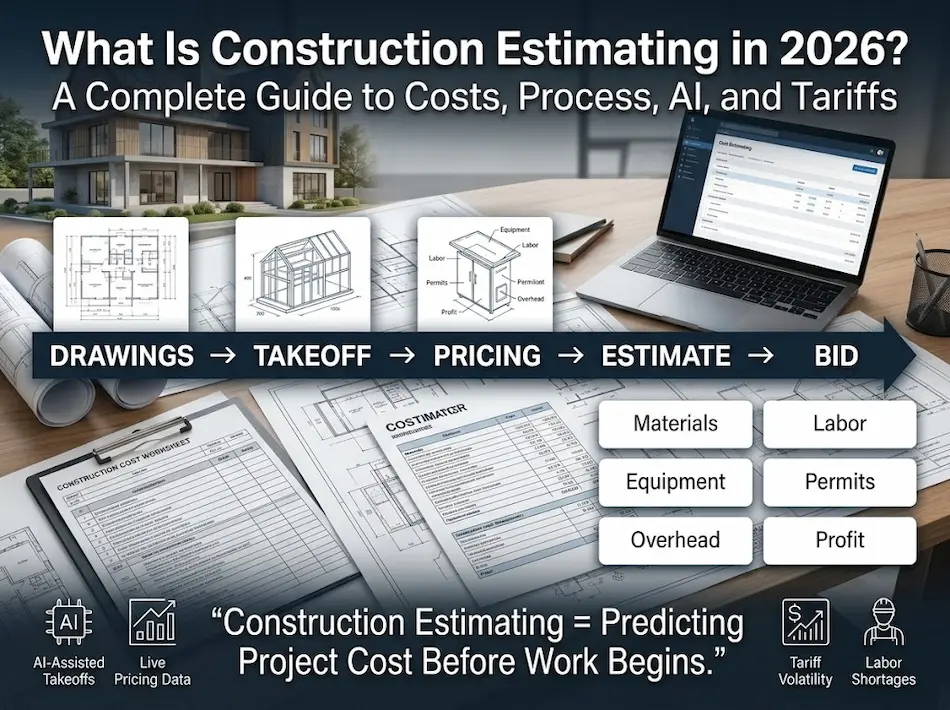
Construction estimating is the process of predicting all the costs a project will require before work begins. That includes the following:
- Materials
- Labor
- Equipment
- Permits
- Overhead
- Profit
A good estimate turns a set of drawings into one real, defensible number. Owners use it to check whether a project is financially possible, and contractors use it to build a bid that wins work without losing money.
Estimate Vs Budget Vs Quote
- An estimate predicts probable cost based on scope and market data
- A budget is the owner’s approved spending plan for the project.
- A quote is a contractor’s fixed-price offer for specific work.
All three terms get used loosely on job sites, but they mean different things.
Why Does Bidding Accuracy Matter So Much?
Bid too high, and a contractor loses the job. Bid too low, and the contractor finishes it at a loss. That razor-thin margin is exactly why estimating accuracy carries so much weight, a theme this guide returns to when covering estimate classes later on.
What Is the History of Construction Estimating?
Builders have estimated costs since the pyramids, but the process only became formal during the Industrial Revolution, when large projects forced companies to track costs on paper. Software replaced pen and paper by the late twentieth century, and BIM further improved accuracy in the 2010s. Now AI is doing what software once did to paper ledgers.
Who Performs Construction Estimates and What Do They Do?
A construction estimator reviews drawings and specifications, then calculates the true cost of building the project. They study architectural plans, engineering details, and site conditions. They talk to suppliers and subcontractors to confirm current pricing. Then they assemble everything into one defensible number for the bid.
What Are the Different Types of Construction Estimators?
- A contractor’s estimator checks whether a project is profitable enough to bid on.
- An engineer’s estimator balances cost against design quality and material choice.
- A client’s estimator represents homeowners and private buyers on smaller projects.
Each type serves a different side of the same negotiation.
What Skills Does a Construction Estimator Need?
- Strong math and geometry skills come first, since every takeoff depends on them.
- Blueprint reading is just as critical, since one missed detail changes the whole number.
- Estimators also need sharp communication skills to explain numbers to non-technical clients.
- Software fluency now matters as much as math ever did.
Which Certifications Matter Most in 2026?
The Certified Professional Estimator credential from the American Society of Professional Estimators carries real weight. So does the Certified Cost Professional designation from AACE International. Both signal that an estimator’s numbers can be trusted under scrutiny.
What Is the Step-by-Step Construction Estimating Process?
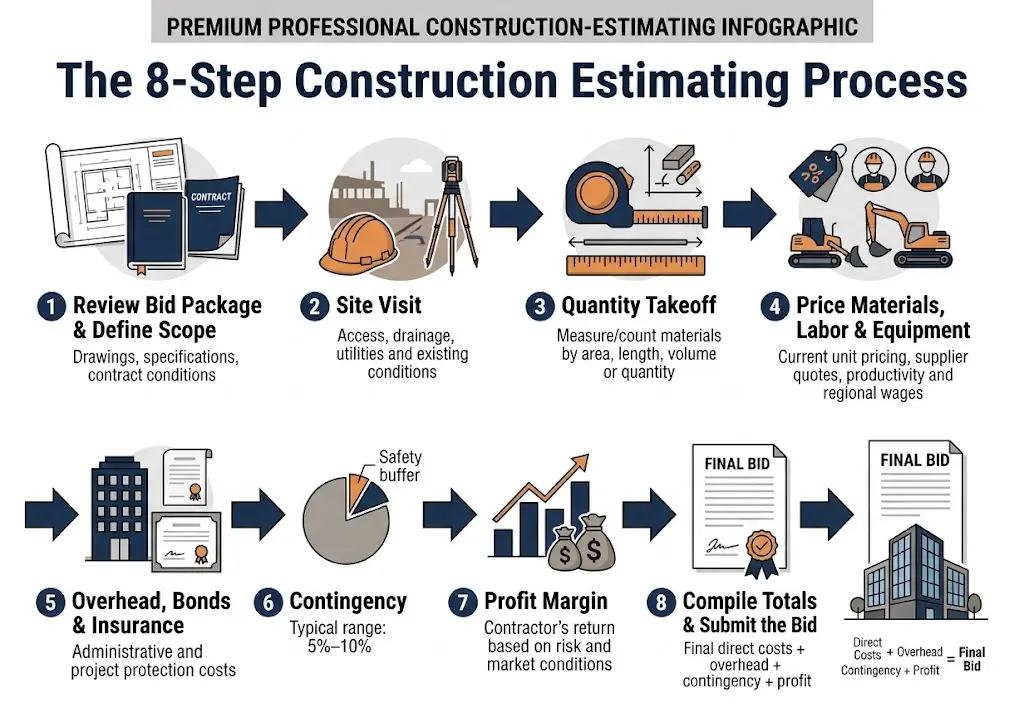
A construction estimate moves through 8 stages, from reviewing the bid package to submitting a final number. Skipping any stage usually shows up later as a costly surprise.
1. Review the Bid Package and Define Scope
The bid package holds drawings, specifications, and contract conditions. Estimators read it closely to catch nonstandard items before pricing begins. A clearly defined scope prevents disputes once construction actually starts.
2. Site Visit Necessary Before Estimating
Drawings never show everything a site actually looks like. A visit reveals access problems, drainage issues, or utility conflicts early. Catching these details before the bid avoids expensive change orders later.
3. Quantity Takeoff Assessment
A quantity takeoff counts every material the project will need. Estimators measure items by count, length, area, or volume, depending on the material. AI-assisted takeoff tools now handle much of this counting automatically, a shift covered in more detail below.
4. Price Materials, Labor, and Equipment
Each quantity (counted in step 3) is multiplied by the current unit price to calculate the cost. Historical data, supplier quotes, and live pricing feeds all inform that rate. Labor pricing also factors in crew productivity and regional wage rates.
5. Estimate Overhead, Bonds, and Insurance
Overhead covers office rent, administrative staff, and other costs not tied to one job. Bonds and insurance protect the owner if a contractor fails to complete the work. Rising insurance premiums have made this line item harder to predict in 2026.
6. Estimate Contingency
Contingency should typically range from 5% to 10% of the total project cost. That range shifts with how complete the drawings are. RSMeans guidance suggests as little as 2% to 3% works once drawings are finalized. Alteration and repair jobs with unclear scope can justify contingency as high as 20%.
7. Calculate Profit Margin
Profit is the fee a contractor earns for taking on the job. Every company sets its own minimum based on risk and market conditions. Thin margins are normal in construction, which is exactly why the earlier steps have to be accurate.
8. Compile Totals and Submit the Bid
All line items combine into one final number: direct costs, overhead, bonds, contingency, and profit. Estimators double-check the math and compare it against the budget before submission. A clean, well-organized bid document, submitted on time, gives owners confidence in the price.
Example:
Picture a 500-square-foot drywall job as a quick example. Materials might run $2,500, and labor might add another $3,000. That brings the direct cost to $5,500 before markups apply. Add 10% overhead, and the number grows to $6,050. Add 7% contingency, and it reaches roughly $6,474. Add 10% profit, and the final bid lands near $7,121. That simple chain is exactly how every larger estimate gets built, just with more line items.
What Are the Different Classes of Construction Estimates?
The American Society of Professional Estimators defines five classes, each more accurate than the last.
- Class 1: Order-of-magnitude estimate: Relies on past projects; can vary by 25% to 75% from the final cost.
- Class 2: Schematic Estimate: Uses early drawings to narrow that range.
- Class 3: Design Development Estimate: Prices out systems in real detail.
- Class 4: Bid Estimate: Comes from complete construction documents and drives the actual bid.
- Class 5: Control Estimate: Tracks costs once construction is already underway.
Each class exists because guessing early and refining later beats guessing once and hoping.
What Costs Are Included in a Construction Estimate?
A complete estimate includes direct costs, indirect costs, and a profit markup.
| Cost Type | What It Covers |
| Direct Costs | Materials, labor, and equipment tied to specific tasks |
| Indirect Costs | Permits, temporary facilities, and administrative overhead |
| Bare Cost | Materials plus labor plus equipment, with no markup added |
| O&P (Overhead & Profit) | Total cost including overhead and profit — what the client actually pays |
That distinction matters most when two bids look similar on paper.
Why Should You Get an Independent Cost Estimate?
An independent estimate gives an owner an unbiased check on a contractor’s numbers. It flags pricing that looks unreasonable before a contract gets signed. It also protects against scope creep once construction begins.
The numbers back this up. Studies show that 90% of projects exceed their budgets by an average of 28%, and 32% of those overruns are due to estimating errors alone, according to Buildcheck. More than half of projects, 52% specifically, experience scope creep after construction begins, exactly the risk an independent check is meant to catch early. Research spanning twenty countries over 70 years found that 85% of construction projects experienced some form of cost overrun, according to Propeller Aero, which is why a second, unbiased set of eyes on the numbers carries real weight before a contract is signed.
Firms with no stake in winning the contract, such as independent estimating providers like USA Estimators, tend to deliver the most objective numbers. Choosing one comes down to track record, trade expertise, and how current their pricing data actually is.
Ready for a number you can trust?
Get your independent estimate from USA Estimators today!
What Tools and Software Power Modern Construction Estimating?
Modern estimating relies on a mix of spreadsheets, BIM software, and cloud platforms, moving from manual, disconnected files to connected, real-time systems that now increasingly use AI.
From Spreadsheets to Disconnected Files
Estimating used to run on static spreadsheets and paper drawings, with takeoffs done by hand and numbers passed around in disconnected files. That left plenty of room for missed quantities and outdated pricing.
BIM, 5D BIM, and Cloud Collaboration Today
Excel still handles smaller jobs and custom templates well, but BIM now connects a 3D model directly to material and cost data. 5D BIM goes further, linking live cost data to design changes as they happen. Cloud-based collaboration software lets estimators, contractors, and subcontractors work off the same numbers in real time, instead of chasing updated files by email.
Tools and Software Trending in 2026 include:
- STACK and AI for AI-assisted takeoffs
- Procore and HCSS HeavyBid for larger contractors managing bid-to-build workflows
- Buildxact and PlanSwift for residential and smaller jobs
- RSMeans Data Online for up-to-date regional cost data
Benefits of the Shift
Fewer takeoff errors, faster bid turnaround, and pricing that stays current instead of going stale between revisions. Most of these platforms have also added AI features in just the past two years, a shift reshaping the job faster than anything else on this list.
How Is AI Changing Construction Estimating in 2026?
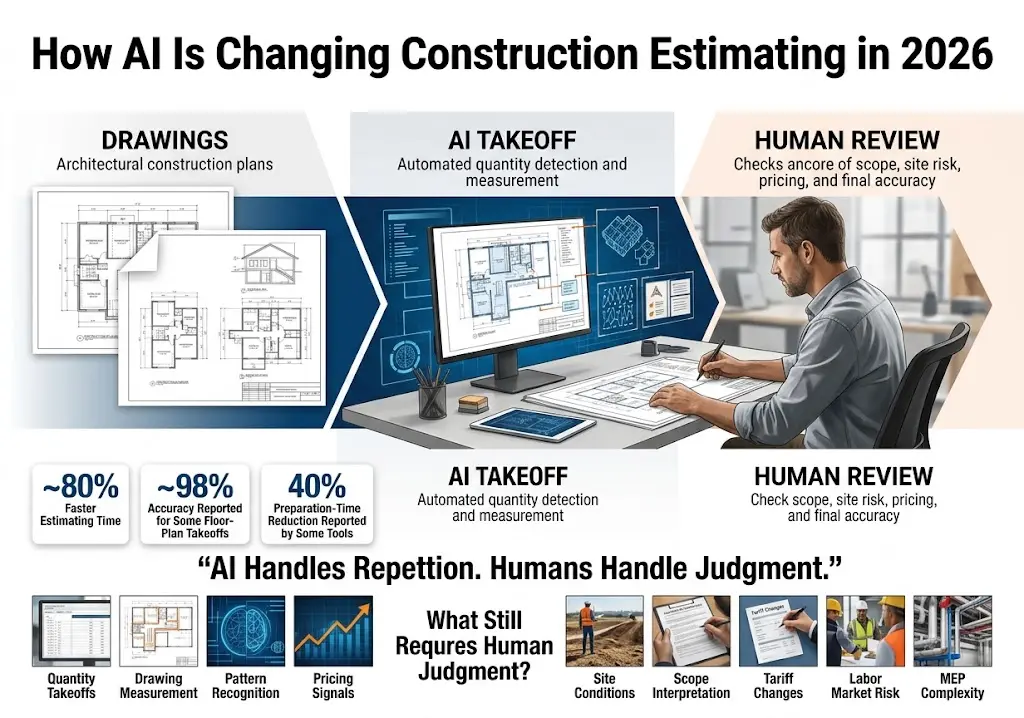
AI now automates the most repetitive part of estimating, the quantity takeoff.
- Automated takeoff technology can cut estimating time by roughly 80% while holding around 98% accuracy on floor plans, according to Vida AI.
- AI-powered estimating tools are pushing bid accuracy toward the 85-90% range while reducing preparation time by about 40%, according to Bridgit.
- Some specialized platforms, including Togal.AI, report accuracy as high as 98% on automated takeoffs, according to a press release covering the Togal.AI and eTakeoff integration.
How Does AI Predict Material Price Fluctuations?
Older software, think static cost databases like RSMeans, relied almost entirely on historical price data, often months out of date. Newer AI systems like Togal.AI and Trimble’s ProjectSight also weigh live supply signals and tariff shifts, letting estimators build sharper, more realistic contingency into a bid.
Can AI Replace Human Construction Estimators?
AI cannot replace human estimators yet, and probably won’t for years. Platforms like STACK and Togal.AI handle measurement and repetitive takeoffs extremely well, often in minutes. Judgment calls, like reading a site’s hidden risk or negotiating scope, still need human experience. Firms pairing AI speed with human review, the STACK-plus-estimator model most GCs now use, consistently outperform firms using either alone.
What Are the Risks of Relying Too Much on AI?
AI accuracy still depends heavily on drawing quality and trade type. MEP work (mechanical, electrical, plumbing) is harder for AI to read than simple architectural plans, which is why Trimble built its AI tools specifically for that trade. A blurry scan or a poorly labeled plan can throw off an automated count on any platform, including Togal.AI.
AI also won’t catch a tariff spike or a sudden labor shortage on its own; those still need a human watching the market. Software itself carries risk too. In 2024, cybersecurity firm Huntress found hackers breaking into Foundation, a widely used construction accounting and estimating platform, because many companies never changed the software’s default login credentials. Every AI-generated estimate still needs a human check before it goes out.
How Are 2026 Tariffs Affecting Construction Cost Estimates?
Tariffs have pushed the effective rate on construction materials to a 40-year high. The Deloitte 2026 Engineering and Construction Outlook notes the effective tariff rate on construction goods climbed to 25% to 30% in 2025, the highest level in four decades. Steel and aluminum tariffs hit 50% in June 2025, and that rate remains in effect. A further tariff of 25% to 50% on furniture, cabinets, and other finish materials, originally scheduled for January 2026, has been delayed to January 2027. That timeline means projects finishing in the next year still face real exposure.
Which Materials Are Most Impacted Right Now?
Steel and aluminum remain the most heavily taxed categories, but the pressure isn’t even across the board.
- Steel and aluminum: Still the most heavily taxed categories, remaining elevated due to tariffs.
- Cement and concrete: Prices have stayed largely flat through 2026.
- Electrical equipment: Keeps swinging due to grid upgrades and the AI construction boom driving demand.
With tariffs and material costs shifting fast, escalation clauses have become the estimator’s main defense against getting locked into an outdated price.
How Do Estimators Add Escalation Clauses to Protect Bids?
An escalation clause lets a contractor adjust pricing if material costs spike mid-project, tying the final price to an index or a supplier quote instead of locking it in at bid time. Many contractors now write stronger, more specific escalation language directly into their bids, naming exact materials and trigger thresholds. Without one, a single price jump on steel or copper can wipe out an entire project’s profit margin.
How Can Contractors Hedge Against Tariff Uncertainty?
Sourcing materials domestically avoids tariff exposure entirely on many items. Identifying at-risk materials early, during preconstruction, allows time to pivot if needed. Locking supplier pricing early protects a bid from swings that happen after submission. Material costs overall are still forecast to rise only 2% to 4% in 2026, but that average hides real volatility underneath.
How Is the Labor Shortage Impacting Estimates in 2026?
A shrinking, aging workforce is pushing skilled labor rates higher across the country. Industry research citing Deloitte’s Engineering and Construction Industry Outlook shows 41% of today’s construction workforce is expected to retire by 2031, while only 7% of current job seekers say they would consider a construction career. That gap between retirements and new entrants keeps tightening every year.
Why Are Data Centers Pulling Trades Away From Traditional Projects?
Hyperscale data center projects are pulling electricians, welders, and other skilled trades toward higher-paying work, backed by tech-scale budgets that traditional projects simply cannot match. That demand pulls experienced crews away from schools, offices, and housing projects at exactly the moment labor is already scarce.
Smaller contractors end up competing directly with billion-dollar tech budgets for the same limited pool of workers. The result is longer timelines, higher labor costs, and bidding wars that squeeze margins on every traditional project still trying to get built.
How Should Estimators Adjust Labor Pricing for This Shortage?
Building a higher labor contingency into every bid is now standard practice. Factoring in regional wage premiums matters more than it did even two years ago; construction wages grew 4.2% year over year in 2026, outpacing the national average, according to industry skilled trades data. Some contractors are turning to prefabrication to offset the shortage directly on site.
With 92% of construction firms reporting difficulty finding qualified workers, pricing labor off last year’s rate sheet is no longer safe; real-time wage data now belongs in every bid, not just the contingency line.
Why Does Real-Time Pricing Data Matter for Accurate Estimates?
Static pricing data goes stale fast in a market this volatile. Live supplier price feeds close the gap between an estimate and the final actual cost.
- Old standard: Traditional cost databases update quarterly, which used to be fast enough.
- New reality: With tariffs and material swings moving month to month, quarterly updates now leave real gaps.
- The fix: Estimators who check pricing weekly, or pull it through a live feed, catch swings before they blow up a bid.
How Do Sustainability and Energy Codes Affect Construction Costs?
Green building requirements now add a real, specific line item to most commercial estimates. LEED and net-zero specifications raise upfront costs, but energy-efficient systems lower operating expenses for years, a tradeoff a strong estimator presents clearly so the owner can decide.
How Is the 2026 Market Shifting Estimating Strategy?
Uneven demand across sectors is forcing estimators to be far more selective about which bids they chase. U.S. construction spending jumped roughly 20% in October 2025. That growth was driven largely by a handful of massive data center projects.
The rest of the market grew only modestly. Overall GDP growth for 2026 is forecast at 2.2%, according to the Congressional Budget Office. That gap between booming sectors and everything else is exactly what’s pushing selective bidding to the front of estimating strategy.
What Is Selective Bidding and Why Does It Matter Now?
Selective bidding means evaluating a project’s funding stability and risk before investing time in a bid. Chasing every opportunity no longer makes sense when market growth is this uneven. Estimating teams that filter early save hours on bids that were never going to close. That shift in strategy is as much a 2026 trend as any software update.
What Are the Most Common Mistakes in Construction Estimating?
The most common construction estimating mistakes are poor scope definition, a skipped or rushed site visit, and underestimated contingency, all rooted in moving too fast through the early stages of the process.
Poor Scope Definition
Poor scope definition causes more cost overruns than any other single mistake. Missed inspection fees and unpriced change orders both trace back to a rushed scope review.
About 32% of construction cost overruns trace back to estimating errors, including incomplete scope definition, according to Construction Industry Institute research.
- How professionals avoid it: They treat the bid package review as its own dedicated step, not something squeezed into day one, and flag nonstandard items before pricing even starts.
Skipping or Rushing the Site Visit
Skipping or rushing the site visit is the second most common error. A drainage issue or a blocked access point discovered mid-project costs far more than catching it early.
Rushed early-stage work, including skipped site checks, feeds directly into the same 32% of overruns tied to estimating errors, since these issues surface later as unpriced change orders, according to CNBA’s cost management research.
- How professionals avoid it: They walk every site in person before pricing, checking access, drainage, and utility conflicts, rather than relying only on drawings.
Underestimating Contingency
Underestimating contingency rounds out the top three mistakes. One bad winter or one material spike can quickly wipe out a thin contingency.
25% of contractors reported that just two or three inaccurate estimates could put them out of business, and roughly 30% experienced regular overruns tied to underpriced profit margins.
- How professionals avoid it: They set contingency based on how complete the drawings actually are, not a flat percentage, and push it higher on renovation or unclear-scope work.
All three mistakes share a single root cause: moving too quickly through the early stages of the process.
How Do Bonding, Insurance, and Liability Affect an Estimate?
Bonds and insurance protect everyone involved if a project goes wrong.
- A bid bond guarantees a contractor will honor the price they submitted.
- A performance bond guarantees the work actually gets finished to spec.
If an estimate proves grossly inaccurate, liability questions may follow. That risk is one reason professional estimating firms carry their own errors and omissions coverage. It is also why owners increasingly prefer a documented, defensible estimating process.
How Accurate Should a Construction Estimate Be?
Accuracy should tighten as a project moves from concept to construction documents.
- A Class 1 estimate can reasonably swing by 25% or more.
- A Class 5 estimate, prepared once drawings are final, should land within a few percentage points.
Bidding too high risks losing the job entirely, and bidding too low risks finishing it at a loss. Neither mistake is one a contractor can afford to repeat often.
What Are the Best Practices for More Accurate Estimates?
The best practices for more accurate estimates are to save every completed job as a reusable template and to track actual costs against the original estimate to catch patterns over time.
- Save every completed estimate as a template. This is the single highest-leverage habit an estimator can build.
- Preserve pricing, subcontractor contacts, and lessons learned in each template so nothing has to be relearned from scratch on the next job.
- Track actual costs against every original estimate. This builds a personal accuracy benchmark over time.
- Use that benchmark to spot patterns; it shows exactly where estimates tend to run high or low.
- Fix that pattern, project after project. That discipline is what separates a good estimator from a great one.
Frequently Asked Questions
Do Contractors Get Paid for Preparing an Estimate?
Contractors are not paid directly for preparing an estimate. That cost is usually absorbed into overhead or folded into the bid itself.
What Is the Difference Between an Estimate, a Quote, and a Bid?
An estimate predicts cost, a quote is a fixed-price offer, and a bid is the formal proposal submitted for a specific contract.
How Long Does It Take to Prepare a Construction Estimate?
Timing depends heavily on project size and complexity. AI-assisted takeoff tools have dramatically shortened that timeline for many contractors in 2026.
Can a Homeowner Create Their Own Construction Estimate?
Homeowners can reasonably estimate the cost of small, simple projects on their own. Larger or more complex renovations still benefit from a professional estimator’s experience and current pricing data.
What Is the Difference Between Construction Estimating and Quantity Surveying?
Estimating focuses on predicting project cost. Quantity surveying, more common outside the United States, manages cost across a project’s entire lifecycle.
How Much Does It Cost to Outsource Construction Estimating?
Pricing varies by project size and trade. Costs often range from a flat fee to a small percentage of total project value.
Is Construction Estimating a Good Career Choice in 2026?
Demand remains strong, especially for estimators comfortable with AI tools and current market data, even as the broader occupation shrinks slightly overall.
How Do Estimators Handle Multi-State Projects?
They adjust for regional labor rates, local material costs, and differing building codes across each state involved.
What Happens During a Change Order Estimate Review?
An independent estimate gets prepared and compared directly against the contractor’s change order request to confirm the price is reasonable.
Do You Need a License to Work as a Construction Estimator?
No federal license is required to work as a construction estimator. Some states and employers do require or strongly prefer ASPE or AACE certification.
Bottom Line
Construction estimating in 2026 demands more than a calculator and a set of drawings. Tariffs, a shrinking skilled labor pool, and AI-driven software have all rewritten the rules in just the past two years. Getting a bid right now means tracking live pricing, building in real escalation protection, and knowing exactly which projects are worth chasing. That is a lot to manage alongside actually running a construction business.
USA Estimators combines experienced estimators with modern, tech-assisted takeoff tools to deliver fast, accurate numbers. Our team covers residential, commercial, and industrial projects across the country. Every estimate gets a human review before it reaches your inbox, not just an automated output.
Ready to bid smarter in 2026?
Request a free quote from USA Estimators and see the difference a dedicated estimating team makes.


