

How Much Does It Cost to Build a Quadplex in 2026? Complete US Price Breakdown
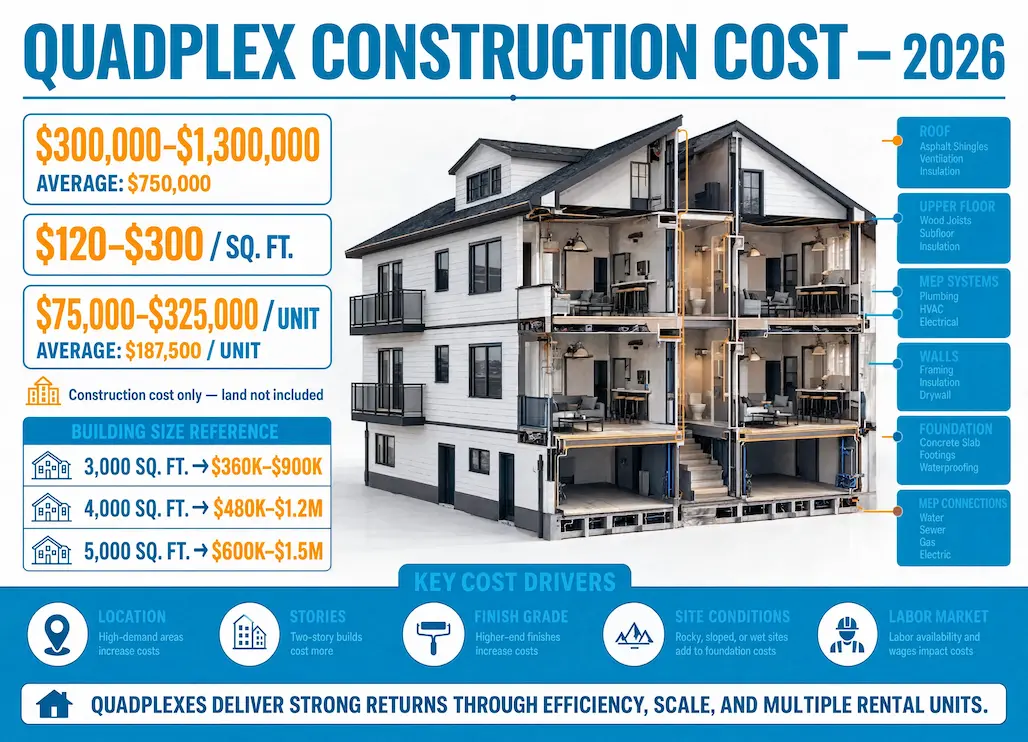
A quadplex, also called a fourplex, costs $300,000 to $1,300,000 to build in the US in 2026, averaging $750,000, or roughly $120 to $300 per square foot.
Both names describe the same four unit residential building. “Quadplex” is more common among West Coast investors, while “fourplex” shows up more often in the Midwest and South.
This guide breaks the number down into every hard cost, soft cost, financing option, and code requirement, using current September 2026 pricing, so you can budget your four unit build with real numbers instead of a guess.
How Much Does It Cost to Build a Quadplex in 2026?
The average cost to build a quadplex in 2026 sits at $750,000, with most projects landing between $300,000 and $1,300,000 depending on size, region, and finish level. These figures cover construction only, not land. Land acquisition typically adds $50,000 to $400,000 or more depending on the market.
| Cost Metric | Low End | Average | High End |
| Total project cost | $300,000 | $750,000 | $1,300,000 |
| Cost per square foot | $120 | $190 | $300 |
| Cost per unit | $75,000 | $187,500 | $325,000 |
| Typical building size | 3,000 sq ft | 4,000 sq ft | 5,500+ sq ft |
Size scales the total predictably once you know your target square footage:
| Total Building Size | Typical Total Cost |
| 3,000 sq ft | $360,000 to $900,000 |
| 4,000 sq ft | $480,000 to $1,200,000 |
| 5,000 sq ft | $600,000 to $1,500,000 |
Multifamily construction is running hotter than single-family right now. For-rent multifamily starts rose 5% year over year in the second quarter of 2026, according to NAHB’s analysis of Census data, which means contractors and subcontractors are busier and bids can take longer to land in some markets.
What Factors Affect the Cost to Build a Quadplex?
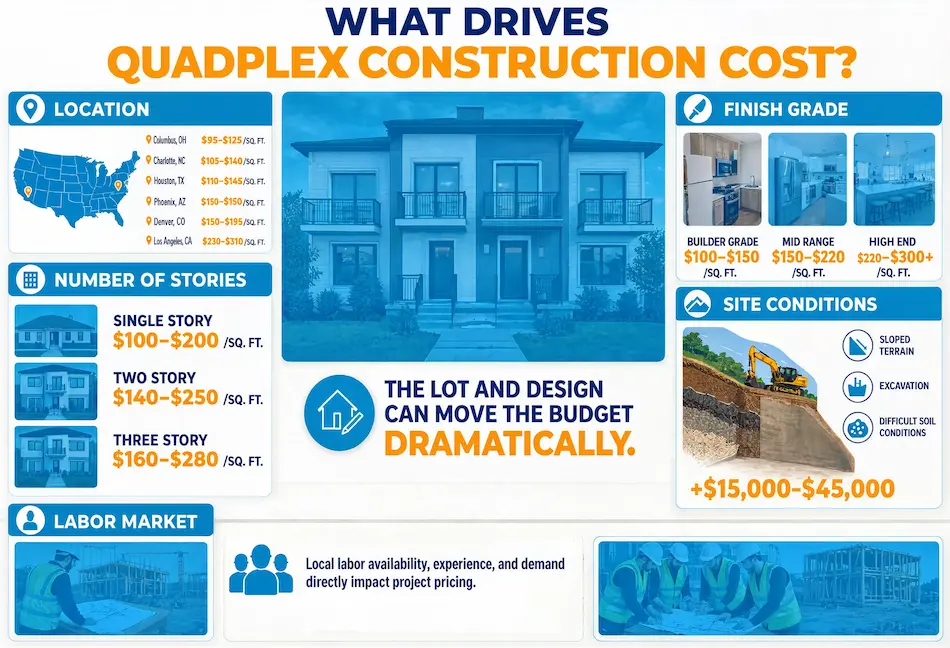
Five variables move the price more than anything else: location, number of stories, material grade, site conditions, and the local labor market.
Location and Regional Labor Rates
Where you build changes the number more than any single design choice.
| Market | Typical Cost Per Sq Ft |
| Columbus, OH | $95 to $125 |
| Charlotte, NC | $105 to $140 |
| Houston, TX | $110 to $145 |
| Phoenix, AZ | $115 to $150 |
| Denver, CO | $150 to $195 |
| Los Angeles, CA | $230 to $310 |
Get three local bids before you lock a budget. A national average tells you the shape of the market, not what your specific lot will actually cost.
Number of Stories
Two-story quadplexes run $140 to $250 per sq ft, since stacking units shares the roof and foundation.
Single-story, side by side layouts run $100 to $200 per sq ft in materials but need a much bigger lot, which usually pushes land cost higher instead.
A third option, a three-story urban infill layout, runs $160 to $280 per sq ft due to egress requirements, but fits a smaller lot in dense markets.
Material and Finish Grade
Builder-grade finishes land at $100 to $150 per sq ft. Mid-range finishes such as quartz counters and LVP flooring run $150 to $220. High-end finishes with custom millwork and premium HVAC push past $220 to $300 or more.
Site Conditions and Soil
Sloped lots, poor soil, or a high water table can add $15,000 to $45,000 in excavation and grading before framing even starts.
What Is the Full Hard Cost and Soft Cost Breakdown for a Quadplex?
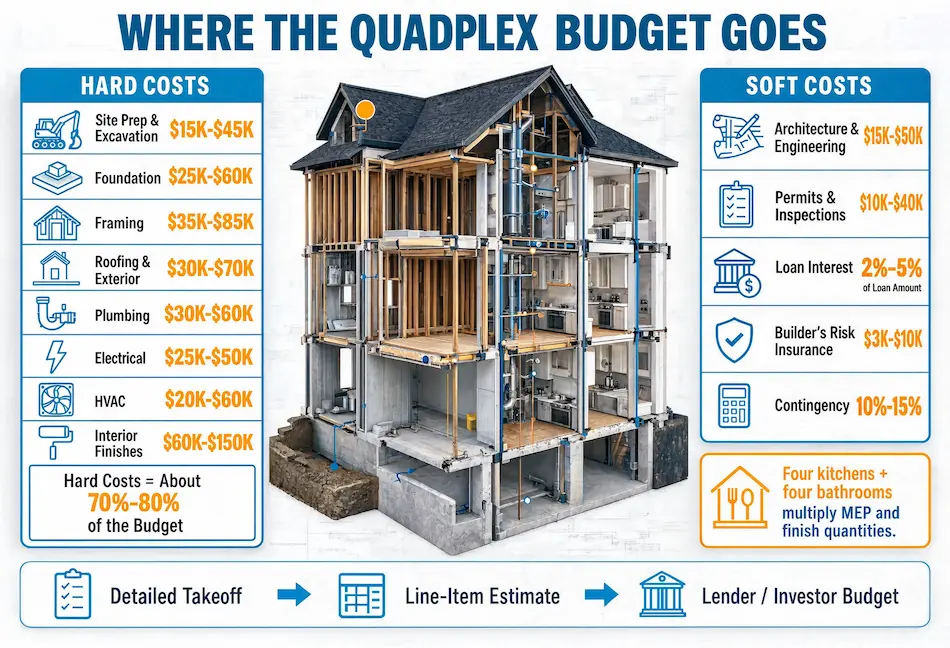
Hard costs, the physical build, usually make up 70% to 80% of the budget. Soft costs, meaning fees, design, and financing, make up the rest.
Hard Costs
| Category | Estimated Range |
| Site prep & excavation | $15,000 to $45,000 |
| Foundation | $25,000 to $60,000 |
| Framing | $35,000 to $85,000 |
| Roofing & exterior | $30,000 to $70,000 |
| Plumbing (4 units) | $30,000 to $60,000 |
| Electrical (4 units) | $25,000 to $50,000 |
| HVAC (4 units) | $20,000 to $60,000 |
| Interior finishes | $60,000 to $150,000 |
A framing estimate and a dedicated MEP takeoff usually catch the biggest swings on a four unit job, since four kitchens and four bathrooms multiply every fixture count.
Soft Costs
| Category | Estimated Range |
| Architecture & engineering | $15,000 to $50,000 |
| Permits & inspections | $10,000 to $40,000 |
| Construction loan interest | 2% to 5% of loan amount |
| Builder’s risk insurance | $3,000 to $10,000 |
| Contingency reserve | 10% to 15% of total budget |
Professional and Labor Fees
Professional fees are often a percentage of the build or a trade rate:
| Role | Typical Fee |
| Architect | 6% to 12% of construction cost |
| GC overhead & profit | 10% to 20% of construction cost |
| Structural engineer | $5,000 to $15,000 flat |
| Electrician (hourly basis) | $50 to $130/hour |
| Plumber (hourly basis) | $50 to $200/hour |
Hidden Costs and Amenities Most Budgets Miss
Two costs surprise builders most:
- Impact fees ($5,000 to $15,000 per unit, billed before your first permit).
- Utility tap fees for water and sewer ($3,000 to $10,000 per unit).
Change orders typically carry a 10% to 20% markup, so lock the design early. On the amenity side, covered parking runs about $6,000 per unit, smart home tech such as keyless entry and smart thermostats adds $2,000 to $6,000 per unit, and a basic shared security system runs $3,000 to $8,000 for the building. None of these are required, but tenants increasingly expect at least one of them.
How Much Does a Quadplex Cost Per Unit?
A quadplex costs $75,000 to $325,000 per unit to build, averaging around $187,500. Per-unit pricing is the cleanest way to compare a ground-up build against buying an existing property, since it strips out total square footage differences between projects. Because one roof, one foundation, and often one set of exterior walls serve all four homes, a quadplex almost always beats building four detached single-family homes of the same size on a per-unit basis.
Turnkey, Shell-Only, or Duplex Conversion: Which Approach Costs Less?
Turnkey costs the most, shell-only costs 40% to 60% less upfront, and converting an existing duplex or triplex is usually cheapest overall. A turnkey build gets you a move-in ready building for the full $300,000 to $1,300,000 range. A shell-only build, meaning just the foundation, framing, roof, and exterior walls, costs 40% to 60% less upfront but shifts the finish-out cost and timeline onto the owner later. Converting an existing duplex or triplex into a quadplex is usually the cheapest path of all, typically $150,000 to $450,000, since the foundation, roof, and main structural shell already exist.
Note: Conversions carry hidden risk. Older electrical service, undersized plumbing, and outdated framing often need full replacement before four units can legally operate, and that discovery rarely shows up until demolition starts.
Is Modular or Prefab Construction Cheaper Than a Site-Built Quadplex?
Yes, modular and panelized construction can cut total cost by roughly 15% to 20% compared with a fully site-built quadplex, based on 2026 project data from South Florida developers building factory-framed wall panels and MEP systems offsite before assembly.
Beyond the direct savings, modular projects also finish 20% to 50% faster, since crews are not waiting on weather or sequential trade scheduling. The tradeoff is design flexibility. Modular works best with standardized, repeated unit layouts, which fits a quadplex naturally, since all four units are often mirror images of each other anyway.
How Are 2026 Material Prices and Tariffs Changing Quadplex Costs?
Lumber and several other framing materials cost more in 2026 than they did two years ago, mainly because of tariffs. Framing lumber has traded between roughly $570 and $620 per thousand board feet through mid-2026, and combined anti-dumping, countervailing, and Section 232 tariffs on Canadian softwood now stack to somewhere in the 35% to 45% range.
The National Association of Home Builders estimates these tariffs are adding $9,000 to $10,900 to the average new home’s construction cost, and a quadplex uses considerably more framing lumber, drywall, and cabinetry than a single-family home, so the dollar impact multiplies across four units and four kitchens. Locking material prices with your general contractor at contract signing protects the budget from mid-build spikes.
How Does Financing a Quadplex Work in 2026?
Because a quadplex still falls under the 1-to-4-unit residential classification, it qualifies for financing tools that five-plus-unit apartment buildings cannot access.
- Conventional construction-to-permanent loans: 20% to 25% down, best rates for qualified borrowers
- FHA loans: as low as 3.5% down if the owner occupies one unit
- VA loans: 0% down for eligible veterans who owner-occupy one unit
- DSCR loans: qualify based on the property’s projected rental income rather than personal income, typically 20% to 25% down, with 2026 rates generally running 5% to 8.5%
Most DSCR programs require six months of PITIA (principal, interest, taxes, insurance, association dues) held in reserve after closing, which can exceed $20,000 on a four unit property, so budget for that reserve separately from your construction costs. Getting your numbers into a lender-ready format is exactly what a proper cost estimate is built to support.
Lock your budget before approaching a lender for smoother DSCR and conventional underwriting!
USA Estimators can turn your plans into a lender-ready number within days.
What Zoning, Permit, and Accessibility Rules Apply to a Quadplex?
Most jurisdictions require multi-family zoning before a four unit building is legally permitted, and several federal design rules kick in specifically at the four unit mark.
● Zoning, Lot Size, and Code Path
Expect a minimum lot size of 8,000 to 15,000 square feet, parking requirements of roughly 1.5 to 2 spaces per unit, and setback rules stricter than single-family standards. A handful of states, including California, Oregon, and Montana, have passed “missing middle” housing reforms that make four unit approvals easier in some previously single-family-only zones, so it is worth checking your specific city before assuming the stricter rules apply.
IBC vs IRC: The Hidden Code Risk
In most states, buildings with three or more units fall under the International Building Code (IBC) rather than the simpler International Residential Code (IRC). Crossing that line from a duplex into a triplex or quadplex can trigger commercial-grade fire-rated assemblies and a more expensive plan review process.
Three-story quadplexes classified as IBC Group R-2 occupancy also typically require an NFPA 13R fire sprinkler system, adding roughly $2 to $5 per square foot. A handful of local governments have adopted single-stair reform ordinances or expanded IRC amendments, so confirm your exact code path with the local building department before you finalize a design.
● Fair Housing Act Accessibility Rules for 4+ Unit Buildings
This is the rule first-time builders miss most often. Under the Fair Housing Act, any building with four or more units built without an elevator must have 100% of its ground floor units meet basic accessibility standards, covering things like an accessible entrance route, usable doors, and reinforced bathroom walls.
This applies regardless of whether the building has one story or three, and it sits separately from your state’s building code. Skipping it is not a fine you can absorb later. It is a federal compliance issue that can affect financing and resale.
What Tax Benefits Can Quadplex Owners Claim in 2026?
Quadplex owners can claim faster depreciation through a cost segregation study, and 2026 rules make this unusually favorable. Under the One Big Beautiful Bill Act, signed into law in July 2025, 100% bonus depreciation was permanently restored for qualifying property placed in service after January 19, 2025.
A cost segregation study identifies components of the building, such as flooring, certain fixtures, and site improvements like parking and landscaping, that depreciate over 5, 7, or 15 years instead of the standard 27.5 year residential schedule, and those reclassified components can now potentially be deducted in full in the first year. Studies typically start around $2,800 and are worth discussing with a tax professional before your quadplex is placed in service, not after.
What Are the Ongoing Costs and ROI After the Quadplex Is Built?
Ongoing ownership typically runs 20% to 35% of gross rent each year, and a well-underwritten quadplex usually returns 6% to 9% cash-on-cash in its first year.
Ongoing Ownership Costs
| Cost | Typical Annual Range |
| Property taxes | 1% to 2.5% of assessed value |
| Landlord/builder’s risk insurance | $3,000 to $8,000 |
| Maintenance reserve | 5% to 10% of gross rent |
| Property management (if outsourced) | 6% to 10% of gross rent |
| Vacancy reserve | 5% to 8% of gross rent |
A four unit building spreads vacancy risk across four income streams. If one unit sits empty, the property still collects roughly 75% of its potential rent, a real cushion compared with a single-family rental where one vacancy means zero income.
Quick ROI Example
Assume four units renting for $1,600 a month each. That is a gross annual income of $76,800. At 40% operating expenses ($30,720), Net Operating Income lands at $46,080. After annual debt service of roughly $32,000, that leaves about $14,080 in annual cash flow. Against $200,000 invested (25% down plus soft costs on a $750,000 build), that works out to a cash-on-cash return of roughly 7%.
How Long Does It Take to Build a Quadplex?
A typical quadplex takes 10 to 14 months from permit approval to certificate of occupancy.
| Phase | Duration |
| Design & permitting | 2 to 4 months |
| Site prep & foundation | 3 to 6 weeks |
| Framing | 4 to 8 weeks |
| MEP rough-in | 3 to 5 weeks |
| Interior & exterior finishes | 8 to 12 weeks |
| Final inspections & CO | 2 to 4 weeks |
Quadplex vs Duplex vs Triplex: Which Costs Less Per Unit?
A quadplex usually delivers the lowest cost per unit of the three, though it needs the biggest lot and loan to get there.
| Building Type | Typical Total Cost | Cost Per Unit | Cost Per Sq Ft |
| Duplex (2 units) | $300,000 to $600,000 | $150,000 to $275,000 | $115 to $240 |
| Triplex (3 units) | $450,000 to $850,000 | $130,000 to $250,000 | $120 to $260 |
| Quadplex (4 units) | $300,000 to $1,300,000 | $75,000 to $325,000 | $120 to $300 |
Per-unit cost generally drops as unit count rises, since more of the structure is shared. A duplex needs less land and a smaller loan, while a quadplex needs a bigger lot and bigger financing but usually produces the lowest per-door cost of the three, which is why it is the sweet spot for investors comparing a full cost to build a house against a small multifamily project.
How Can You Reduce the Cost to Build a Quadplex?
The fastest way to cut cost is to standardize the four units and lock your bids before you break ground.
- Standardize all four unit layouts so framing, plumbing, and cabinetry repeat instead of getting custom-priced four times
- Choose a two-story, stacked layout where the lot allows it, since it shares the roof and foundation
- Get a detailed preconstruction estimate before you bid the job out; a preliminary estimate typically costs a small fraction of the project and catches expensive design choices before they get locked in
- Run an accurate quantity takeoff so material orders match the drawings; a proper takeoff prevents both shortages and over-ordering
- Bid the job to three or more contractors instead of one; the spread between the low and high qualified bid typically runs 15% to 25%
- Lock material prices at contract signing so lumber and steel volatility does not eat into your margin mid-build
Tip: Bundle your permit applications and work with a permit expediter in slower jurisdictions. Shaving even one month off the 2 to 4 month permitting phase reduces your carrying costs on the construction loan.
Why Should You Get a Professional Estimate Before You Build?
Generic per-square-foot ranges are a starting point, not a budget. Your real number depends on your lot, your local labor market, your permit timeline, and your finish tier, and the gap between a rough guess and an accurate number is exactly where quadplex budgets blow up mid-build. USA Estimators builds detailed, line-item multi-family residential estimates covering site work, framing, MEP, finishes, and soft costs, calibrated to your exact plans and location, so you are bidding or borrowing against real numbers instead of a national average.
A detailed estimate typically pays for itself several times over:
- Fewer mid-build change orders, since materials and labor are quantified upfront
- Stronger lender and investor confidence, backed by a line-item takeoff
- More competitive contractor bids, since every bidder prices the same scope
Whether you are a first-time investor comparing build-versus-buy or a contractor bidding a four unit job, request an estimate before you commit capital!
Frequently Asked Questions About the Cost To Build A Quadplex in 2026
Can you build a quadplex on a lot zoned for single-family use?
Not without a zoning change or a conditional use permit in most cities. Some states now allow four unit buildings on previously single-family lots under recent housing reform laws, but local approval is still required before you can legally build.
Do quadplexes require an elevator?
No, elevators are not required for a two-story quadplex, but skipping one means all ground floor units must meet Fair Housing Act accessibility standards instead of just one entry-level unit per stack.
Does each quadplex unit need its own separate utility meter?
Most lenders and many local codes strongly prefer separate electric and gas meters so tenants pay their own bills, though water is sometimes shared through one building-level meter with cost allocated by lease terms.
Can an existing duplex or triplex be converted into a quadplex?
Yes, and it is often cheaper than new construction since the foundation and roof already exist. Expect $150,000 to $450,000 for a conversion, though older wiring and plumbing frequently need full replacement first.
Is a quadplex treated as residential or commercial property for insurance?
Residential. Because it falls under the 1-to-4-unit classification, a quadplex typically qualifies for landlord and builder’s risk insurance policies rather than the commercial multifamily policies required for five-plus-unit buildings.
Can the owner live in one unit while renting the other three?
Yes, and doing so unlocks owner-occupant financing like FHA and VA loans with much lower down payments than an investment-only DSCR or conventional loan would require.


