

Why Two Contractors Quote the Same Job Differently
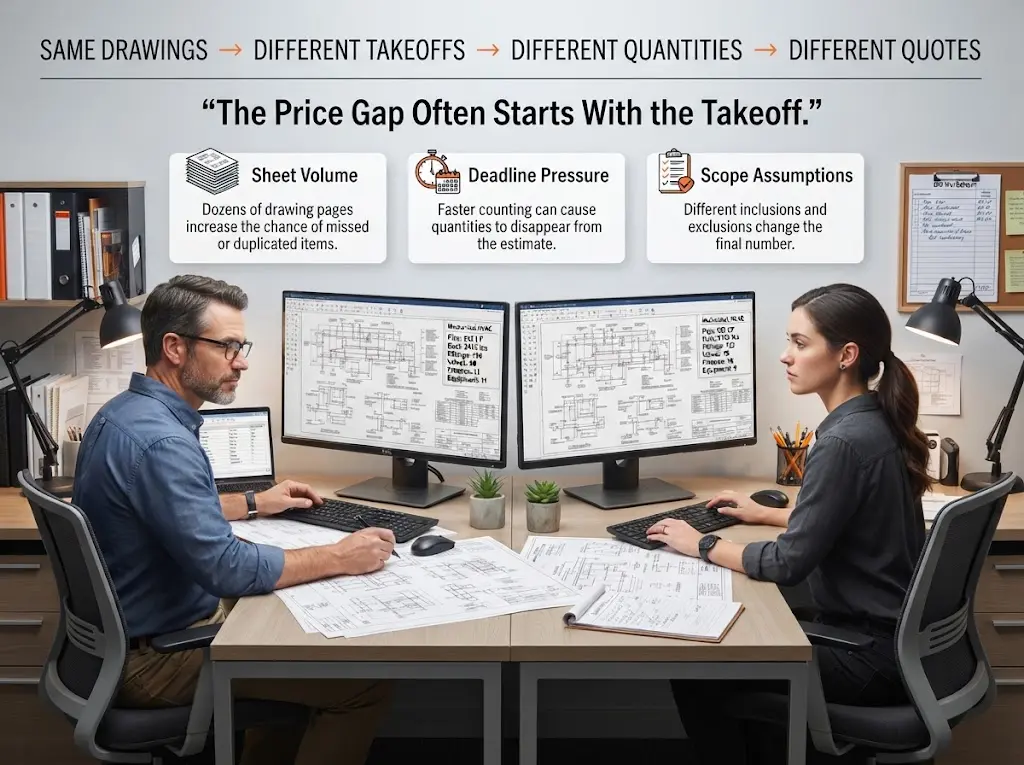
Ask three mechanical subcontractors to price the same commercial HVAC or plumbing package, and the numbers rarely land close together. Thousands of dollars can separate the lowest bid from the highest, on the exact same drawings.
Markup gets blamed first. It’s rarely the real story. The gap almost always starts earlier, at the quantity takeoff: the itemized count of every fitting, valve, duct run, and fixture the job will need. Two estimators can read identical plans and walk away with two different totals, and the one who counted most carefully doesn’t always come in lowest. That part rarely makes it into the conversation with the owner.
What Exactly Is a Takeoff?
Before a contractor can quote a job, someone has to sit with the plans and count what’s actually in them: linear feet of pipe, square footage of ductwork insulation, fixtures, fittings, and every piece of equipment the installation calls for. That list is the takeoff, and pricing only begins once the quantities are locked.
Takeoffs Explained With Statistics
The name comes from the act itself: taking quantities off a drawing. On a small residential remodel, that might be one person with a scale rule and a highlighter. On a commercial mechanical package, it’s a dedicated role, staffed by people who do nothing else all day. The Bureau of Labor Statistics counted 226,400 cost estimators working across the United States in 2025. A third of them, 33 percent, sit inside specialty trade contractors, which is exactly where HVAC, piping, and plumbing packages get priced.
It also helps to know that “takeoff” isn’t one single thing. A material takeoff lists what a job needs. A quantity takeoff measures how much of it sits in place and ties that measurement to a scope of work. The two terms get used interchangeably on job sites, but understanding the difference between quantity takeoff and material takeoff before you compare line items will save a confused phone call later.
Where Does the Count Actually Go Wrong?
Two things push a takeoff off course, and neither is really about skill.
| What Goes Wrong | Why It Happens | The Result |
| Sheet volume | Commercial sets run to dozens of pages | Items get double-counted or skipped entirely |
| Deadline pressure | Estimators juggle several bids against one clock | The count speeds up, and speed is where items disappear |
Volume
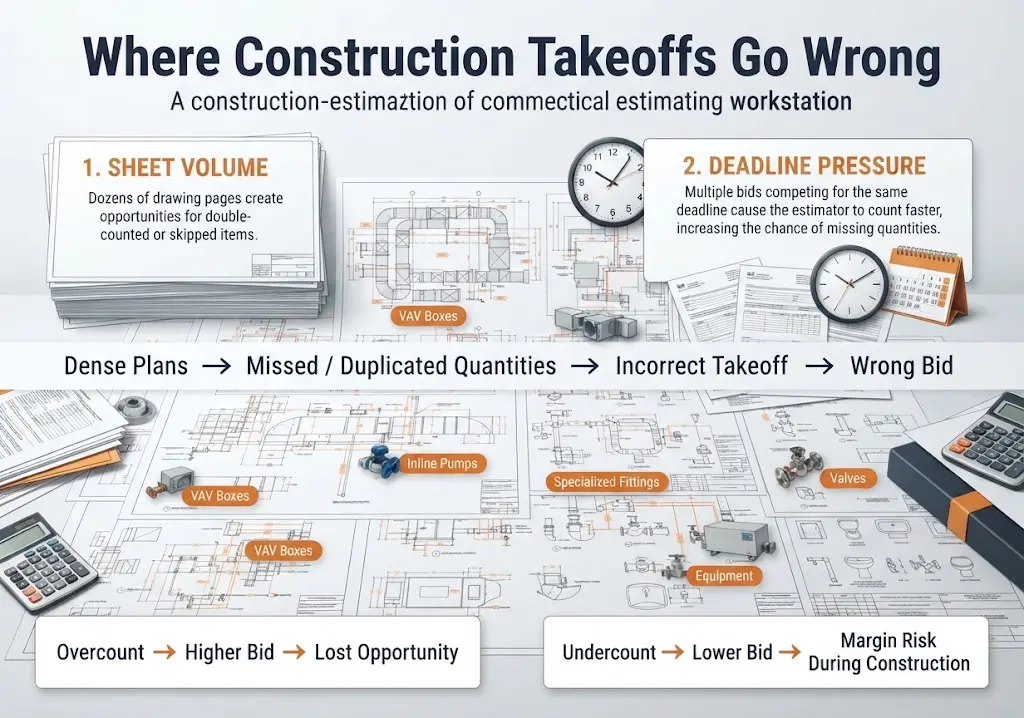
Volume is the first problem. Drawings are dense, and a single commercial set can stretch across dozens of sheets. Holding your place across all of them, without losing track of what’s already been counted, gets harder with every additional page.
Time Pressure
Time pressure is the second. Estimators are rarely working one bid at a time; they’re juggling several against the same deadline, and when the clock runs down, the count moves faster. A fast count is exactly where items go missing.
The consequences don’t land evenly. An estimator who overcounts loses the bid to someone cheaper. One who undercounts wins the job, then finds the shortfall halfway through construction, when the material has to be bought no matter what the original number said. On a large commercial project, missing even a few pieces of equipment, a bank of variable air volume (VAV) boxes, or a run of specialized inline pumps, can wipe out a subcontractor’s entire margin before the project breaks ground.
The Real Time Cost of Counting by Hand
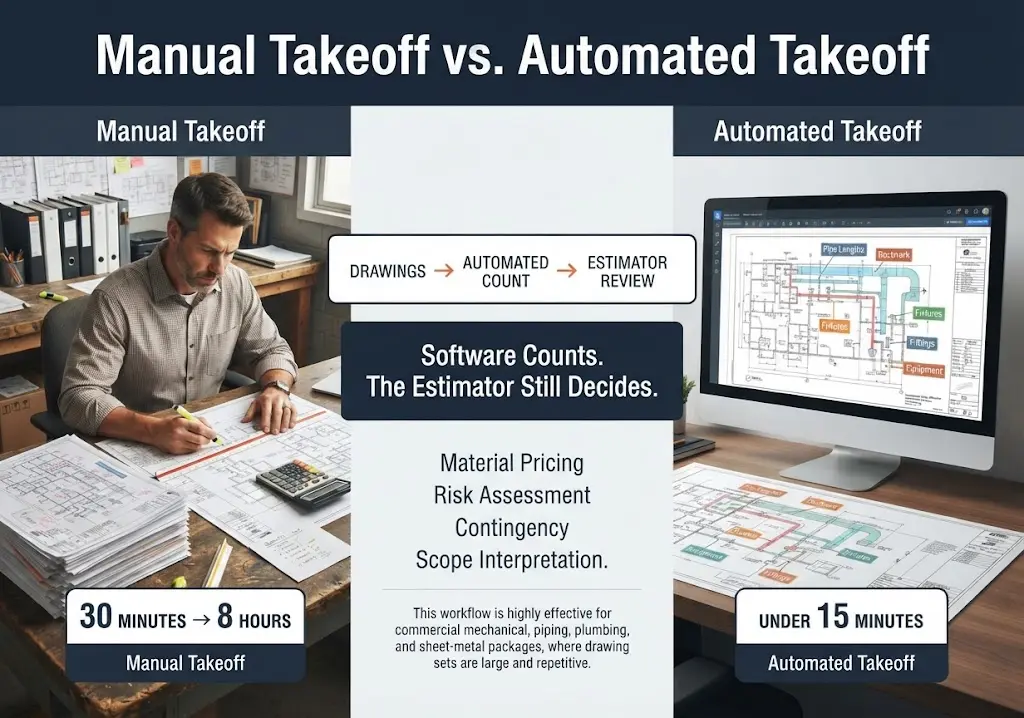
Counting a drawing set by hand takes longer than most people outside the trade assume. Something simple might run thirty minutes. A dense commercial set can eat a full eight-hour day, start to finish. A mid-sized commercial project can arrive with anywhere from five sheets to sixty, and every single one has to be read.
| Method | Typical Time Required | Where It Fits Best |
| Manual takeoff | 30 minutes to 8 hours | Small residential jobs, simple scopes |
| Automated takeoff software | Under 15 minutes for a reviewable set | Large commercial MEP packages |
That time isn’t free, and it shows up somewhere: as direct estimating overhead, or indirectly, in the bids a contractor never submits because nobody was free to price them. A firm that can’t count fast enough simply takes on less work.
Don’t Hire A Boatload Of Estimators!
Hiring more estimators sounds like the obvious fix. It keeps getting harder to execute. Employment in the role is actually projected to decline 3 percent between 2025 and 2035, even with roughly 17,600 openings a year, most of them arising from replacement rather than growth.
The Associated General Contractors of America found in its 2025 workforce survey that 92 percent of firms with open roles report difficulty finding qualified workers, and estimating positions specifically were flagged as hard to fill by 77 percent of the firms trying to hire them. That shortage is the practical reason more subcontractors are shifting measurement onto an automated vision workflow. Bids keep arriving whether or not the desk is fully staffed.
What Changed When the Counting Moved to Software
Computer vision is well suited to the measurement phase specifically, and only that phase. Modern takeoff software analyzes standard flat PDF drawings to isolate lengths, item counts, fixtures, and fittings, usually returning a reviewable set of quantities in under fifteen minutes. From there, the estimator works through the output on screen, corrects anything the system misread, and prices it.
Notice what stays with the human. The software counts. The estimator still decides what things cost, where the risk sits, and how much contingency the job needs. Used that way, automation cuts takeoff time by at least half, and the savings grow with the drawing set: the bigger the plan set, the bigger the payoff.
Commercial Applications and Industry Adoption
This is commercial territory more than residential, and that split isn’t likely to close soon. These tools are built for mechanical, piping, plumbing, and sheet metal packages on new commercial construction, where drawing sets are large enough for the automation to pay for itself. Anyone pricing a kitchen renovation is still working from a tape measure and years of experience, and reasonably so.
Adoption industry-wide remains early. A 2025 survey of more than 2,200 built-environment professionals by RICS found that 45 percent of firms had implemented no AI at all, with most of the remainder still in early pilot stages rather than running it across live projects. McKinsey’s productivity research sizes the wider opportunity at roughly 1.6 trillion dollars a year in recoverable construction output. That figure is global, not per-firm, but it gives some sense of how much room the industry still has to close.
Preserving Expert Estimating Judgment
None of this replaces the estimating judgment behind the number. A ground-up commercial build might call for bottom-up estimation, breaking the project into phases, pricing each one, then combining the parts into a total. A design-build package on a tight schedule might call for the opposite, top-down estimation, where the overall budget gets set first and allocated down to individual trades afterward.
Unit price estimating, area and volume estimating, parametric cost estimating, and assembly and system estimating each answer a slightly different version of the same question: how to turn a takeoff into a number a contractor can actually stand behind.
Matching the right method to the right project is exactly what our estimating services are built around, pairing an accurate quantity takeoff with whichever approach the job actually calls for, instead of running every project through the same template regardless of scope.
What This Means When You’re Comparing Quotes
Compare what’s included before comparing what it costs. A lower number often just means a shorter list, not a better deal.
| Question to Ask | Why It Matters |
| What does the quote include, and what does it exclude? | Exclusions are where the surprises tend to live |
| How were the quantities arrived at? | Anyone who counted carefully will walk you through it |
| What happens if those quantities turn out to be wrong? | The answer tells you who’s carrying the risk |
A contractor who handles all three questions comfortably has almost certainly done the counting properly. The cheapest quote in the stack is sometimes just the one that missed the most, and by the time that surfaces, the drawings are old news and the material is already on order.
If you’d rather not find that out mid-project, talk to our estimating team before the next bid goes out, and have the takeoff checked by people who do nothing else all day.
Get Your Takeoff Checked Before You Bid
Frequently Asked Questions
What’s the difference between a takeoff and an estimate?
A takeoff is the itemized count of everything a job requires: linear feet of pipe, fittings, valves, fixtures, equipment, measured straight off the drawings. An estimate is what those quantities cost once labor rates, overhead, and markup get layered on top. The takeoff sets the quantities, and the estimate prices them. An error in the count carries straight through to the final number no matter how carefully the pricing itself gets done.
Why do two contractors quote the same job differently?
Most of the gap comes from what each contractor actually counted, not from how much profit got added on top. Two estimators reading identical drawings can land on different quantities, and different assumptions about scope push the totals further apart still. Exclusions matter as much as inclusions here. A quote that leaves out equipment the others included will always look cheaper, right up until the missing items surface during construction and someone has to pay for them.
How long does a construction takeoff actually take?
Counting by hand runs from about thirty minutes for a straightforward layout to a full eight hours when the drawings are dense. A mid-sized commercial project can show up with anywhere from five sheets to sixty, and each one has to be read. Automated takeoff software returns a reviewable set of quantities in under fifteen minutes, after which the estimator verifies the output and prices it, rather than spending the day measuring it by hand.
Does takeoff software replace the estimator?
No, though it does change what the role spends its week doing. The software handles the counting. The estimator keeps everything that calls for judgment: what materials cost, where the risk sits, how much contingency the job needs, and whether the drawings carry notes no system should be trusted to interpret on its own. The output is a starting point for review, not a finished bid.
Do residential contractors use takeoff software?
Some do, but it’s far more common on commercial work, where drawing sets are large enough for the automation to pay for itself. These tools are built around mechanical, piping, plumbing, and sheet metal packages on new commercial construction. On a smaller residential job, the counting is quick enough that a tape measure and experience remain perfectly normal, and the setup overhead rarely justifies the time it would save.

