

Where US Contractors Actually Find Construction Bids in 2026
Most contractors build their bid pipeline the same way. They pick two or three platforms they heard about from another contractor. They stick with those for years. As a result, they miss entire categories of work they never knew existed.
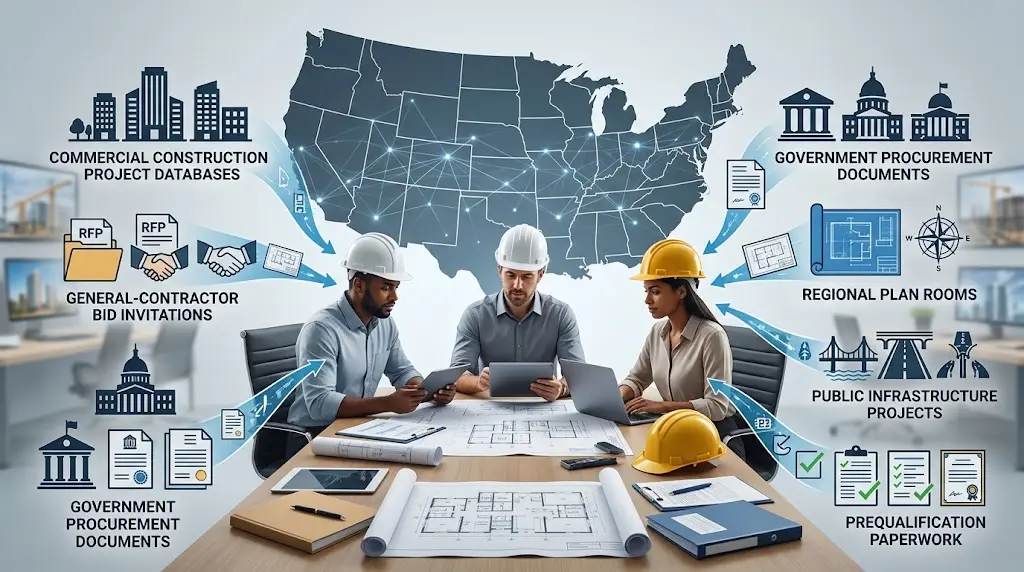
Public bids. Regional plan rooms. Prequalified GC lists. These pipelines run quietly in the background while most “best platform” articles keep repeating the same five commercial websites.
This guide maps the full landscape. It covers the commercial platforms everyone knows, the public procurement systems most guides skip, and the eligibility rules that determine whether a bid you find is one you can actually win.
What Is a Construction Bid Lead Platform, and Why Does the Type You Use Matter?
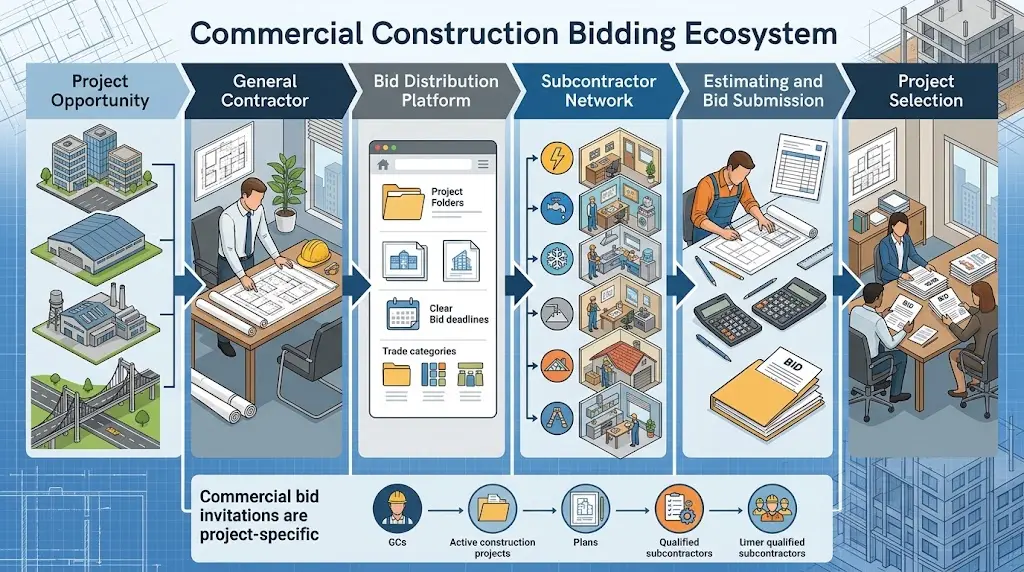
A construction bid lead platform is any service, directory, or government portal that connects contractors with projects open for bidding. The type matters because not all bid work looks the same.
There are three broad categories, and almost every source of work fits into one of them.
- Commercial GC invitation platforms. General contractors post projects and invite prequalified subs to bid.
- Residential lead generation platforms. Homeowners submit a request, and the platform sells that lead to one or more contractors.
- Public and government procurement. Federal, state, and local agencies post open solicitations that any eligible contractor can bid on.
Each category has a different cost structure, buyer, and win rate. Before choosing a platform, figure out which category actually drives your revenue. That single decision shapes everything else in this guide.
Which Construction Bid Platforms Do Most US Contractors Actually Rely On?
Five platforms appear repeatedly across industry sources. Together, they cover most of the commercial and residential bid landscape in the United States.
| Platform | What It Does | Best For |
| BuildingConnected (Autodesk) | Free subcontractor profile, GC-side bid invitations | Subs who want visibility with GCs |
| HomeAdvisor/Angi | Pay-per-shared-lead homeowner requests | Residential remodelers and trades |
| The Blue Book/Dodge Construction Network | Directory plus BidScope plus GC project posting | Commercial subs and material suppliers |
| PlanHub | Plan distribution and bid management | Subs and GCs coordinating on active bids |
| ConstructConnect/BidClerk | Commercial project data and bid alerts | GCs and subs tracking upcoming work |
Should Residential and Commercial Contractors Use the Same Bid Platforms?
No. The platform that works for a kitchen remodeler rarely works for a commercial GC bidding off plans. Most popular lead sites, including HomeAdvisor, Angi, Thumbtack, Houzz, and Porch, are built for homeowner remodel requests. They connect contractors with individual property owners, not with commercial or public bid invitations.
If your business is residential and project-based, these platforms are a reasonable fit. If you bid for commercial or public work, they will waste your budget. The rest of this guide focuses on what commercial and public-work contractors actually need.
How Much Do Construction Leads Actually Cost, and Are They Worth Paying For?
Sticker price is the wrong number to compare. What actually matters is cost per booked job, not cost per lead.
Here is why the distinction matters so much. A $40 shared lead sounds cheap. But if five other contractors bought the same lead, and you only close one job out of every fifteen leads, your real cost per booked job could run into the hundreds of dollars.
Why Response Time Changes the Math
Speed changes this math dramatically. A landmark study by Dr. James Oldroyd, conducted with InsideSales.com, found that the odds of contacting a lead are roughly 100 times greater when you call within five minutes instead of thirty. The odds of qualifying that lead are about 21 times greater over the same window.
That means two contractors paying the same price for the same lead can get completely different results, based purely on response time.
Example
Here is a simple way to see the math. Say you buy ten shared leads at $50 each, for a total of $500. If you close one job worth $4,000 in profit, your real cost per booked job is $500, not $50. Now imagine a competitor calls back within five minutes on every lead and closes three jobs from the same ten leads. Their cost per booked job drops to roughly $167, even though they paid the exact same price per lead as you did.
Pro Tip: Before comparing two platforms on price, ask each one for their average close rate by lead type. A platform that will not share this number is telling you something too.
A few practical takeaways:
- Shared leads are cheaper per lead but usually have a lower close rate.
- Exclusive leads cost more upfront but often convert at a higher rate.
- Response time inside the first five minutes is one of the biggest levers you control.
Track cost per booked job for 90 days before committing to an annual platform contract. If you want a simple framework for building that number into your actual bid pricing, you must know how to calculate an accurate construction bid cost.
How Do Contractors Find Government and Public Construction Bids?
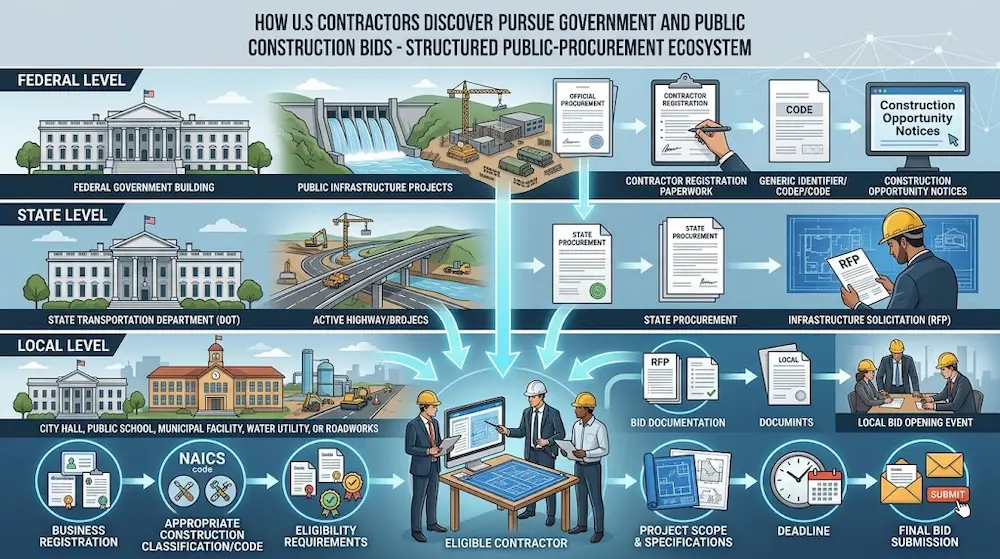
The platforms above cover commercial and residential work. They do not cover public procurement in any real depth. Public sector work runs through a separate set of systems.
SAM.gov Registration and NAICS Codes
SAM.gov is the starting point for federal contracts. Registration is free and mandatory for any business that wants to bid on federal work. You will need a Unique Entity ID, which replaced the old DUNS number system in 2022 (Source: SAM.gov). Registration typically takes seven to fifteen business days when your information is entered correctly.
You will also need the right NAICS code. Most construction work falls under NAICS sector 23, and choosing the correct subcode affects which set-aside opportunities you become eligible for.
SAM.gov registration must be renewed annually, and a lapsed registration can freeze active contracts, not just block new bids. Put a renewal reminder on your calendar the day you first register, since this single missed step quietly disqualifies more contractors than any actual bidding mistake.
Federal Set-Asides That Affect Who Can Win
Several federal programs exist specifically to award contracts to certain business types:
- 8(a) Business Development Program, for small disadvantaged businesses
- HUBZone, for businesses in historically underutilized business zones
- SDVOSB, for service-disabled veteran-owned small businesses
State and Local Government Portals
Beyond the federal level, state and local governments run their own systems. DemandStar and OpenGov/PlanetBids are two of the most common platforms for state and municipal bid postings. Most state departments of transportation also run dedicated portals for highway and infrastructure work.
This layer takes more setup than a commercial platform. But it opens a pipeline that most of your competitors are not even looking at, simply because they never registered.
What Is Prequalification, and Why Might It Stop You From Bidding at All?
Finding the right bid does not guarantee you can submit one. Many GCs and owners require prequalification before a contractor is even allowed to bid. Prequalification is a screening process. It typically reviews your safety record, insurance coverage, financial stability, and past project history.
Four systems handle most of this screening across the industry.
● Avetta
Avetta is a supply chain risk platform widely used across industrial and commercial sectors. Many owners require suppliers and subs to clear an Avetta profile before they can bid.
● ISNetworld
ISNetworld is common on energy and heavy industrial projects. It weighs safety compliance documentation especially heavily during review.
● PICS
PICS is used by many utilities and oil and gas owners to screen contractors for safety and insurance compliance before granting bid access.
● Textura
Textura focuses on payment management and lien waiver compliance rather than safety screening, and is often required alongside one of the other three systems.
Clearing these systems can take several weeks. Start building your prequalification file, including safety records, insurance certificates, and financial statements, before you actually need it. Waiting until a bid deadline is looming is the most common mistake contractors make here.
Pro Tip: Many GCs and owners share the same prequalification network. Clearing one Avetta or ISNetworld profile can quietly unlock bid invitations from several owners at once, not just the one who asked you to register.
Where Do Regional Contractors Find Local Bid Opportunities?
National platforms and government portals still miss an entire layer that regional contractors depend on the most. Local and regional work often moves through channels the big national platforms never touch.
● AGC and ABC Chapter Plan Rooms
Local chapters of the Associated General Contractors and Associated Builders and Contractors run their own bid postings, often invisible outside the region.
● Local Builders Exchanges
These membership-based organizations have operated in many US cities for decades, sharing bid documents among local contractors.
● Procore Preconstruction Tools
Procore’s bid management features act as a direct competitor to BuildingConnected, and many regional GCs already use them.
If your work is concentrated in one metro area or state, check with your local AGC or ABC chapter directly. Coverage and access vary significantly by region, and this is often the fastest way to find work your competitors are not chasing online.
What Do You Need in Place Before You Can Actually Bid on a Project?
None of the platforms or portals covered so far will tell you if you are actually eligible to win what you are bidding on. That eligibility depends on a separate set of prerequisites: Bonding Capacity, Licensing Requirements, Insurance and Certificates of Insurance, and Davis-Bacon Act and Prevailing Wage.
● Bonding Capacity
Bonding capacity caps the size of the project you can bid on. Get this assessed early, especially before chasing public work, since most public contracts require a performance bond.
● Licensing Requirements
Licensing requirements vary by state and sometimes by trade. Confirm that your license covers the project’s specific scope and jurisdiction before you bid.
● Insurance and Certificates of Insurance
Insurance and certificates of insurance are almost always required as part of a bid package. GCs and owners will ask for proof before they even review your number.
● Davis-Bacon Act and Prevailing Wage
Davis-Bacon Act compliance applies to most federally funded construction projects. It requires paying prevailing wages set for the local area and trade, and it adds certified payroll reporting obligations that catch many first-time public bidders off guard. Underestimating labor cost against the prevailing wage table is one of the fastest ways to win a public bid and lose money on it.
These four items determine which of the leads and bid invitations covered earlier in this guide you can actually convert into a signed contract. A lead is only valuable if you can legally and financially deliver on it. Getting your bonding, licensing, and eligibility documentation in order before you bid is exactly where a dedicated bid preparation and takeoff service can save you weeks of back-and-forth on a tight deadline.
How Can Contractors Avoid Wasting Money on Bad or Fake Leads?
Not every lead is worth paying for, and some platforms have a documented history worth knowing before you commit your budget. Start with the basic distinction between lead types.
- Shared leads are sold to multiple contractors at once. They are cheaper but more competitive.
- Exclusive leads cost more but are sold only to you, which usually results in a higher close rate.
Regulatory history also matters here. In April 2023, the Federal Trade Commission finalized an order requiring HomeAdvisor to pay up to $7.2 million over deceptive claims about lead quality. That same year, the San Francisco District Attorney secured a separate $6.82 million settlement against HomeAdvisor over misleading advertising about background checks.
More recently, in January 2025, Angi Services agreed to pay $2.95 million to settle claims by the FTC and the New York Attorney General that its Handy platform misled independent workers about hourly pay rates.
None of this means avoiding these platforms entirely. It means reading the fine print, tracking your actual results, and treating marketing claims about lead quality with healthy skepticism.
A few fraud red flags worth watching for on any platform:
- Vague project scope with no verifiable address
- Pressure to pay upfront before any contact with the client
- Contact information that changes or cannot be confirmed
Should US Contractors Rely on Bid Platforms Built for Other Countries?
No, and this is an easy mistake to make. Some widely shared “best construction bid site” lists include platforms built primarily for Canadian projects, such as Merx, Bidcentral, and Biddingo.
These lists rarely highlight differences between countries.
Before signing up for any bid board you found on a generic roundup article, confirm it actually posts US projects in your region. Otherwise, you may pay for access to a pipeline that never applies to your business.
Ready to turn more bid opportunities into profitable contracts?
Get an accurate, on-time construction estimate from USA Estimators before your next bid deadline.
Which Bid Source Should You Start With, Based on Your Business Type?
With every layer of this guide now covered, here is how it maps back to a specific contractor’s situation.
| Business Type | Best Starting Channel | Why |
| Residential remodeler | HomeAdvisor or Angi | Built for homeowner-submitted requests |
| Commercial general contractor | BuildingConnected and ConstructConnect | Direct access to sub networks and project data |
| Commercial subcontractor | BuildingConnected and The Blue Book | Free profile visibility to GCs actively bidding |
| Public-work contractor | SAM.gov, plus state DOT and DemandStar | Required registration for any public dollar |
| Regional or local contractor | AGC or ABC chapter plan room | Local coverage the national platforms miss |
Most contractors eventually need more than one channel. But starting with the one that matches your actual business type saves months of wasted subscription fees.
How Do You Turn More Bid Leads Into Signed, Profitable Contracts?
Every platform, portal, and plan room in this guide hands you an opportunity, not a win. Finding the bid is genuinely the easy part. Contractors who win consistently are the ones who can turn a bid invitation into an accurate, defensible estimate before the deadline. That is where most bid pipelines actually break down, not in lead generation, but in the estimating step that comes right after.
A late estimate loses the bid regardless of price. An inaccurate estimate wins the bid and then erodes your margin on the job. Both outcomes trace back to the same bottleneck: estimating capacity.
This is where USA Estimators’ construction estimating services fit into everything covered above. We build the accurate, on-time estimates that help contractors respond to more bids without stretching their in-house team thin, and that build the kind of trust with clients that turns a single job into a repeat relationship.
Getting invited to bid is only half the job. Winning it, and protecting your margin once you do, depends on the number you submit. If you want help turning more of the leads and bids covered in this guide into signed, profitable contracts, get in touch with USA Estimators for a free estimate consultation.
Frequently Asked Questions
Is BuildingConnected free for subcontractors?
Yes, subcontractors can create a free profile on BuildingConnected to receive bid invitations from general contractors. Autodesk, which owns the platform, charges general contractors and larger firms for advanced project management features, not subs for basic bid access.
What is the difference between HomeAdvisor and Angi now?
HomeAdvisor and Angi are both owned by the same parent company, Angi Inc. HomeAdvisor traditionally focused on pay-per-lead pricing, while Angi historically used membership and review-based models. The two brands have increasingly merged their contractor-facing tools.
How long does SAM.gov registration take?
SAM.gov registration is free and typically takes seven to fifteen business days when submitted correctly. Delays usually come from mismatched business information, such as a legal name that does not exactly match IRS records, so gather your documents carefully first.
What is a builders exchange?
A builders exchange is a regional, membership-based organization that shares bid documents and project information among local contractors. Many US cities have operated one for decades, and they remain a strong source of local commercial work that rarely appears on national bid platforms.
Do I need to be prequalified for every GC I bid with?
Not every GC requires prequalification, but many mid-size and large commercial owners do, especially on industrial or utility work. Systems like Avetta and ISNetworld are used across many owners at once, so clearing one profile can open several bid opportunities simultaneously.
What is the difference between bonding and insurance?
A performance bond guarantees a project owner that the job will be completed as contracted and is backed by a surety company. Insurance protects against accidents, damage, or liability that may occur during the work itself. Public projects typically require both before you can be awarded a contract.
What is the difference between a bid invitation and a homeowner lead?
A bid invitation comes from a general contractor or agency and asks you to submit a price for a defined project. A homeowner lead is a raw inquiry from a consumer that has not been scoped or vetted, and may go to several contractors at once.
Can subcontractors bid directly on federal contracts, or only through general contractors?
Subcontractors can register on SAM.gov and pursue federal work directly as a prime contractor if they meet the eligibility requirements. Most subs, however, get federal work by bidding to general contractors who hold the prime contract, which requires no separate federal registration.
What is a CAGE code, and do I need one?
A CAGE code is a five-character identifier assigned automatically when you register on SAM.gov. The Department of Defense and many other federal agencies use it to identify your business, so any contractor bidding on federal work will have one issued at registration.
Is BuildingConnected the same platform as Procore?
No, they are separate companies that compete for the same job. BuildingConnected, owned by Autodesk, focuses on bid management and subcontractor invitations. Procore is a broader construction management platform that also includes preconstruction and bidding tools as part of a larger suite.
Can a brand new construction company bid on government contracts?
Yes, there is no minimum time in business required to register on SAM.gov. However, many agencies weigh past performance heavily, so new contractors often start with smaller set-aside contracts or subcontract under an established prime before pursuing larger federal work on their own.
How many bid platforms should a contractor realistically use at once?
Most contractors do well with two to three platforms matched to their business type, rather than spreading thin across many. Start with one commercial platform and one public procurement channel, then add more once you’re tracking cost per booked job.


