


5 Mistakes Contractors Make in Client Billing
Late payments, disputed invoices, clients who “never got your email” might sound familiar to you. In 2026, U.S. contractors are losing thousands every year not because they do bad work, but because they bill badly. The numbers are harder to ignore now. Material costs are up, crews are expensive, and cash flow mistakes hit faster than they used to. Here are five billing mistakes that quietly kill your margins and how to stop making them.
Mistake 1: Sending Invoices That Nobody Can Decipher
In order to understand this mistake in a better way, we need to assess one of the most common scenario. You complete a bathroom renovation, send a one-line invoice that reads “Renovation work: $14,500,” and then wait. A week passes. Then comes the client call stating “What exactly are we paying for?”
Vague invoices don’t just confuse people. They also stall payment. Homeowners, property managers, and commercial clients all want to see the breakdown. Labor hours, materials, subcontractor costs, permit fees, you need to list them all. When a client can cross-reference your invoice against what they actually watched happen on site, payment disputes drop sharply.
One Phoenix-based remodeling contractor said he cut his average payment cycle from 38 days to 12 by switching to itemized billing. That’s not a minor efficiency tweak but the difference between making payroll comfortably and making it nervously. Using proper contractor invoice software (MrTask, for instance, has gained real ground among small and mid-size construction firms) turns itemization from a midnight chore into something that generates itself in three clicks.
Mistake 2: Waiting Until Next Week to Send the Invoice
You finish the job Friday afternoon. You think, “I’ll send the invoice Monday.” Monday turns into Wednesday. Wednesday drifts into the following week. By the time your invoice actually arrives, the client has mentally filed your project under “done and closed.” You’re now an afterthought and that’s a terrible position to be in when you need to get paid.
Every day between job completion and invoice delivery is a day the client’s attention moves somewhere else. The longer you wait, the more your invoice has to fight to get noticed.
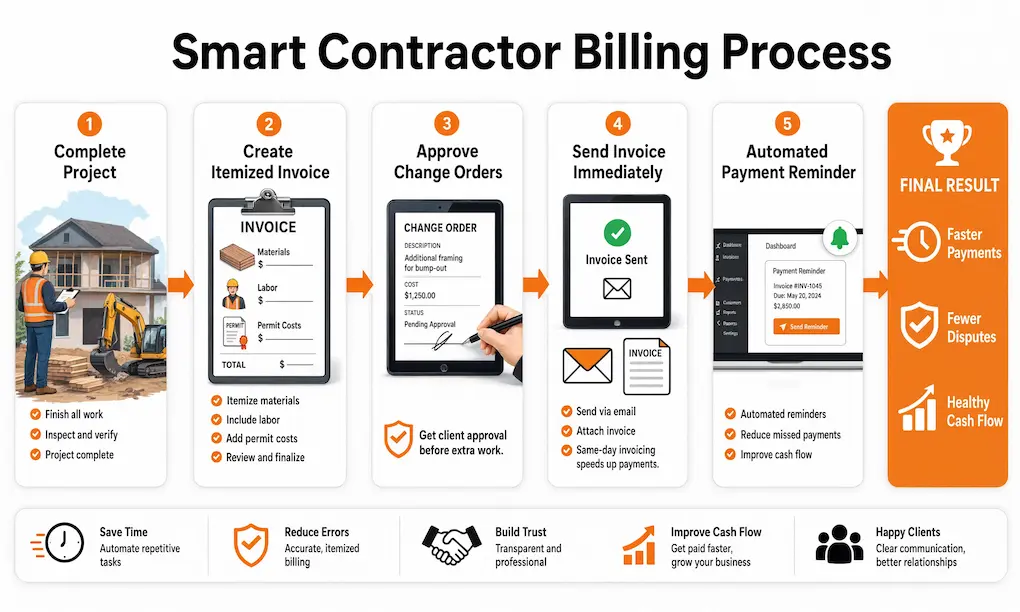
So what is the practical fix for this in 2026? Try invoicing the same day. Better yet, some contractors now send the final invoice as part of the closeout walkthrough. Pull up the tablet, confirm the line items together, get a digital signature and hit send. Job closed, Invoice sent, and the task done before you’re out of the driveway.
Mistake 3: Not Locking Down Change Orders in Writing
This one causes more arguments than almost anything else in the business. The client asks you to add a utility room, and you say Sure. The project stretches three weeks and $11,000 beyond the original scope. But there’s nothing in writing. And now the client is insisting that “that was always included. That seems dramatic, but it happens frequently.
Change orders need to be documented, signed, and billed separately every single time. It doesn’t matter if it’s a $150 material swap or a $45,000 structural addition. DocuSign has made this almost effortless; there is no excuse for a handshake agreement in 2026.
A clean change order process looks like this:
- Written description of the change with a specific date
- Revised cost breakdown covering labor, materials, and any subcontractor fees
- Client signature before a single nail goes in
Mistake 4: Writing Payment Terms That Mean Nothing
“Due upon receipt” is not a payment term. Neither is “net 30” if there’s no consequence attached to crossing that deadline. Using both of them for writing payments is one of the most common mistakes when it comes to budgeting strategies for modern contractors.
Contractors who skip late fees are essentially offering clients an interest-free loan voluntarily. In a sector where material and labor costs climbed significantly between 2023 and 2025, that’s a position you can’t afford to hold.
Your invoices need to be specific. We are not saying that it should be in a threatening way. Just make everything crystal-clear. Here are some suggestions:
- Exact due date (write the calendar date, not “net 30”)
- Late fee structure (1.5% per month is the standard in most states and holds up legally)
- Accepted payment methods are listed plainly
Stop Billing Mistakes Before They Cost You Thousands
| An Important Note |
| More clients are now running their own projects on credit lines with 30-to-60-day cycles. If you don’t know your client’s payment rhythm, your “net 30” might be competing with a credit card cycle they’re already managing. Ask upfront. It’s not weird; it’s just professional. |
Mistake 5: Running Everything Through Spreadsheets and Gut Feeling
Spreadsheets are fine for a lot of things. However, managing billing across four or five active jobs simultaneously is not one of them.
When you’re tracking invoices in Excel while also estimating a new commercial project, managing a crew change, and arguing with a supplier about a late delivery, things fall through. Invoices don’t go out. Follow-ups don’t happen. Overdue accounts sit unpaid for 60, 80, 90 days while you’re too buried to notice.
The construction firms growing fastest right now moved off manual systems years ago. The ones still on spreadsheets tend to be the ones still chasing invoices at 90 days.
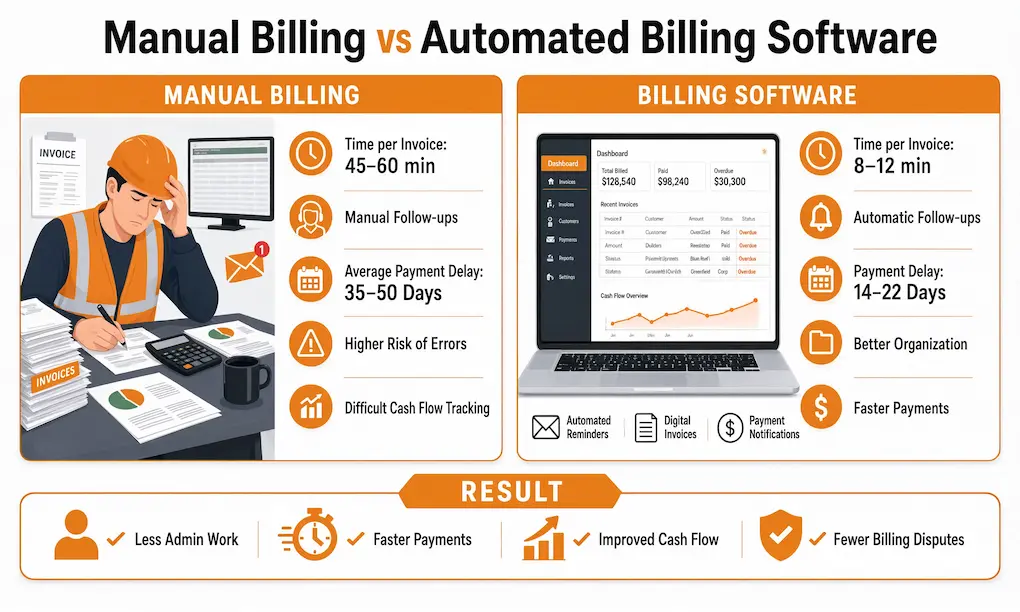
Here’s a rough comparison that reflects what contractors across the country actually report:
| Method | Time per invoice | Follow-up | Avg. payment delay |
| Manual (spreadsheet/email) | 45-60 min | You remember to do it | 35-50 days |
| Purpose-built billing software | 8-12 min | Automated reminders | 14-22 days |
The difference isn’t subtle. And it’s not just the time but also the mental load. When reminders and overdue flags happen automatically, you stop spending brain space on “did I follow up with that client from two weeks ago?
FAQs
What Is The Most Common Contractor Mistake While Billing Clients?
Undocumented change orders are the most common culprit when it comes to contractors making billing mistakes. Most of the time, construction managers and developers perform extra work just on a verbal request from clients. However, they do not get written approval for it first. All of it leads to massive payment disputes later on. Withheld payments and outright write-offs are the most common issues associated with this mistake.
Who Pays When A Contractor Makes A Mistake?
It all comes down to the point of origin. If the mistake is solely from the contractor’s side, it is the contractor’s duty to pay for it or cover it via their liability insurance. However, if the problem originated due to an incomplete or incorrect owner-supplied design defect, rework costs would be absorbed by the homeowner themselves.
What Are Deceptive Billing Practices?
Deceptive billing practices are misleading or illegal strategies used to extract money from clients. The most common forms of deceptive billing practices are unauthorized charges, cramming, and hidden fees.
What Is The Reasonable Error Rate In Contractor Billing?
As per the recent studies, the industry average of reasonable error rate in contractor billing lands anywhere between 1% and 3%. Most of the clients stop accepting when the number goes above 5%.
What This Actually Costs You
Billing mistakes aren’t just annoying paperwork problems. They’re a direct hit to your operating capital. A contractor running $750,000 in annual work who consistently collects 30 days late is essentially floating tens of thousands of dollars in unpaid labor and materials at any given moment. That’s money that could cover new equipment, a stronger emergency reserve, or finally hiring that second project manager you’ve been putting off.
The clients who pay late aren’t necessarily bad people. Most of them are just responding to whatever system you put in front of them. Clear invoices, firm terms, timely delivery, and automatic follow-ups change that dynamic without any awkward conversations. Fix the invoices, document the changes, set real deadlines, and stop doing it by hand.
If you are still worried about bidding and client billing, call us! Our construction estimating company will create a perfectly precise estimate for your next construction project. Contact the team and get a free quote.


