

Average Cost of a 4-Bedroom House in 2026
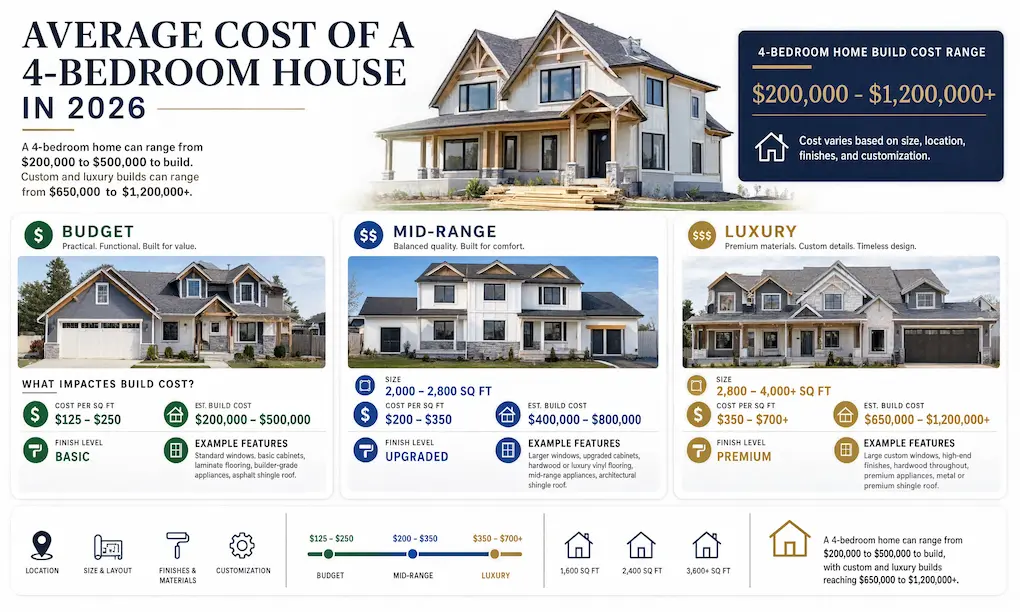
The average cost of a 4-bedroom house in 2026 is $200,000 to $500,000 to build, excluding land, for a typical 1,600–2,800 sq ft home finished from budget to upper-standard grade. Custom and luxury builds commonly cost $650,000 to $1,200,000+.
Buying an existing 4-bedroom home costs less on a national median basis, $404,600 in Q1 2026, according to Census Bureau and National Association of Realtors data. This nearly matched the $403,200 median price of a newly built home the same quarter, an unusually close gap by historical standards.
The number mentioned above can fluctuate significantly, depending on cost-affecting factors like location, size, time of construction, etc. This guide breaks down every driver of 4-bedroom house cost. Let’s start.
What Is the Average Cost to Build a 4-Bedroom House in 2026?
The average cost to build a 4-bedroom house in 2026 is $200,000 to $500,000, excluding land, permits, and site work. According to NAHB‘s 2024 Cost of Construction Survey, the national average construction cost was $428,215 for a 2,647 sq ft home. It is about $162 per square foot, the highest level in the survey’s history.
Exact spending depends on build tier; here’s a worked example for a 2,400 sq ft house.
| Build Tier | What’s Included | Cost per Sq Ft | Estimated Cost (2,400 sq ft) |
| Budget | Basic finishes, standard floor plan, no upgrades | $150 – $190 | ~$350,000 – $450,000 |
| Mid-range | Upgraded windows, solid-surface counters, efficient HVAC | $195 – $230 | ~$470,000 – $550,000 |
| Luxury | Custom architecture, smart-home wiring, stone facades | $280 – $400+ | ~$675,000 – $960,000+ |
What Is the Cost Per Sq Ft to Build a 4-Bedroom House?
The cost per square foot to build a 4-bedroom house in 2026 is $150 to $320 for standard construction, and $300 to $600+ for custom or luxury builds. This figure covers labor, materials, permits, and basic site work, but excludes land. The cheapest markets, parts of Oklahoma, Texas, and the rural South, can fall below this range, down to roughly $100–$140 per square foot for the most basic builds.
Modular and prefabricated 4-bedroom homes cost less, averaging $100 to $150 per square foot, because sections are factory-built and assembled on-site with less waste and faster labor cycles.
A quick way to turn these ranges into a real number is to multiply your planned square footage by your local cost per square foot, then add land, permits, utility connections, and a 10–15% contingency on top. Professional residential estimating services can help you account for these costs more accurately and build a realistic project budget.
Note: The per-square-foot rate only covers the structure, not everything else that lands on the final bill.
What Is the Complete 4-Bedroom House Construction Cost Breakdown by Category?
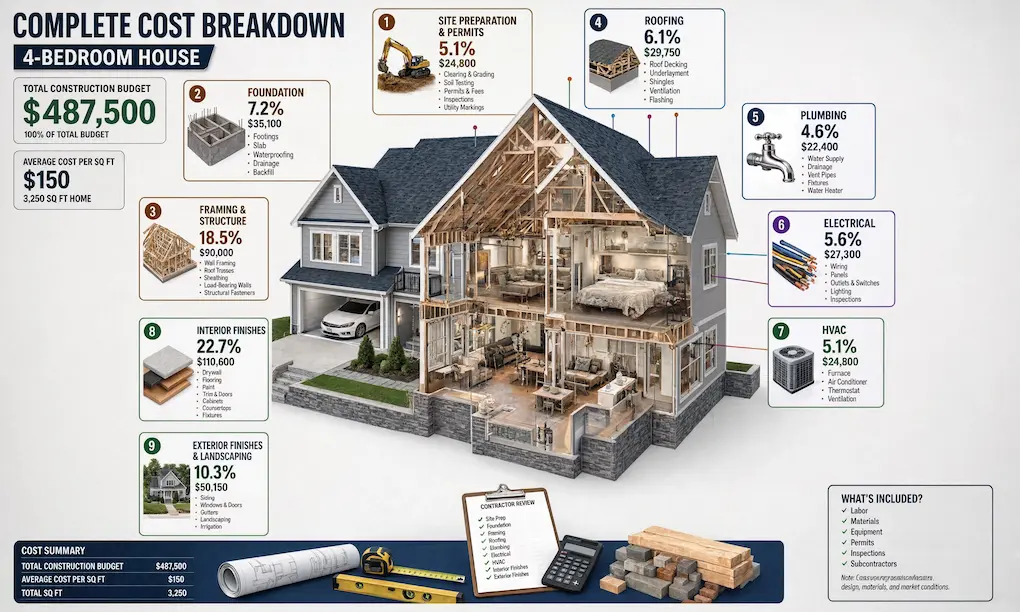
The complete construction cost of a 4-bedroom house splits across nine major categories, with framing, foundation, and MEP systems consuming the largest share of the budget. Site work and permits typically run 10% to 15%. Structural work (foundation and framing) spans 23% to 28%. Roofing adds another 5% to 7%. MEP systems (plumbing, electrical, HVAC) make up 17% to 23%. The remaining 28% to 35% covers interior finishes, exterior finishes, and landscaping.
| Cost Category | % of Total Budget | Estimated Cost Range (2,400 sq ft house) |
| Site preparation & permits | 10% – 15% | $48,000 – $72,000 |
| Foundation | 8% – 10% | $38,400 – $48,000 |
| Framing & structure | 15% – 18% | $72,000 – $86,400 |
| Roofing | 5% – 7% | $24,000 – $33,600 |
| Plumbing | 6% – 8% | $28,800 – $38,400 |
| Electrical | 6% – 8% | $28,800 – $38,400 |
| HVAC | 5% – 7% | $24,000 – $33,600 |
| Interior finishes (drywall, flooring, cabinets) | 20% – 25% | $96,000 – $120,000 |
| Exterior finishes & landscaping | 8% – 10% | $38,400 – $48,000 |
What Is a Realistic Total Budget for a 4 Bedroom Home?
A realistic total budget for a 4-bedroom home in 2026 is roughly $385,000 to $665,300 once land, construction, permits, and contingency are included, with NAHB’s 2024 survey putting the average all-in new-home sale price at $665,298. House construction cost alone covers only part of the actual project cost.
| Budget Line Item | Estimated Range |
| Land (typical 0.25–0.5 acre lot; rural acreage often costs less per acre, small urban lots more per sq ft) | $20,000 – $200,000 |
| Construction cost (2,000–2,500 sq ft) | $300,000 – $500,000 |
| Permits & site prep | $10,000 – $30,000 |
| Design/architectural fees | $15,000 – $60,000 |
| Contingency reserve (10–15% of construction cost) | $30,000 – $75,000 |
| Construction loan carrying costs | $10,000 – $30,000 |
| Sum of low-end/high-end figures above | $385,000/$895,000 |
| Typical realistic budget (blended, not simultaneous maximums) | ~$385,000 – $665,300 |
Construction loans typically carry interest rates 1 to 2 percentage points above a standard 30-year mortgage, adding $10,000 to $30,000 in carrying costs over a 12-month build. Production-style homes take 7 to 9 months to complete, while fully custom 4-bedroom homes average 12 to 18 months from permit to move-in.
What Factors Affect the 4-Bedroom House Building Cost?
House size, location, labor wages, number of stories, site condition, building type, design, finish level, material quality, timing, and global trade conditions all affect 4-bedroom house construction cost.
How Does House Size Change the Construction Cost?
Bigger homes cost more overall but less per square foot, since fixed costs like permits and site mobilization spread across more areas.
| House Size Range | Cost per Sq Ft |
| 1,500 – 2,200 sq ft | $160 – $260 |
| 2,200 – 3,200 sq ft | $170 – $270 |
| 1,800 – 2,800 sq ft | $180 – $290 |
| 1,600 – 2,400 sq ft | $165 – $255 |
| 2,000 – 3,500 sq ft | $200 – $350 |
How Does the Number of Stories Change the House Building Cost?
Single-story homes need a bigger foundation and roof relative to livable space, raising cost per square foot. Two-story designs shrink that footprint but add framing complexity and staircases.
| House Type | Foundation/Roof | Cost per Sq Ft |
| Single-story | Higher (larger footprint) | $170 – $300 |
| Two-story | Lower (smaller footprint) | $160 – $280 |
| Three-story | Lowest per sq ft, added structural/stair cost | $180 – $320 |
How Does House Building Type Affect the Construction Cost?
Modular and prefab construction costs $100–$150 a square foot, well under the $150–$320 typical for stick-built homes, because factory assembly means fewer weather delays and fewer on-site labor hours.
| House Building Type | Cost per Sq Ft | Notes |
| Traditional stick-built | $150 – $320 | Most customizable, longest timeline |
| Modular | $100 – $150 | Factory-built sections, assembled on-site |
| Panelized | $110 – $170 | Pre-built wall panels, faster framing |
| ICF (insulated concrete form) | $160 – $260 | Higher upfront cost, lower energy bills |
| Steel-frame | $150 – $250 | Strong in high-wind/seismic zones |
How Does the Design of the House Change the Construction Cost?
Complicated rooflines and irregular footprints drive up material waste and labor hours. A simple rectangular footprint is the most cost-efficient shape to build.
| Home Design | Cost per Sq Ft | Why |
| Simple rectangular footprint | $150 – $220 | Least material waste, fastest framing |
| L-shaped | $170 – $250 | More corners, moderate complexity |
| Wrap-around porch/multiple gables | $190 – $280 | Added rooflines and trim work |
| Custom architect-designed | $250 – $400+ | Unique structural details, high labor hours |
| Multi-level/split design | $200 – $320 | Extra framing and foundation transitions |
How Does Finish Level Affect the 4-Bedroom House Construction Cost?
Finish level is the biggest lever a homeowner personally controls. Budget finishes keep cost near $150 a square foot; luxury finishes can push past $400 on the same footprint.
| Finish Level | Cost per Sq Ft | Common Features |
| Budget | $150 – $190 | Laminate counters, vinyl flooring, builder-grade fixtures |
| Standard | $190 – $220 | Mid-grade cabinets, engineered flooring |
| Mid-range | $220 – $280 | Solid-surface counters, upgraded windows, efficient HVAC |
| Premium | $280 – $350 | Hardwood floors, custom cabinetry, higher-end appliances |
| Luxury | $350 – $450+ | Stone exteriors, smart-home systems, designer finishes |
How Does Location of the House Affect the Building Cost?
West Coast builds cost $220–$280 a square foot, while Midwest builds cost $150–$190. For homeowners researching the cost to build a house in Wisconsin, these Midwest construction rates provide a useful starting point. However, actual costs vary by location, home size, materials, and finishes.
Zillow’s Q1 2026 Home Value Index puts the national typical home value at $365,452, with state-level values ranging from $173,639 in West Virginia to $832,071 in Hawaii.
| State | 4-Bedroom House Cost per Sq Ft |
| Texas | $120 – $270 |
| Florida | $130 – $280 |
| California | $220 – $350+ |
| Hawaii | $205 – $350+ |
| Washington | $173 – $280 |
| New York | $200 – $400+ |
| New Jersey | $180 – $400+ |
| Massachusetts | $192 – $300 |
| Ohio | $150 – $190 |
| Oklahoma | $100 – $220 |
Contact USA Estimators today for a professional 4-bedroom house cost estimate and build with confidence.
How Do Local Labor Wages Affect the House Construction Cost?
Labor typically makes up 30% to 50% of total construction cost. Tight labor markets or strong union wage requirements push per-square-foot pricing toward the top of the range.
| US Region | Labor Cost Share | Labor Rate Impact |
| Northeast | 40% – 50% | Highest: union labor common, dense permitting |
| West Coast | 40% – 50% | Highest: high demand, high cost of living |
| Midwest | 30% – 38% | Lower: more moderate wage base |
| South Central | 28% – 35% | Lowest: most affordable skilled labor pool |
| South Atlantic | 30% – 40% | Moderate: coastal counties run higher than inland |
How Does Site Condition Affect the House Construction Cost?
A sloped lot, poor soil, a high water table, or rock excavation can add $10,000 to $60,000+ in site prep.
| Site Condition Factor | Added Cost Range |
| Flat lot, utilities already accessible | $0 – $10,000 |
| Moderate grading/clearing needed | $10,000 – $20,000 |
| Sloped lot requiring retaining walls | $20,000 – $40,000 |
| Poor soil requiring engineered foundation | $15,000 – $35,000 |
| High water table/drainage system needed | $10,000 – $30,000 |
| Rock excavation | $30,000 – $60,000+ |
How Does Building Material Quality Affect the House Construction Cost?
Standard lumber, vinyl siding, and laminate counters keep costs in check. If you need help estimating building material cost for house construction, these choices can provide a more accurate starting point for your budget. Engineered lumber, fiber-cement siding, or quartz counters add $15,000 to $60,000, depending on how far you go.
| Material Tier | Examples | Added Cost vs. Standard |
| Standard-grade | Dimensional lumber, vinyl siding, laminate counters | Baseline |
| Mid-grade | Engineered lumber, fiber-cement siding, quartz counters | +$15,000 – $30,000 |
| Premium | Natural stone, hardwood, high-end fiber-cement systems | +$30,000 – $60,000 |
How Does Time of the Year Affect the House Building Cost?
Spring and summer bring faster progress, but more contractor competition and peak-season pricing; winter often means slower work but better contractor rates.
| Season | Weather Impact | Labor/Cost Impact |
| Spring | Favorable weather, faster progress | Higher demand, contractors booked out |
| Summer | Long work days, good conditions | Peak season pricing, highest labor demand |
| Fall | Still workable in most regions | Moderate pricing, easier scheduling |
| Winter | Weather delays likely (North/Midwest) | Lower demand can mean better contractor pricing |
How Do Global Conditions Affect the House Construction Cost?
Tariffs and supply chain disruptions directly affect material costs. As of 2026, Section 232 tariffs keep imported steel, aluminum, and copper at up to 50%.
Canadian softwood lumber faces a 10% Section 232 tariff, plus separate antidumping and countervailing duties that vary by producer. These additional duties typically add another 14% to 25% or more, creating a combined burden of approximately 24% to 40%+, depending on the specific mill.
Cushman & Wakefield’s April 2026 analysis estimates current tariff rates have raised overall construction material costs 6.0% and total project costs 3.0% above a 2024 baseline.
| Material | 2026 Tariff Rate | Estimated Cost Impact | Source |
| Steel & aluminum products | Up to 50% | Framing, rebar, and structural cost increases | Section 232, U.S. trade policy filings |
| Copper | Up to 50% | Wiring, plumbing, electrical component costs up | Section 232 |
| Softwood lumber (Canadian imports) | 10% Section 232 + ~14–25%+ AD/CVD (producer-dependent) | Framing lumber costs up | Global Affairs Canada / U.S. trade filings |
| Kitchen cabinets & vanities | 25% (rising to 50% in Jan. 2027) | Interior finish costs up | Section 232 |
| Overall construction materials | ~6% above 2024 baseline | ~3% increase in total project cost | Cushman & Wakefield (April 2026) |
Pro tip: Given how much tariffs shift material pricing, locking in supplier quotes early and building a slightly larger contingency reserve (closer to 15%) is a smart hedge in the current environment.
What Does a 4-Bedroom House Cost After Move-In?
Construction cost isn’t the end of the spending. A 4-bedroom home typically carries $300 to $600 a month in utilities, plus insurance, property taxes, and ongoing maintenance that scale with size. Insulation quality, window performance, air sealing, and HVAC upgrades decided during construction shape these bills for as long as the home stands.
Is Buying a House in 2026 Cheaper than Building a New One?
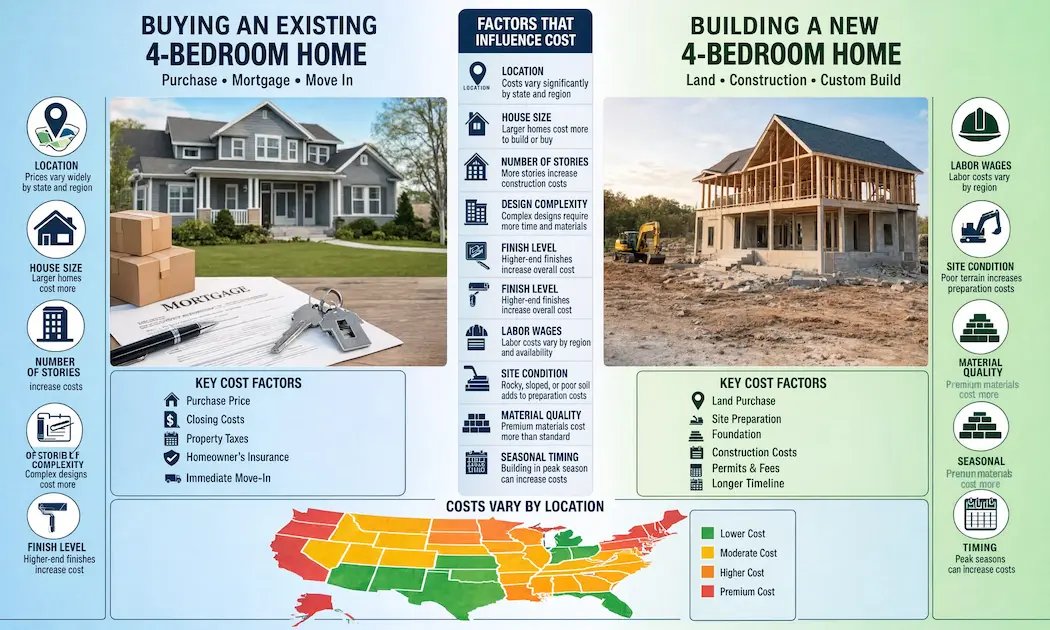
Buying an existing 4-bedroom house is often cheaper than building one in 2026, though not always. The national median existing-home price was $404,600 in Q1 2026, almost identical to the $403,200 median price of a newly built home in the same quarter. Building a comparable home from scratch can cost $200,000–$500,000+, excluding land.
Construction accounted for a record 64.4% of a new home’s sale price in 2024, per NAHB, up from 60.8% in 2022. Building can still undercut buying if you’re at the budget end of construction and already own the land.
| Factor | Buying an Existing 4-Bedroom House | Building a New 4-Bedroom House |
| Median national cost (Q1 2026) | ~$404,600 | $200,000 – $500,000+ (excludes land) |
| Timeline | Weeks to a few months | 7 – 18 months |
| Customization | Limited to renovations | Full control over layout & finishes |
| Financing | Standard 30-year mortgage | Construction loan, then conversion |
| Upfront repair risk | Possible hidden repairs | Lower, new systems and materials |
| Energy efficiency | Often outdated systems | Can meet current energy codes |
| Land included | Yes | No, purchased separately |
| Best for | Faster move-in, established neighborhoods | Custom layout, long-term ownership |
Zillow’s state-level data shows this range concretely: Typical home values run under $200,000 in the most affordable states and above $800,000 in the priciest ones. Building tends to make more financial sense when land is already owned, local resale inventory is thin, or a buyer needs a layout that doesn’t exist in the current market.
Where Do 4-Bedroom House Budgets Go Wrong?
- Site surprises. A sloped lot, clay soil, or a long utility run can add $15,000 to $60,000 that never showed up in the first quote, because the builder hadn’t seen a full site survey yet.
- Finish allowances set too low. A $5,000 cabinet allowance on a kitchen that actually costs $18,000 turns into an unplanned change order.
- Mixing up the quote with the total project. A builder’s number covers the structure, not land, utility hookups, landscaping, or move-in costs; treating it as the full budget leaves a gap.
- Change orders after framing starts. Decisions made once the frame is up can cost three to five times more than the same decision made before ground was broken, since they now involve tearing out finished work.
How Can You Control the 4-Bedroom House Construction Cost?
Controlling 4-bedroom construction costs comes down to planning decisions made before ground is broken:
- Choose a simple footprint. Rectangular floor plans cut framing waste and labor.
- Build up, not out. A two-story design on a smaller foundation often costs less per square foot than a sprawling single story.
- Lock material prices early. Ordering lumber, windows, and fixtures ahead of the build shields the project from mid-construction price swings.
- Schedule the build off-season. Starting outside peak spring/summer demand can lower contractor pricing.
- Select mid-range finishes strategically. Save premium spending for high-visibility areas like kitchens.
- Bundle site work with excavation crews already on-site. Combining grading, trenching, and foundation prep reduces mobilization fees.
- Get an accurate cost estimate first. A detailed, category-by-category construction estimate turns a rough budget into a controllable one.
Why Does Outsourcing Residential Estimating Services Make Sense?
Outsourcing 4-bedroom house estimating replaces guesswork with a category-by-category number. Builders and project owners who estimate in-house often miss line items in MEP systems, site prep, or material escalation, and those mistakes show up later as costly change orders.
If you want precision without the cost of an in-house team, outsourcing residential construction estimating services to USA Estimators is worth considering. The team builds detailed, trade-by-trade cost breakdowns covering site work, framing, MEP systems, and finishes.
FAQs About 4-Bedroom House Construction Cost
What is the average size of a 4-bedroom house in the US?
Most 4-bedroom homes in the U.S. fall between 2,200 and 2,800 square feet, close to NAHB’s national new-home average of 2,647 sq ft. Layout, bathroom count, and flex spaces also affect the final total.
Is constructing a 4-bedroom house in 2026 a good investment?
Constructing a 4-bedroom house in 2026 can be a strong investment when local land is affordable and resale inventory is thin. Custom builds let buyers meet current energy codes, which older existing homes often can’t match.
How much is the total cost to construct a house from scratch?
Construction alone runs $200,000 to $500,000 for standard builds, excluding land. Including land, permits, design fees, and contingency, a realistic total project budget runs roughly $385,000 to $665,300, based on NAHB’s 2024 average all-in new-home price.
Is it cheaper to buy or build a 4-bedroom house?
Buying is typically cheaper upfront: the national median existing-home price was $404,600 in Q1 2026, versus $200,000–$500,000+ to build before land costs. Building becomes competitive when land is already owned, or a custom layout is a priority.
How much does solar cost for a 4-bedroom house in 2026?
Solar for a 2,000–2,500 sq ft 4-bedroom home typically costs $18,000 to $31,000 before incentives, based on a 7kW to 12kW system, per EnergySage’s 2026 marketplace data (national average: $2.58 per watt). Cost per square foot for solar runs roughly $7 to $15, depending on energy use and location.
What is the cheapest state to buy a 4-bedroom house?
West Virginia, Mississippi, Louisiana, Oklahoma, and Arkansas posted the five lowest typical home values in the U.S. in Q1 2026, per Zillow. West Virginia’s $173,639 is the nation’s lowest. Iowa, Kansas, and Ohio offer the best price-to-income ratios (roughly 2.7 to 3.0 years of median household income), even where raw prices aren’t the very lowest.
Do 4-bedroom house prices vary by season or market trends?
Yes. Spring and summer typically see higher buyer competition and pricing, while material costs and labor availability also shift with tariffs, supply chains, and regional demand cycles.


