

How Much Does It Cost to Build a Bowling Alley? (2026 Cost Guide)
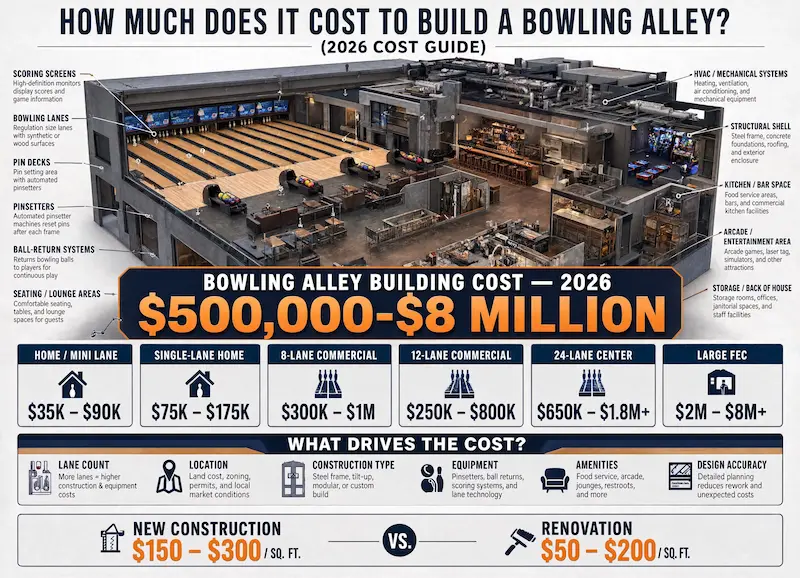
| Bowling Alley Building Cost in 2026 = $500,000 to $8 million |
Building a bowling alley is one of those projects where the price tag swings wildly depending on who you ask. One site says $75,000. Another says $8 million. Neither is wrong; they’re simply describing completely different projects.
Most cost guides throw out a single number without explaining what it includes. This guide fixes that, breaking down real 2026 numbers for every project size, the same way we build an actual estimate: line by line.
How Much Does It Cost to Build a Bowling Alley in 2026?
A commercial bowling alley costs $500,000 to $8 million to build in 2026, while a home bowling alley ranges from $35,000 to $500,000.
That wide range comes down to three things: lane count, whether you’re building from the ground up or converting an existing space, and how much you’re spending on extras like a bar, arcade, or kitchen.
| Project Type | 2026 Cost Range |
| Mini home bowling lane | $35,000 to $90,000 |
| Single-lane home alley | $75,000 to $175,000 |
| 8-lane commercial alley | $300,000 to $1,000,000 |
| 12-lane commercial alley | $250,000 to $800,000 |
| 24-lane commercial center | $650,000 to $1.8 million+ |
| Large family entertainment center | $2 million to $8 million+ |
We’ll break down each cost category from the table above to show where your budget goes.
How Much Does a Home Bowling Alley Cost?
A home bowling alley typically costs $75,000 to $175,000 for a single lane, and up to $500,000 for a luxury multi-lane setup.
Interest in residential bowling has grown steadily into 2026 as more manufacturers offer turnkey lane packages. The final price depends heavily on which format you choose.
Single-Lane Home Bowling Alley Cost
A single regulation lane runs $75,000 to $100,000, up to $175,000 with premium finishes. This generally covers the lane surface, pinsetter, ball return, and basic scoring. Plan on at least 88 to 100 feet of length for the approach, lane, pin deck, and service aisle.
Two-Lane and Luxury Home Bowling Alley Cost
Two lanes side by side typically cost $110,000 to $175,000, up to $200,000 with heavy customization, requiring a minimum room width of about 22 feet. A fully luxury build, with designer finishes, acoustic paneling, premium LED lighting, and top-tier scoring, can run $200,000 to $500,000 or more.
A private lane is a lifestyle purchase, not an investment that pays back at resale. It’s generally a neutral to minor value-add in standard residential markets and only meaningfully boosts marketability in the $2 million-plus luxury segment. If a bowling lane is going into a new custom home rather than an existing basement, our breakdown of the average cost of a 4-bedroom house in 2026 is a useful reference point for the overall construction budget.
Mini Bowling Lane Cost
If space or budget is tight, a mini bowling lane is the more practical option. These systems cost $35,000 to $90,000, use shorter lanes in the 27- to 35-foot range, and rely on smaller balls and pins, delivering most of the fun without needing a dedicated 100-foot room.
How Much Does a Single Bowling Lane Cost?
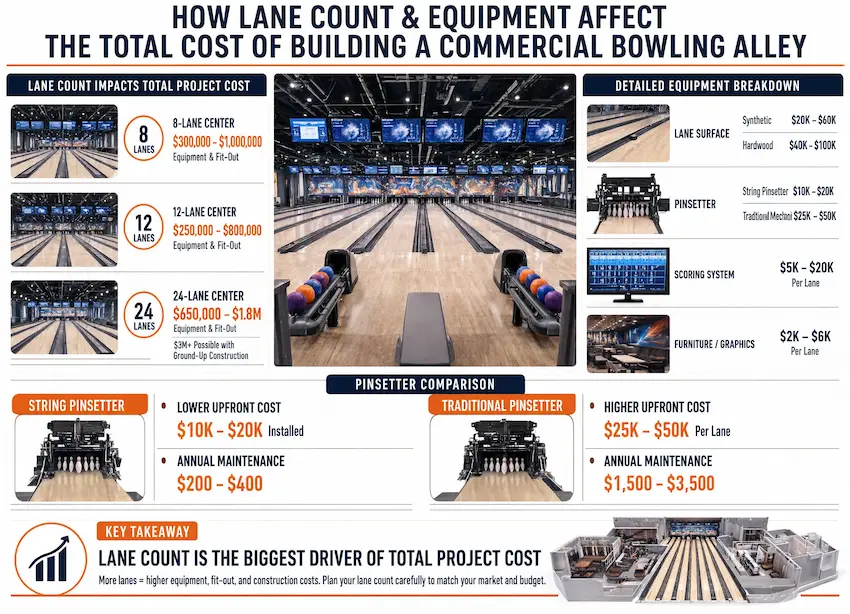
A single bowling lane, including equipment and basic installation, costs $25,000 to $80,000 on average. This figure covers the lane surface and core mechanical components, not the surrounding construction, walls, HVAC, or seating. Here’s roughly how it splits:
| Item | Estimated Cost |
| Lane surface (wood or synthetic) | $20,000–$60,000 |
| Pinsetter | $10,000–$50,000 |
| Ball return system | $3,000–$8,000 |
| Scoring system | $5,000–$20,000 |
| Gutters, bumpers & lane cushion | $1,000–$4,000 |
| Lane oiling equipment | $2,000–$6,000 |
A regulation tenpin bowling lane requires a total length of approximately 88 to 100 feet and a width of about 14 feet per lane. The approach area is 16 feet long, followed by the bowling lane, which measures 60 feet. The pin deck and pit require an additional 7 feet, while a 3.5-foot service aisle is also needed. Together, these areas provide the necessary space for a complete regulation tenpin bowling lane setup.
Multiply the per-lane cost by your total lane count for a rough equipment budget. For a commercial project, though, equipment is usually the smaller half of the total bill; construction and site preparation almost always cost more once you scale past a handful of lanes.
How Much Does It Cost to Build an 8, 12, or 24-Lane Bowling Alley?
Lane count is the single biggest driver of total project cost.
8-Lane Bowling Alley Cost
An 8-lane bowling alley typically costs $300,000 to $1,000,000. This size works well for boutique concepts, sports bars adding a bowling feature, or smaller family entertainment centers. Each lane needs about 100 feet of length, including the approach and service areas.
12-Lane Bowling Alley Cost
A 12-lane setup, common for malls, resorts, and family entertainment centers, lands between $250,000 and $800,000, excluding rent and permits. Duckpin or mini-bowling with string pinsetters sits at the lower end, while a full tenpin build with premium interiors and USBC-certified equipment pushes toward the top.
24-Lane Bowling Alley Cost
A full 24-lane center costs $650,000 to $1.8 million for equipment and fit-out alone, and can exceed $3 million with ground-up construction and higher-end finishes. Large-scale centers with full food and beverage, arcades, and event space regularly fall in the $2 million to $8 million range when all categories are included.
What Factors Affect the Cost of Building a Bowling Alley?
No two bowling alley budgets are the same, as costs can vary significantly based on factors such as location, facility size, number of lanes, amenities, material and equipment quality, and overall design.
Location
Land, labor, and construction costs for building a bowling alley vary significantly by U.S. region. States such as California, New York, and Massachusetts typically have higher costs for commercial land, skilled labor, permits, and construction materials, while Texas, Florida, Georgia, and Ohio may offer more affordable development opportunities. Urban locations can increase overall project costs, whereas suburban areas may provide cheaper land but potentially lower customer traffic.
Size and Lane Count
For a bowling alley, size and lane count directly affect construction costs because more lanes require additional floor space, foundation work, roofing, electrical systems, HVAC capacity, seating, and bowling equipment. A small 8-lane center may need far less investment than a 24- or 32-lane facility, making lane count one of the most important factors in the overall project budget.
Amenities
Modern bowling centers often combine bowling with other entertainment and hospitality features. A kitchen, bar, arcade, laser tag area, party rooms, or restaurant can significantly increase construction costs because each addition requires extra space, equipment, plumbing, electrical work, ventilation, seating, and permits. In some projects, these amenities can cost as much as or even more than the bowling area itself.
Materials and Equipment Quality
The quality of lanes, pinsetters, scoring systems, lighting, seating, and other equipment can have a major effect on the initial investment and long-term operating costs. Synthetic lanes usually cost more upfront than traditional wood lanes but can provide longer service life with less maintenance. Higher-quality scoring systems, lighting, and pinsetters may also increase the budget while reducing repairs, downtime, and replacement costs over time.
Planning and Design Accuracy
Planning and design accuracy can significantly impact the final cost of a bowling alley project. Modern U.S. bowling centers increasingly use boutique bowling layouts, hybrid entertainment designs, VIP lane zones, social lounge seating, and integrated food-and-beverage areas. Poor planning can result in incorrect lane spacing, limited customer flow, insufficient clearances, and costly changes during construction. Using 3D floor plans for more accurate construction estimating can help identify layout problems before construction begins, reducing rework, change orders, and unexpected expenses.
What Does Bowling Alley Equipment Cost?
A typical bowling alley equipment package costs $37,000 to $126,000 per lane, depending on pinsetters, lane materials, scoring technology, furniture, and graphics.
Pinsetters
The pinsetter is usually the single most expensive piece of equipment in the building. Traditional mechanical pinsetters cost $25,000 to $50,000 per lane and require ongoing maintenance. String pinsetters, using a simpler cable-based mechanism, typically cost $10,000 to $20,000 per lane installed, a big reason they’ve become the standard for new US builds.
Lanes
Synthetic lane surfaces run $20,000 to $60,000 per lane; traditional hardwood runs $40,000 to $100,000 per lane. Synthetic has become the default for most new commercial builds because of its durability and lower upkeep.
Scoring Systems
Touchscreen displays, player statistics tracking, LED lane lighting, and interactive game modes cost $5,000 to $20,000 per lane, and this is one of the easiest places to scale your budget depending on how high-tech you want the experience to feel.
Furniture, Masking Units, and Graphics
Seating, masking unit graphics above each lane, and sidewall branding typically run $2,000 to $6,000 per lane, but noticeably affect how professional the finished center feels.
Planning a bowling alley project? Get an accurate construction estimate from USA Estimators.
String Pinsetter vs Traditional Pinsetter: Which Costs Less?
String pinsetters cost less both upfront and over time. Annual maintenance runs $200 to $400 per lane, compared to $1,500 to $3,500 per lane for a traditional mechanical system.
Beyond maintenance savings, string pinsetters eliminate the need for a certified mechanic, run more quietly, and install faster, lowering the total cost of ownership over the life of the business. For boutique concepts and family entertainment centers built in 2026, they’ve effectively become the industry default, with traditional pinsetters now mostly reserved for large, high-volume league centers.
How Much Does Bowling Alley Construction Cost Per Square Foot?
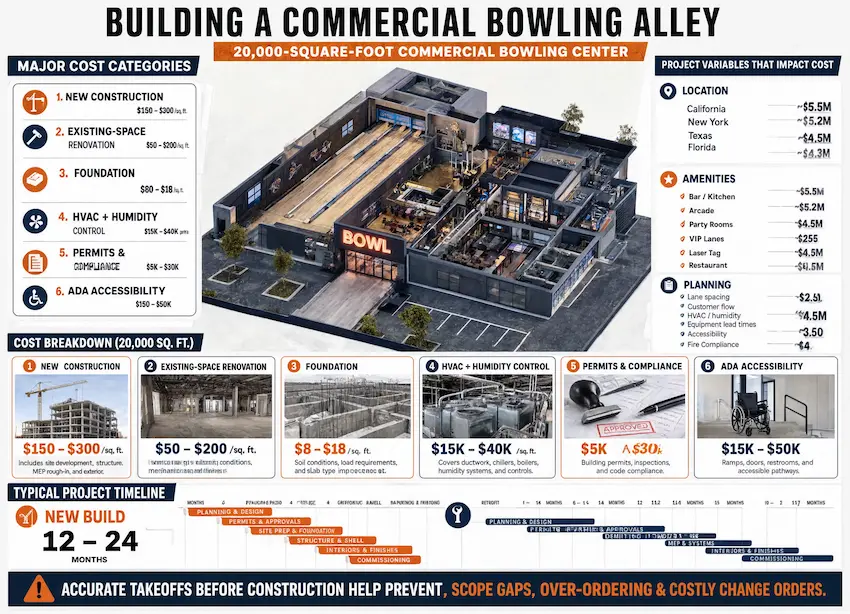
New commercial construction averages $150 to $300 per square foot. Renovating an existing space is cheaper, typically $50 to $200 per square foot.
A 20,000-square-foot new build lands between $3 million and $6 million for structure alone, before land, equipment, or fit-out. That’s why so many operators retrofit an existing retail box or warehouse instead, cutting structural cost roughly in half.
How Much Does a Bowling Alley Foundation Cost in 2026?
Foundation work deserves its own line item because bowling alleys need long, perfectly flat lane runs plus reinforced pit and machine areas at the back of every lane. In 2026, foundation costs typically run $8 to $18 per square foot for standard slab-on-grade, trending higher where soil conditions are poor or seismic reinforcement is required.
Because lane flatness tolerances are so tight that even minor slab variance throws off ball roll, this isn’t a section to estimate loosely. Accurately calculating the cost of construction materials for concrete, rebar, and vapor barriers upfront helps prevent costly change orders and budget overruns on bowling alley projects.
How Much Does Bowling Alley HVAC Cost in 2026?
Lane humidity directly affects how much oil the surface absorbs, which changes how the ball reacts down the lane, and league bowlers will notice quickly if it’s wrong. Budget $15,000 to $40,000 per lane for HVAC and dedicated humidity control on a new build, factoring in continuous dehumidification and tighter climate tolerances than a standard retail space would need.
Cutting corners here tends to cost more later, since resurfacing a lane damaged by chronic humidity problems is far more expensive than getting the mechanical design right the first time.
How Long Does Bowling Alley Construction Take, and When Should You Hire a Contractor?
A new commercial build typically takes 12 to 24 months from site selection to opening day, while retrofitting existing space compresses that window to roughly 6 to 14 months. Two things regularly blow past even a well-planned timeline: hiring a general contractor with no bowling-center experience, and ordering equipment too late.
Custom pinsetters and lane systems have 3- to 4-month lead times, so ordering early protects your opening date. It’s also worth hiring a contractor who has actually built a bowling center before, since lane leveling tolerances and pinsetter electrical runs are details an inexperienced contractor is likely to underestimate.
How Much Should You Budget for Permits, ADA, and Fire Compliance?
Budget $5,000 to $30,000 for permits and general compliance, plus $15,000 to $50,000 for ADA accessibility work.
- Building permits: $1,000 to $10,000, depending on your municipality
- ADA compliance: $15,000 to $50,000, covering accessible parking, routes, lane positions, and restrooms
- Fire marshal and occupancy inspection: Required before your certificate of occupancy
- Health department permits: Required for a kitchen or bar
- Liquor licensing: Varies significantly by state, often one of the pricier line items
- Commercial insurance: General liability, liquor liability if applicable, and property coverage for high-value equipment
Permitting timelines vary by state, running 6 to 12 months in California and New York versus 2 to 4 months in Texas and Florida. Build this into your schedule early.
Does Bowling Alley Cost Vary by US State or City?
Yes, building the same bowling alley can cost 20 to 25 percent more or less depending on the state.
| U.S. State | Average Bowling Alley Construction Cost |
| California | Around $5.5 million |
| New York | Around $5.2 million |
| Texas | Around $4.5 million |
| Florida | Around $4.3 million |
City-level gaps widen further; San Francisco or New York City can run 25% to 30% higher than Houston or Miami. When comparing markets, lean on professional construction estimating services rather than national averages, since regional pricing shifts fast.
How Much Does It Cost to Operate a Bowling Alley Each Month?
Expect monthly fixed overhead of $30,500 to $88,000, depending on facility size and market.
| Operating Cost | Typical Share /Frequency | Details |
| Facility Costs | 40–50% of operating expenses | Rent or mortgage, maintenance, and building-related costs |
| Staffing | 20–30% of operating expenses | Wages, salaries, and employee-related costs |
| Utilities | Varies | Electricity and other utilities for pinsetters, HVAC, scoring, and lighting |
| Lane Resurfacing | Every 1–2 years | Regular maintenance to keep lanes in good condition |
| Insurance & Licensing | Recurring annually | Insurance premiums and license or permit renewals |
This is the part of the budget that trips up first-time owners the most, who often plan carefully for construction but get caught off guard by monthly overhead.
How Much Profit Can a Bowling Alley Make? (ROI and Break-Even)
A typical new center reaches break-even around 14 months after opening, requiring a working capital buffer of roughly $943,000.
Well-run centers generate $100 to $250 per square foot per year from leagues, corporate events, parties, and food and beverage sales. Bowling has historically held up well in downturns as an affordable night out.
Returns depend heavily on getting upfront numbers right. Under-budgeting construction or overestimating early revenue are the top two reasons new centers hit cash flow trouble in year one.
How Can You Reduce the Cost of Building a Bowling Alley?
- Choose string pinsetters for lower upfront cost and lower maintenance
- Consider mini or duckpin formats if space or budget is tight
- Retrofit an existing space rather than building new, cutting structural costs by half or more
- Buy certified used equipment for scoring systems and furniture where quality allows
- Use energy-efficient lighting and HVAC to lower long-term utility costs
- Phase your amenities, opening with core lanes and adding a full bar or arcade once revenue is established
- Get a detailed quantity takeoff before breaking ground, since accurate quantity takeoffs prevent over-ordering and catch scope gaps before they become change orders
Is Building a Bowling Alley Worth It in 2026?
For commercial projects, generally yes, when you choose the right format, location, amenities, and target market. Bowling remains a resilient entertainment category, and centers pairing lanes with food, beverage, and events tend to perform best.
For a home installation, treat it as a lifestyle investment rather than a financial one. The everyday enjoyment is the real return, not a resale bump. Either way, projects that stay on budget almost always start with an accurate, detailed estimate.
Get Accurate Bowling Alley Construction Estimates!
Building a bowling alley can cost anywhere from $500,000 to $8 million, depending on the number of lanes, location, design, equipment, amenities, and construction requirements. Accurate estimating helps you control material costs, avoid costly change orders, and protect your profit margin.
USA Estimators provides detailed bowling alley estimating services, including quantity takeoffs, material estimates, and project cost breakdowns, helping contractors and developers bid with greater confidence and accuracy. Contact us today to get an accurate bowling alley construction estimate and bid with confidence!
Frequently Asked Questions About the Bowling Alley Cost in 2026
How long does it take to build a bowling alley?
A new commercial build typically takes 12 to 24 months from site selection to opening. Retrofitting an existing space is faster, usually 6 to 14 months.
What’s the cheapest way to add bowling to a venue?
A mini bowling or duckpin format with string pinsetters, starting around $35,000 for residential or $250,000 for a small commercial installation.
What is the average cost per lane for a bowling alley?
$25,000 to $80,000 for equipment alone, though the Bowling Proprietors’ Association of America cites a broader industry average closer to $80,000 per lane for a fully fitted-out commercial center.
How much does the land for a bowling alley cost?
$500,000 to $2 million, depending on whether the location is rural or urban. Rural land is cheaper but typically means lower foot traffic.
How much space does a bowling alley need?
Roughly 1,000 square feet per lane once you include seating, walkways, and back-of-house space. Each lane needs about 14 feet of width. An 8-lane center typically needs 10,000 to 40,000 square feet depending on amenities.
How much does it cost to rent a building instead of buying land?
$15 to $40 per square foot per year. For an 8,000-square-foot, 8-lane venue, that’s roughly $10,000 to $27,000 in monthly rent before utilities or build-out.
How much does it cost to renovate an existing space into a bowling alley?
$50,000 to $200,000 in renovation work on top of equipment, almost always cheaper than ground-up construction since the shell and utilities already exist.
How much do automated pinsetters and scoring systems cost separately?
Automated pinsetters run $15,000 to $30,000 per lane; electronic scoring adds $10,000 to $20,000 per lane, for a combined cost of roughly $25,000 to $50,000.
How much does upgrading to premium equipment add to a home bowling alley?
A high-end pinsetter like a Brunswick Boost adds around $19,300 per lane; a multi-color LED lighting package adds $6,400 to $9,000.
Is the bowling industry growing in 2026?
Yes. US bowling center revenue hit roughly $5.1 billion in 2024 across about 3,600 centers, and the global market, valued at $18.3 billion in 2024, is projected to reach $25.6 billion by 2034.
What’s the cheapest possible way to add a bowling lane at home?
A basic DIY conversion with minimal enhancements can run $8,000 to $25,000, though it typically skips automated pinsetting and scoring.
Does adding a bar or restaurant significantly increase the total build cost?
Yes, often meaningfully. A commercial kitchen build-out, extra seating, bar equipment, and the additional staff needed for food and beverage service can add $100,000 to $500,000 or more to a mid-size project, depending on menu scope and whether alcohol is served.


