

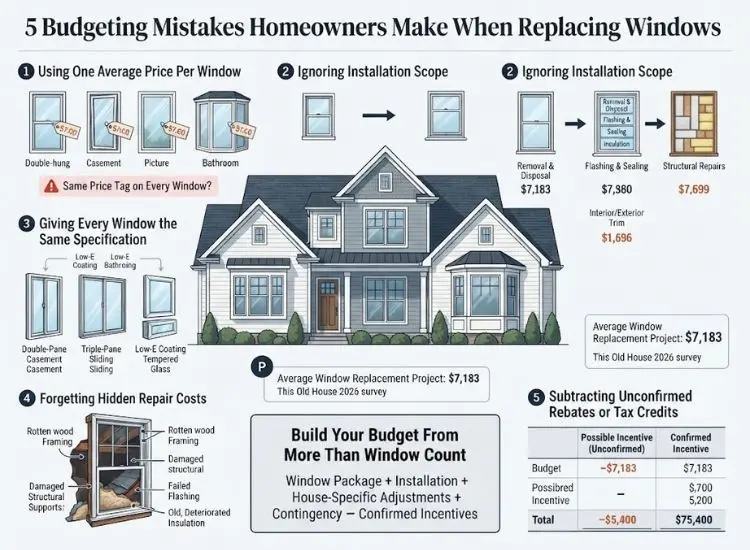
5 Budgeting Mistakes Homeowners Make When Replacing Windows
Homeowners who replace windows in 2026 typically budget by multiplying a per-window average by the number of openings. This method fails because window replacement cost depends on frame condition, installation method, glass specification, access, and code compliance rather than window count alone.
According to This Old House’s 2026 survey of 1,000 homeowners, the average window replacement project cost $7,183. However, replacing a standard double-hung window on the first floor is a much different job than installing large bay windows. Individual window prices in that same survey ranged from roughly $232 to $740 depending on brand, material, and complexity.
This guide breaks the five most common budgeting mistakes into direct answers, then shows a four-layer framework for building an accurate window replacement budget before requesting quotes.
Why Does Estimating With One Average Cost Per Window Fail?
A single average cost per window fails because it assumes every opening in a home requires the same product and labor. Most homes contain a mix of window styles, sizes, and glass requirements that price differently even within the same project.
Consider a 10-window project priced at a flat $700 estimate, producing a preliminary budget of $7,000. The actual opening list is rarely uniform. A typical mix looks like this:
- Four standard double-hung windows
- Two casement windows
- Two larger picture windows
- One bathroom window with privacy or safety glazing
- One wide living-room opening (sometimes a bay window) containing several window units
Bay windows change the math significantly. Industry cost guides for 2026 put bay window installation between roughly $1,000 and $6,000 per unit depending on frame material and whether the project reuses an existing opening or cuts a new one, and multiple sources note that bay windows run about three times the cost of a standard double-hung window. Folding a bay window opening into a flat “10-window” average erases that difference entirely.
What Variables Affect Price Beyond Window Count?
| Variable | Why It Changes the Price |
| Size | A 36-by-54-inch window and a six-foot picture window need very different amounts of frame and glass. |
| Operating style | Windows that open need hardware, locks, and weatherstripping; fixed windows do not. |
| Custom features | Special shapes, upgraded glass, exterior colors, and grids add cost per opening. |
| Unit count per opening | A fixed center pane with two operable side units may look like one window but prices as three. |
A more reliable estimating method starts with a list for every window opening: size, operating style, condition, and special requirements. National averages indicate whether a project will likely run a few thousand dollars or considerably more, but they cannot price a specific set of windows.
Why Do Homeowners Underestimate Installation Costs?
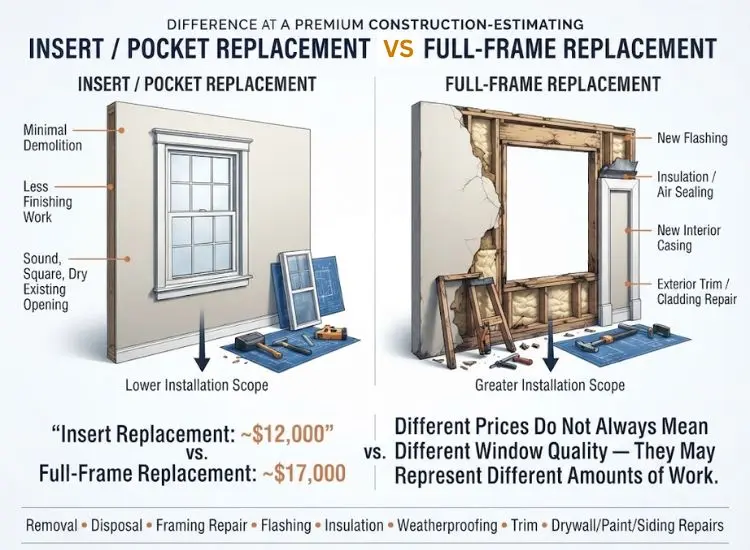
Homeowners underestimate installation costs because they compare the price of the window unit without accounting for how much surrounding work each installation method requires. Two contractors quoting the identical window can arrive at very different totals depending on whether they plan an insert replacement or a full-frame replacement.
What Is the Difference Between Insert and Full-Frame Replacement?
| Installation Type | What It Involves | When It Applies |
| Insert (pocket) replacement | The existing frame stays in place; the new unit fits inside it. Less demolition and finishing work. | Frame is structurally sound, square, dry, and properly integrated with the wall. |
| Full-frame replacement | The window is removed to the rough opening, allowing inspection and repair of surrounding structure, new insulation, and flashing. | Frame shows damage, rot, or the wall structure needs correction. |
A full-frame project typically adds several line items that an insert job does not require:
- Removal and disposal of the old frame
- Inspection of the sill and surrounding framing
- Replacement of deteriorated wood
- New flashing or water-management details
- Insulation and air sealing around the opening
- New interior casing or jamb extensions
- Exterior trim or capping
- Drywall, paint, siding, stucco, or masonry repairs where needed
This is why comparing two total quotes in isolation can mislead a homeowner. A $12,000 quote for insert replacement and a $17,000 quote for full-frame replacement may look like a $5,000 gap for the same job, but the contractors are pricing different amounts of work entirely.
Do All Windows in a Home Need the Same Specification?
No. Every opening in a home does not need the same window specification. A bathroom window, a large living-room bay window, and a bedroom casement typically require different glass, hardware, sizes, and performance features, even when ordered from the same manufacturer.
Which Specification Variables Change Window Pricing?
- Operating style: Casement, awning, double-hung, slider, and fixed windows use different hardware and frame designs.
- Glass package: Low-E coatings, additional panes, laminated glass, and privacy glass affect both performance and price.
- Safety glazing: Certain locations may require safety glazing depending on the size and position of the glass and its proximity to floors, doors, tubs, stairs, or walking surfaces.
- Energy performance: The optimal U-factor and solar heat gain coefficient depend on climate zone; ENERGY STAR applies different performance criteria by region rather than one national specification.
- Design options: Grids, custom colors, unusual shapes, oversized glass, and matching existing architecture add cost opening by opening.
Upgrading every window to the highest-tier glass is rarely the best use of a fixed budget. Colder climates benefit more from stopping heat loss; hotter climates benefit more from blocking solar heat gain. ENERGY STAR expresses this trade-off through U-factor and SHGC ratings rather than a single “best” glass package.
What Hidden Costs Appear After a Window Is Removed?
Hidden costs that appear after window removal include rotted wood, deteriorated trim, gaps in old insulation, failed flashing, and evidence of a prior incorrect installation. These issues are frequently invisible from inside the home because moisture damage accumulates behind the sill, framing, and sheathing over years.
What Warning Signs Predict Hidden Repair Costs?
- Staining below the sill
- Bubbling or peeling paint
- Soft or deteriorated exterior trim
- Recurring condensation or moisture around the frame
- Noticeable drafts around the perimeter
- Caulking that has repeatedly failed
- Signs of previous patching or water repairs
Home age changes the probability of these findings substantially. A house built in 2005 with vinyl frames, dry trim, and no water history carries a much lower repair risk than a house built in 1948 with painted wood frames and visible sill damage. Applying the same contingency percentage to both properties ignores that difference.
How Does Home Age Affect Lead-Safe Compliance Costs?
Homes built before 1978 can trigger federal lead-safe work requirements that online per-window estimates rarely include. The EPA’s Renovation, Repair and Painting Rule applies to paid renovation work that disturbs qualifying painted surfaces in many pre-1978 homes, and window replacement is specifically listed as a covered activity. Contractors performing covered work must follow lead-safe practices unless the affected components are verified lead-free or another exemption applies. Compliance can add containment, cleanup, paperwork, and additional labor beyond a standard swap.
The goal of a contingency line is not to inflate the budget against problems that may never occur. It is to avoid allocating every dollar to the window package before confirming what condition exists behind the current frames. Before signing a contract, homeowners should ask what happens to the price if rot, damaged framing, or bad flashing surfaces during removal, and how that additional work gets priced.
Can Homeowners Rely on Rebates or Tax Credits to Lower Their Budget?
Homeowners should not lower their working budget based on rebates, tax credits, or projected energy savings until those amounts are confirmed. This distinction matters more in 2026 because one of the most widely cited federal incentives has changed.
The federal Energy Efficient Home Improvement Credit under Section 25C does not apply to qualifying property placed in service after December 31, 2025, per the applicable federal tax provisions. Older articles that still promise a federal window credit can make a 2026 project appear cheaper than it actually is.
State, local, utility, and manufacturer programs may still exist, but eligibility depends on location, product choice, income, application timing, and whether pre-approval is required before work begins.
Get a detailed window replacement estimate based on your home’s actual windows, installation scope, and potential hidden costs.
How Should Homeowners Categorize Incentives When Budgeting?
| Category | Definition | Budget Treatment |
| Confirmed incentives | Verified programs where the project and homeowner meet current eligibility rules. | Subtract from the working budget. |
| Possible incentives | Rebates or utility programs still requiring approval or product verification. | Track separately; do not subtract yet. |
| Uncertain savings | Projected reductions in heating and cooling costs after installation. | Exclude from the budget entirely. |
How Should Homeowners Structure a Window Replacement Budget?
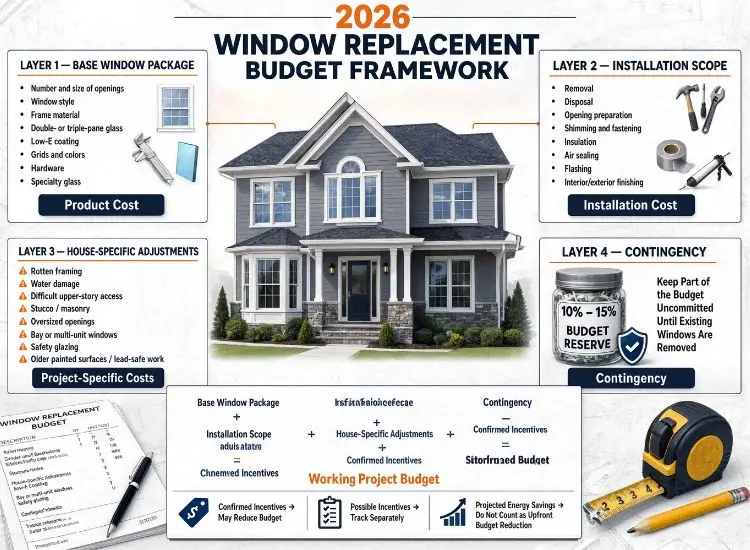
Homeowners should structure a window replacement budget in four layers rather than relying on a single average price: base window package, installation scope, house-specific adjustments, and contingency.
Layer 1: Base Window Package
This layer covers the product itself, before installation complexity enters the picture:
- Number and size of openings
- Window style
- Frame material
- Double- or triple-pane glass
- Low-E coating
- Grids, colors, and hardware
- Privacy, laminated, or other specialty glass
Layer 2: Installation Scope
This layer identifies what work has to happen around each opening. An insert replacement generally involves less demolition and finishing than a full-frame installation, which may require new insulation, flashing, interior casing, exterior trim, or repairs to surrounding finishes. Contractors should list these items explicitly in every quote — a lower product price is sometimes offset by more installation labor, and a higher-priced window may already include more finishing work.
Layer 3: House-Specific Adjustments
This is where generic online calculators fall short. Add allowances for conditions such as:
- Visible sill or frame deterioration
- Difficult second- or third-story access
- Stucco, masonry, or complex exterior trim
- Oversized or multi-unit openings, including bay windows
- Safety or specialty glazing requirements
- Older painted windows that may require lead-safe work
- Interior repairs after full-frame removal
Layer 4: Contingency
A portion of the budget should stay uncommitted until the old windows come out. The contingency amount should reflect the home’s age and condition rather than a fixed percentage pulled from an online calculator.
Once all four layers are estimated, only confirmed incentives are subtracted. The resulting formula is:
Base window package + installation scope + house-specific adjustments + contingency − confirmed incentives = working project budget
This method takes more upfront work than multiplying a window count by an online average, but it produces a realistic number for comparing quotes and deciding how much of the project to take on at once. Homeowners weighing several quotes side by side may also benefit from a guide to comparing window replacement quotes that breaks down line items the same way.
The Bottom Line
A window replacement budget only holds up when it’s built from actual opening details, not a single average price. Homeowners who separate the base window package from installation scope, house-specific adjustments, and contingency end up with a number they can actually defend against a contractor’s quote.
For homeowners who want a second set of eyes before committing to a number, a construction estimating company puts together detailed, line-item construction estimates that account for exactly these variables.
Frequently Asked Questions
How Much Does Window Replacement Cost in 2026?
Window replacement costs vary by size, style, frame material, glass, and installation method. A simple insert replacement usually costs considerably less than a full-frame job with trim, flashing, or structural repairs. Homeowners should generally budget $700 to $1,000 for a mid-size, standard replacement window, with bay windows and other large or multi-unit openings running higher.
Why Do Window Replacement Quotes Vary So Much?
Quotes vary because contractors include different amounts of work under the same headline price. One quote might cover only insert installation, while another includes full-frame removal, insulation, flashing, trim, disposal, and repairs. Comparing window details and installation scope line by line (rather than comparing totals) reveals which quote is the better value.
How Much Extra Should I Budget for Unexpected Costs?
The contingency reserve should match the home’s age and condition. Newer, dry windows carry less risk, while older wood frames, water stains, rot, or a history of past repairs justify a larger reserve. Ask contractors directly how they price hidden damage before work begins, so a surprise repair does not derail the project budget.
Is It Cheaper to Replace All Windows at Once?
Often, yes. Larger projects can reduce per-unit delivery, setup, and labor costs. Replacing every window at once is not mandatory, though. Homeowners on a tight budget can prioritize leaking, damaged, drafty, or broken windows first and ask whether the contractor offers volume pricing for larger jobs. A local window replacement estimate that itemizes bay windows and standard units separately makes this kind of phased planning easier to price out.


