

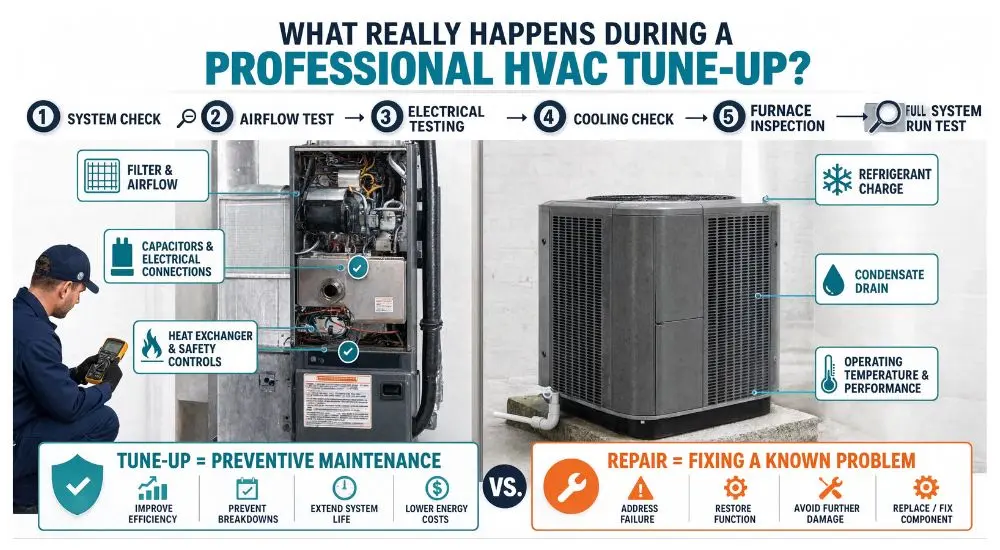
What Really Happens During a Professional HVAC Tune-Up?
Your furnace kicks on. Your air conditioner blows cold air right on command. Everything seems fine; so why pay someone to come look at it?
There’s a big problem associated with that logic. A failing capacitor, a refrigerant charge that’s 10% low, or a blower wheel caked in dust can all sit quietly inside a system that still “works.” The house stays comfortable for months. Then, on the coldest night in January or the hottest afternoon in July, the part finally gives out.
A professional tune-up exists to catch that gap between running and running correctly. It’s a structured inspection, not a five-minute glance at the thermostat, built around how the equipment actually performs under load. So what does a technician actually do during that visit, and what should it cost you? Let’s find out!
What Is an HVAC Tune-Up?
An HVAC tune-up is scheduled, preventive maintenance, not a repair call. The distinction matters. A repair responds to a known failure. A tune-up looks for problems before they announce themselves.
The scope changes with the equipment. A gas furnace, a central air conditioner, and a heat pump each carry different maintenance checklists, and a technician should adjust for the unit’s age, its manufacturer’s service bulletins, and anything the homeowner has already noticed.
This isn’t left to guesswork industry-wide. The Air Conditioning Contractors of America (ACCA) publishes ANSI/ACCA 4 QM, Maintenance of Residential HVAC Systems. It is a nationally recognized standard, most recently reaffirmed in 2024, that lists minimum inspection tasks by equipment type. A contractor following it is working from a checklist, not a hunch.
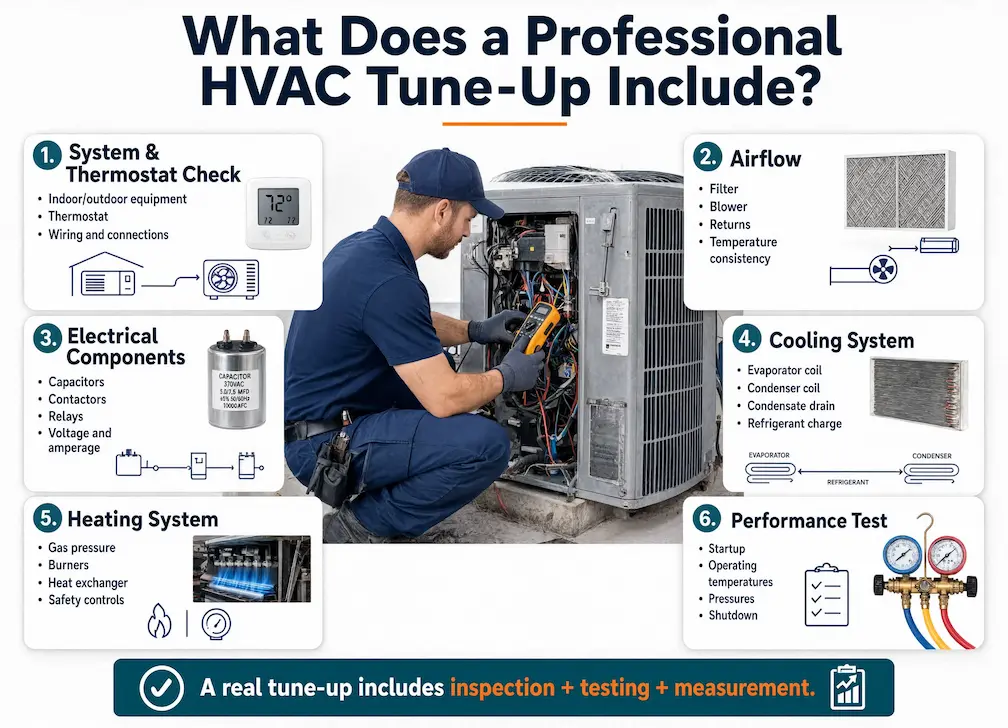
What Happens During a Professional HVAC Tune-Up?
The exact sequence varies by contractor, but a thorough visit moves through the same general stages every time.
The Visit Usually Starts With a System Check
Before a technician touches a single component, expect a few questions. Has the furnace been short-cycling? Is one bedroom always five degrees off from the rest of the house? Is there a new noise from the outdoor unit? Answers like these point the technician toward the part of the system that deserves the closest look.
From there, the visual pass covers the indoor and outdoor equipment, the thermostat, exposed wiring and connections, the filter, and the condensate components.
Airflow Gets Attention
Airflow problems hide well, because the system usually keeps running anyway. A clogged filter, a dirty blower wheel, or a blocked return can quietly choke the volume of air moving through the ducts.
The warning signs typically include:
- Uneven temperatures from room to room
- Longer run cycles to reach the thermostat setting
- A system that struggles on the hottest or coldest days of the year
- Utility bills that creep up with no obvious cause
A restricted filter is one of the most common culprits, and one of the most avoidable. The U.S. Department of Energy notes that a dirty filter can force a system to work meaningfully harder to move the same volume of air, and ENERGY STAR recommends checking filters monthly during heavy-use months, replacing them as soon as they look gray or matted.
Electrical Components Are Tested
HVAC equipment relies on a small set of electrical parts to start motors and hold operation steady: capacitors, contactors, relays, and the control board among them.
During a tune-up, a technician checks connections for corrosion or looseness and tests voltage and amperage draw against the equipment’s rated specifications. A weakening capacitor, for example, often measures below its rated microfarad value long before the compressor actually fails to start.
This is the least visible part of the visit and arguably the most valuable one. That’s because a degrading electrical component rarely produces a symptom you’d notice from inside the house.
Cooling Equipment Is Checked Before It Has to Work Hard
For central air conditioners and heat pumps running in cooling mode, the checklist typically covers the evaporator coil, the condenser coil, the blower assembly and airflow, the condensate drain, and refrigerant charge.
The outdoor condenser deserves particular attention. Leaves, cottonwood, grass clippings, and dirt build up around the fins and restrict the airflow the unit needs to reject heat. A condenser fighting blocked airflow works harder and cools less, even though it never technically shuts off.
The condensate drain is a small component with an outsized job. When it clogs, water backs up into the drain pan and, in older installations without a float switch, can overflow into a ceiling or mechanical closet.
A refrigerant charge that’s off by even 10% in either direction, too much or too little, can measurably cut a system’s efficiency. That’s why a competent technician checks superheat and subcooling values rather than simply glancing at a pressure gauge.
Furnace Components Are Inspected Too
Heating-season maintenance covers different ground: gas pressure and connections, burner condition and combustion quality, the heat exchanger, ignition components, and the limit and safety controls.
The heat exchanger inspection matters more than any other single item on a gas furnace checklist. A cracked heat exchanger can allow combustion byproducts, including carbon monoxide, to mix with the air moving through the home, and a furnace with this problem can still heat the house without producing an obvious symptom.
A technician who finds a concern should explain what it is and why it matters, rather than simply recommending a replacement and moving on.
The Equipment Is Run and Observed
None of the inspection above means much if the equipment is only examined while it’s switched off. A real tune-up includes running the system through a full cycle: watching the startup sequence, listening for new sounds, checking operating temperatures and pressures, and confirming the thermostat’s calls for heat or cooling are answered correctly.
ENERGY STAR’s own maintenance guidance calls for checking system controls and confirming the equipment starts, runs, and shuts down properly.
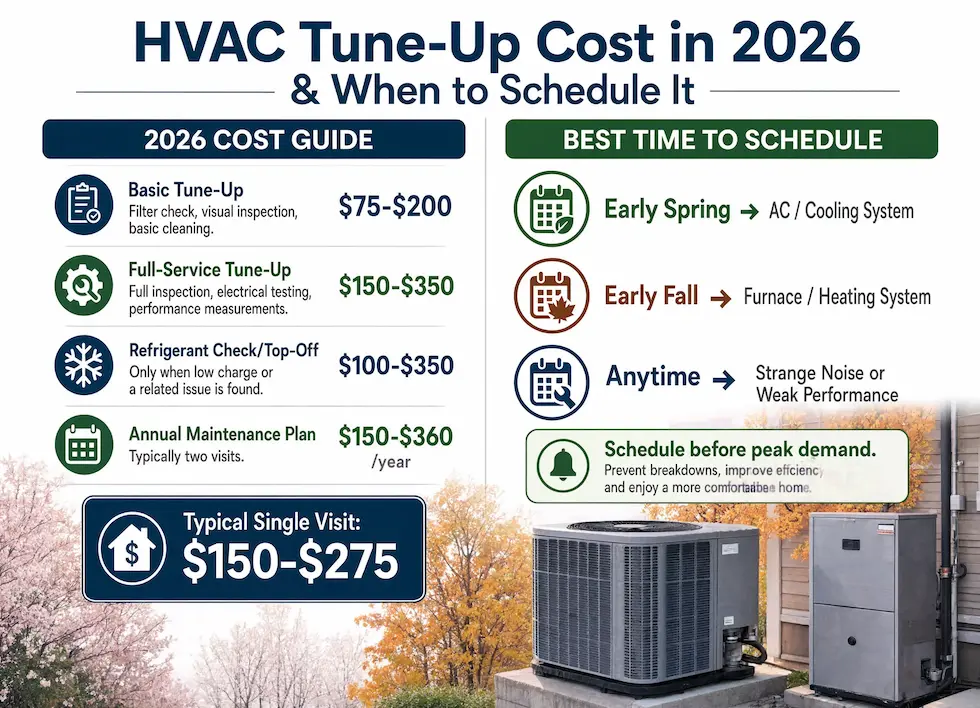
What a Professional HVAC Tune-Up Costs in 2026
Pricing varies by region, equipment type, and what’s included in the visit, but national cost data gives a useful benchmark for budgeting.
| Service | Typical Cost Range | What’s Usually Included |
| Basic tune-up (single system) | $75 – $200 | Filter check, visual inspection, basic cleaning |
| Full-service tune-up (AC + furnace) | $150 – $350 | Full inspection, electrical testing, performance measurements |
| Refrigerant check or top-off | $100 – $350 | Billed separately, only if a leak or low charge is found |
| Annual maintenance plan (2 visits) | $150 – $360 / year | Spring AC visit plus fall furnace visit, often at a discount |
Most homeowners land around $150 to $275 for a standard single-visit tune-up, based on national contractor pricing data. The exact figure depends on system size, equipment age, and whether the technician finds something that needs a follow-up repair quote.
For contractors and property managers scoping HVAC maintenance or replacement across multiple units, that per-visit figure stops being useful fast, since duct condition, equipment age, and unit count all move the number. That’s the kind of variable a trade-specific HVAC estimating service is built to account for, rather than a flat per-unit average.
Need to budget HVAC maintenance or replacement work? Get a detailed estimate based on your equipment, scope, and project requirements.
Can a Tune-Up Prevent an HVAC Repair?
It can help catch problems early, but no honest HVAC professional will promise that maintenance prevents every future repair.
Motors fail. Electrical components stop working. An aging heat exchanger eventually develops a problem that cleaning can’t fix. Normal wear doesn’t disappear just because a system receives annual maintenance.
What preventive maintenance actually does is give you a chance to catch a weak component, restricted airflow, an odd electrical reading, or a drainage issue while it’s still a $150 fix instead of a $1,500 one.
That’s particularly useful for homeowners looking for HVAC Services in Downers Grove when an inspection turns up something maintenance alone can no longer resolve.
When Should You Schedule an HVAC Tune-Up?
Timing matters, because HVAC equipment gets hit hardest right when outdoor temperatures reach their extremes.
| Equipment | Best Time to Schedule | Why It Matters |
| Air conditioner or heat pump (cooling) | Early spring | Beats peak cooling demand and contractor backlogs |
| Furnace or heat pump (heating) | Early fall | Beats the season’s first hard freeze and holiday scheduling crunch |
| Either system, if something’s already wrong | Immediately | A strange noise or weak performance shouldn’t wait for the “right” season |
ENERGY STAR recommends checking cooling equipment in spring and heating equipment in fall, giving a technician time to catch a problem before the system runs for hours every day. That said, if the furnace is rattling in January or the AC is struggling through a July heat wave, waiting for the ideal season isn’t a maintenance strategy. It’s a gamble.
DIY vs. Professional: What Homeowners Can (and Can’t) Check
Not every item on a maintenance checklist requires a technician. A few tasks are worth handling between professional visits.
Homeowners Can Typically Manage:
- Checking and replacing the air filter monthly, more often with pets or allergies
- Clearing leaves, mulch, and debris from around the outdoor condenser
- Confirming vents and returns aren’t blocked by furniture or rugs
- Testing the thermostat’s schedule and replacing its batteries
Better Left To A Licensed Technician:
- Measuring and adjusting refrigerant charge
- Electrical testing on capacitors, contactors, and control boards
- Combustion analysis and heat exchanger inspection
- Condensate drain clearing that requires disassembly
Handling the simple items yourself doesn’t replace a professional visit. It just keeps the HVAC system from degrading in between them.
How Tune-Up Findings Affect Renovation and Replacement Budgets
A tune-up occasionally turns into bigger news: a cracked heat exchanger, a compressor drawing more amps than it should, or a system old enough that another repair no longer makes financial sense. At that point, the conversation shifts from maintenance to replacement, and the cost math changes with it.
A full system replacement, a ductwork reconfiguration during a remodel, or new HVAC installation as part of a home addition all carry very different price tags than a tune-up, and generic per-ton averages rarely hold up once labor, duct modifications, and permitting are factored in. Contractors pricing that kind of work typically rely on trade-specific mechanical estimating rather than a rule-of-thumb figure, particularly when the HVAC scope is bundled into a larger residential estimating package for a renovation or addition.
For homeowners comparing contractor bids after a tune-up flags a needed replacement, the same principle holds on a smaller scale. A detailed, line-item cost estimate makes it far easier to tell a fair quote from a padded one.
What Should You Expect From a Good Tune-Up?
A worthwhile visit should leave you knowing more about your system’s condition than you did before the technician arrived.
At minimum, expect the technician to explain what was inspected, whether anything unusual turned up, and whether a repair or further evaluation makes sense. You should be able to ask why a specific repair is necessary. A vague “it needs to be replaced” isn’t an answer.
ACCA’s residential maintenance standard is a useful reference point here, since it frames a tune-up as a structured inspection with defined tasks rather than a quick cleaning service with an invoice attached.
A Tune-Up Is More Than a Quick Inspection
A professional HVAC tune-up isn’t someone glancing at the furnace and declaring it fine. Done right, it’s inspection, testing, and measurement, built around how the equipment actually performs rather than whether it simply turns on.
For most homeowners, the real payoff is information: a clear picture of the system’s condition, what deserves attention now, and what can reasonably wait a season.
That makes routine maintenance a practical, low-cost habit. And when a tune-up does turn up something bigger, from a failing furnace to a renovation-scale HVAC project, getting an accurate estimate before committing to a number is worth the extra day it takes.
Frequently Asked Questions
Is an HVAC tune-up the same as an HVAC repair?
No. A tune-up is preventive maintenance performed on a schedule, regardless of whether anything is obviously wrong. A repair addresses a known fault. A tune-up can uncover a repair that’s needed, but the two services solve different problems.
How long does an HVAC tune-up take?
Most single-system visits run 45 minutes to two hours. A straightforward system in good condition moves faster; older equipment, multiple zones, or anything requiring extra testing adds time.
Can a tune-up lower my energy bills?
It can, particularly when dirt, restricted airflow, or a developing mechanical issue is dragging down performance. It isn’t a guarantee, though. A tune-up restores a system to its designed efficiency; it doesn’t upgrade that efficiency.
Is annual HVAC maintenance really necessary?
ENERGY STAR recommends annual pre-season checkups for both heating and cooling equipment, and many manufacturer warranties require documented annual maintenance to stay valid. It is a detail that catches plenty of homeowners off guard during a warranty claim.
What’s the difference between a tune-up and a pre-purchase HVAC inspection?
A pre-purchase inspection is broader and more documentation-heavy, since it’s meant to inform a home purchase or a negotiation. A routine tune-up focuses on keeping an already-owned system running well.


