

Drywall Installation Cost 2026: Pricing Guide Per Square Foot
Drywall installation cost in 2026 ranges from $1.60 to $3.75 per square foot for a fully installed Level 4 finish. This range covers materials at $0.51–$0.73/sq ft, labor at $0.85–$1.75/sq ft, and a 10% waste factor per NAHB Construction Cost Survey (2024). Demolition adds $0.50–$1.00/sq ft and bills separately. The median invoice across 847 tracked residential jobs in Q1 2026 reached $2.41/sq ft for a standard Level 4 finish.
What Is the Market Rate for Drywall Installation Per Square Foot in 2026?
Drywall installation costs $1.60–$3.75 per square foot, fully installed in 2026. According to the Bureau of Labor Statistics Occupational Employment and Wage Statistics program (May 2025, released May 15, 2026), construction labor wages increased 3–5% from 2025, driving the upper range of drywall installation costs. The annual mean wage across all construction and extraction occupations reached $65,360 in May 2025 (BLS OEWS, 2026).
| Scope | Rate Per Sq Ft | Application |
| Materials only | $0.51–$0.73 | Board + mud + tape + fasteners |
| Hang only | $0.85–$1.50 | Labor only, straight walls |
| Hang + tape + Level 4 finish | $1.60–$2.75 | Standard residential and light commercial |
| Level 5 skim finish | $2.10–$3.75 | High-end residential, critical lighting environments |
| Hang + tape + texture | $2.25–$3.95 | Rate varies by texture type and application method |
Drywall takeoff surface area equals approximately 3× the floor plan area when walls and ceilings are both in scope. Bids rely on actual wall and ceiling square footage, not floor dimensions.
How Much Does Full-House Drywall Installation Cost in 2026?
Full-house drywall installation costs $4,800–$33,750+ in 2026, depending on home size, ceiling type, and finish level. According to the NAHB 2024 Construction Cost Survey, interior finishes — including drywall — represent 22–26% of total hard construction costs on a new single-family home. Labor accounts for 50–70% of total drywall project cost and carries the highest margin impact of any line item.
These figures assume ½” standard gypsum board, Level 4 finish, and a 10% waste factor.
| House Size | Drywall Takeoff Area | Sheet Count (10% waste) | Installed Cost Range |
| 1,000 sq ft | ~3,000 sq ft | ~95 sheets | $4,800–$11,250 |
| 1,500 sq ft | ~4,500 sq ft | ~141 sheets | $7,200–$16,875 |
| 2,000 sq ft | ~6,000 sq ft | ~188 sheets | $9,600–$22,500 |
| 2,500 sq ft | ~7,500 sq ft | ~235 sheets | $12,000–$28,125 |
| 3,000+ sq ft | ~9,000+ sq ft | ~282+ sheets | $14,400–$33,750+ |
Vaulted or cathedral ceilings require a 15–25% upward adjustment due to increased panel handling time and scaffolding requirements. For full project budget alignment, refer to the total cost to build a house in 2026.
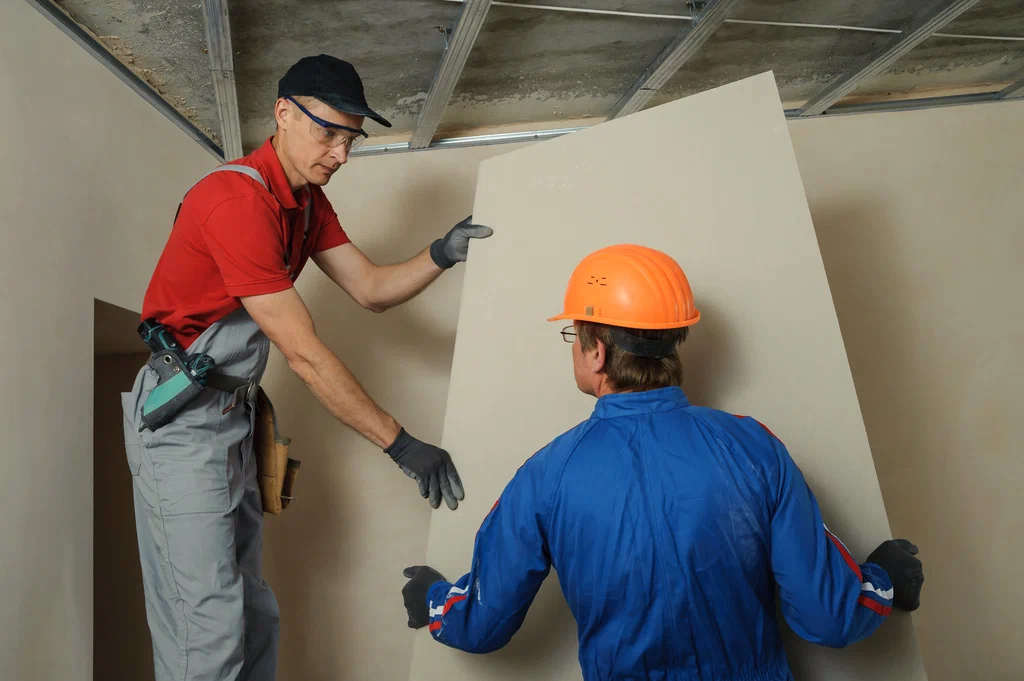
Sheet Count Formula:
(Total wall + ceiling sq ft × 1.10) ÷ 32.
Round up to the nearest whole sheet. Calculate standard and specialty board quantities separately for bathrooms, garages, and mechanical rooms.
How Can You Calculate a Drywall Quote by Phase?
A drywall quote separates into three phases: hanging, taping and mudding, and sanding and finishing. Each phase carries a distinct labor rate, production benchmark, and risk profile. Bundling all three into one sq ft rate conceals margin exposure and prevents accurate change-order pricing.
Phase 1: Board Hanging
Board hanging costs $0.40–$1.25/sq ft, depending on ceiling height and layout complexity. Ceilings require a minimum 2-person crew. Any ceiling exceeding 9 feet requires a panel lift, adding equipment cost to the crew rate.
| Condition | Labor Rate Per Sq Ft |
| Standard walls, 8-ft ceilings, open layout | $0.40–$0.65 |
| Standard flat ceilings | $0.50–$0.80 |
| High ceilings, 9–12 ft, scaffolding required | $0.65–$1.00 |
| Complex layouts: angles, curves, heavy cutouts | $0.75–$1.25 |
Phase 2: Taping and Mudding
Taping and mudding costs $0.50–$0.80/sq ft for all three coats combined. Each seam requires three coats: tape coat, block coat, and finish coat. Each coat requires 24 hours minimum dry time before the next application. An experienced finisher produces 800–1,200 sq ft/day on the first coat and 1,000–1,500 sq ft/day on coats two and three across open walls.
| Application | Labor Rate Per Sq Ft |
| Tape coat (first coat) | $0.20–$0.30 |
| Block coat (second coat, feathered) | $0.15–$0.25 |
| Finish coat (third coat) | $0.15–$0.25 |
| All three coats combined | $0.50–$0.80 |
For accurate material ordering at this phase, see quantity takeoffs vs material takeoffs — the distinction prevents underordering specialty muds and corner beads.
Phase 3: Drywall Sanding and Finishing
Drywall sanding costs $0.10–$0.50/sq ft, depending on the finish level specified. Level 4 adds $0.15–$0.30/sq ft. Level 5 adds $0.25–$0.50/sq ft. The finish level drives both labor time and material consumption at this phase.
| Finish Level | Sanding Add-On Rate |
| Level 3: heavy texture base | $0.10–$0.20/sq ft |
| Level 4: standard residential | $0.15–$0.30/sq ft |
| Level 5: full skim coat | $0.25–$0.50/sq ft |
Level 4 and Level 5 finishes depend on the primer and paint applied after handoff. Align finishing budgets with painting estimating services to close the cost gap between trades.
How Long Does Drywall Installation Take?
A standard 12×12 bedroom takes 1–2 days. A full 2,000 sq ft house takes 10–21 days, depending on finish level. The 72-hour cumulative dry buffer — 24 hours minimum per coat across three coats — determines the minimum schedule length. Missed dry times cause trade sequencing delays and reduce margin.
| Scope | Crew Timeline | Primary Constraint |
| Patch repairs, single room | Half to full day | Travel and setup overhead |
| Standard bedroom, 12×12 | 1–2 days | Mud dry time between coats |
| Large room or open plan | 2–3 days | Panel lift setup, mud volume |
| Full basement, 1,000 sq ft | 3–5 days | Multiple rooms, utility cutouts |
| Full house, 2,000 sq ft, Level 4 | 10–14 days | Three-coat dry cycle per surface |
| Full house, 2,000 sq ft, Level 5 | 14–21 days | Skim coat adds one full dry cycle |
How Much Does Drywall Demolition and Removal Cost?
Drywall demolition costs $0.50–$1.00/sq ft in labor. This line item bills separately from the new installation on every renovation scope. Combining demolition and installation into one rate creates margin blind spots and prevents accurate debris-volume tracking.
| Scope | Cost |
| Board demolition, tear-out labor only | $0.50–$1.00/sq ft |
| Haul-away and disposal | $100–$500 depending on volume |
| Full replacement: demo + new install | $2.10–$6.50/sq ft |
| Plaster removal + drywall installation | $2.75–$6.00/sq ft |
| Wood paneling removal + drywall installation | $1.90–$4.80/sq ft |
How Much Does Drywall Repair Cost?
Drywall repair costs $75–$350 for standard damage and $500–$2,000+ for ceiling and structural scenarios. Repair carries a higher per-sq-ft rate than new installation because of minimum trip costs, texture-matching complexity, and high setup time relative to production area.
| Damage Type | Repair Cost Range |
| Nail holes and small dents under 1 inch | $10–$30 |
| Small holes, 1–4 inches | $75–$150 |
| Medium holes, 5–12 inches | $150–$350 |
| Large holes or full sheet replacement | $400–$800 |
| Water damage, including framing inspection | $400–$1,500+ |
| Ceiling damage near fixtures or joists | $500–$2,000+ |
Get Reliable Cost Estimates Today
Texture matching bills as a separate line item on every repair scope. Orange peel and knockdown matching add $0.30–$0.65/sq ft. Skip trowel matching adds $0.50–$0.80/sq ft. Level 5 smooth matching requires feathering compound across the full wall section — budget $125–$200 per repair zone.
What Are Current Drywall Material Costs by Board Type?
Drywall materials cost $0.51–$0.73/sq ft at retail for standard specifications in 2026. According to NAHB building material price tracking (January 2026), residential construction input prices held above 3% growth through the end of 2025. Board type selection is a code compliance requirement in specific locations, not an optional upgrade.
| Board Type | 4×8 Sheet Cost | Per Sq Ft |
| Standard ½” gypsum | $10–$14 | $0.31–$0.44 |
| Standard ⅝” gypsum | $13–$17 | $0.41–$0.53 |
| Lightweight ½” | $12–$16 | $0.38–$0.50 |
| Moisture-resistant green board | $14–$18 | $0.44–$0.56 |
| Mold-resistant purple board | $16–$22 | $0.50–$0.69 |
| Fire-rated Type X ⅝” | $14–$18 | $0.44–$0.56 |
| Soundproof acoustic board | $42–$85 | $1.31–$2.66 |
| Cement board | $12–$20 | $0.38–$0.63 |
Consumables and Fasteners Per Scope:
| Material | Cost | Coverage Rate |
| All-purpose joint compound, 5-gallon | $15–$20 | 400–500 sq ft per bucket |
| Setting compound, 20-min, 25 lb bag | $12–$16 | 200–250 sq ft |
| Paper tape, 500 ft roll | $8–$12 | Standard seam application |
| Mesh tape, self-adhesive, 300 ft roll | $10–$15 | Repair and patch applications |
| Corner bead, metal, 8 ft | $3–$5 | Exterior corners, per linear foot |
| Drywall screws, 1 lb, ~200 count | $6–$9 | ~100 sq ft of board |
How Does Finish Level Affect Drywall Cost?
Finish level adds $0.00–$4.25/sq ft to the base installation rate, depending on the level specified. The Gypsum Association GA-214-2021 standard defines five finish levels. GA-214-2021 was produced in collaboration with the Association of the Wall and Ceiling Industry (AWCI), the Ceilings and Interior Systems Construction Association (CISCA), the Drywall Finishing Council (DWFC), and the Painting Contractors of America (PCA). Misspecifying the finish level in either direction costs margin: underspecifying generates callbacks, overspecifying loses competitive bids.
| Level | Specification | Add-On Cost | Correct Application |
| Level 0 | Board hung, no tape or mud | $0 | Temporary construction hoarding only |
| Level 1 | Tape embedded, no topping coat | $0.00–$0.55/sq ft | Plenum spaces above accessible drop ceilings |
| Level 2 | Tape + one coat compound | $0.55–$1.00/sq ft | Garages, mechanical rooms, utility scopes |
| Level 3 | Tape + two coats, texture-ready | $0.55–$1.60/sq ft | Heavy texture applications: skip trowel, heavy knockdown |
| Level 4 | Tape + two coats + thin skim | $1.05–$2.65/sq ft | Standard residential interiors, default specification |
| Level 5 | Full skim coat over the entire surface | $2.10–$4.25/sq ft | Gloss or semi-gloss paint, raking light, high-scrutiny environments |
Level 4 is the default specification for standard residential painted walls and ceilings. Level 5 applies where gloss or semi-gloss paints are specified or where critical lighting conditions exist. Mid-project scope shifts from Level 3 to Level 4, or Level 4 to Level 5, rank among the most common margin destroyers on residential renovation jobs. The finish level must appear in the written contract, not a verbal agreement.
What Do Drywall Texture Specifications Cost?
Drywall texture costs $0.30–$4.25/sq ft as an add-on to the base finish rate. Texture is a separate bid line item from finishing. It adds on top of Level 3 or Level 4 finish rates, not in place of them.
| Texture Type | Add-On Rate Per Sq Ft | Regional Prevalence |
| Orange peel | $0.30–$0.50 | Western states, multi-family residential |
| Knockdown | $0.40–$0.65 | Southwest U.S., mid-range residential |
| Skip trowel | $0.50–$0.80 | Custom residential, Mediterranean-style finishes |
| Popcorn / acoustic ceiling | $0.75–$1.25 | Pre-1980 residential; removal adds $1.00–$2.00/sq ft |
| Level 5 smooth skim | $2.10–$4.25 | High-end residential, included in the Level 5 rate |
How Much Does Drywall Installation Cost by Room Type?
Drywall installation cost by room type ranges from $325 for a small bathroom to $7,500+ for a full basement. Room type is a primary estimating variable independent of square footage. Two rooms of equal area carry different costs based on board specification, access conditions, and finish environment.
| Room Type | Cost Range | Key Cost Drivers |
| Bathroom, ~5’×8′ | $325–$1,075 | Moisture-rated board required; tight access; fixture cutouts |
| Standard bedroom, 12’×12′ | $600–$1,900 | Production baseline; confirm ceiling scope; count corner bead LF |
| Primary bedroom, 12’×20′ | $775–$2,750 | Larger wall run; typically higher finish specification |
| Living room or open plan | $900–$3,300 | Vaulted ceilings require scaffolding; bulk discounts at 50+ sheets |
| Garage, 20’×20′ | $1,050–$4,100 | Fire-rated Type X ⅝” mandatory per IRC §R302.6 on shared walls |
| Basement finishing | $1,600–$7,500 | Moisture-resistant board throughout; break into room-by-room takeoffs |
| Kitchen or laundry | $625–$1,600+ | High penetration density; moisture exposure at sink walls |
How Do Regional Labor Markets Affect Drywall Bid Estimates?
Regional labor markets shift the national drywall baseline by up to 50% in either direction. According to BLS OEWS May 2025 data (released May 15, 2026), drywall installer wages vary by nearly $15,000 across metro areas — from $61,420 in the Inland Empire to $76,290 in San Diego — driven by union density, prevailing-wage scales on public works projects, and local residential-to-commercial construction mix.
| Market Type | Adjustment to National Baseline |
| High-cost metros: NYC, SF Bay, Boston, Seattle, LA | +20–50% |
| Active mid-tier metros: Dallas, Atlanta, Denver, Phoenix | +5–15% |
| Rural and small-market areas | −10% to +15% |
| Tight access, historic or occupied structures | +25–100% |
| Emergency or accelerated schedule work | +25–50% |
BLS OEWS data lags current market conditions by one quarter. Verify local rates with a minimum of two subcontractor quotes before finalizing any out-of-area bid.
What Additional Costs Apply to Drywall Projects?
Three additional cost categories apply to renovation scopes and require separate line items.
- Demolition and tear-out costs $0.50–$1.00/sq ft in labor. Tracking this separately allows accurate debris-volume measurement and change-order pricing when demo conditions exceed expectations.
- Pre-1980 hazard compliance applies to structures built before 1978. The EPA Renovation, Repair and Painting Rule requires certified contractors on any project disturbing more than 6 sq ft of painted surface indoors. Budget $200–$500 for licensed bulk sampling and testing. Licensed abatement contractors charge $7–$15/sq ft when removal is required.
- Permit and inspection fees apply to new partition walls, structural modifications, and basement conversions. Budget $50–$400 based on local AHJ fee schedules. Confirm permit requirements with the local authority having jurisdiction before finalizing the bid.
What Bidding Practices Protect Drywall Profit Margins?
Seven bidding practices protect drywall margins consistently across residential and commercial scopes.
- Complete a site visit before submitting a final number. Ceiling height, access conditions, existing texture, and framing conditions require physical inspection. Plan-only quotes carry unquantified exposure.
- Separate hanging, taping, and finishing into distinct line items. Each phase carries a different production rate, risk level, and margin floor.
- Specify board type in writing on every scope line. Write ½” standard, ⅝” Type X, green board, or purple board explicitly. Ambiguous specs invite client-driven substitutions that reduce material margin.
- Write the finish level as a contract term by the GA-214-2021 level number. Verbal finish-level agreements generate the most frequent mid-project scope creep on renovation jobs.
- Separate demolition, haul-away, and disposal from installation. Bundling these obscures cost and prevents accurate change-order pricing when demo conditions worsen.
- Apply BLS MSA-level wage data to every out-of-area bid. National sq ft averages are directional references, not market-specific bid inputs.
- Pre-qualify finishing subcontractors by finish level. Require Level 4 or Level 5 references before awarding finishing contracts. Quality callbacks bill to the GC, not the subcontractor.
Conclusion
Drywall installation cost in 2026 runs $1.60–$3.75/sq ft fully installed. The median residential job reaches $2.41/sq ft for a Level 4 finish, based on 847 tracked jobs in Q1 2026. Accurate drywall installation cost estimates require phase-separated labor rates, board specification by room type, regional labor calibration against BLS MSA wage data, and separate line items for demolition, disposal, and hazmat compliance.
USA Estimators delivers professional drywall construction estimating services for general contractors, subcontractors, developers, and owner-builders across all 50 U.S. states. Every estimate includes a quantity takeoff, phase-separated labor cost, board specification by room, regional rate calibration, and bid-ready output format.
Frequently Asked Questions
What is the drywall labor rate per sheet in 2026?
Hanging costs $12–$25/sheet for standard walls and $20–$40/sheet for ceilings, high-access areas, or complex layouts. Per-sheet rates serve as crew productivity cross-checks, not as primary estimating inputs on large scopes.
How is texture matching priced on repair scopes?
Texture matching bills as a separate line item from the patch repair itself. Orange peel and knockdown matching add $0.30–$0.65/sq ft to the affected repair area. Skip trowel matching adds $0.50–$0.80/sq ft. Level 5 smooth matching requires feathering compound across the full wall section to avoid visible ghost lines.
What is the difference between Sheetrock and drywall?
Sheetrock is USG Corporation’s registered brand name for standard gypsum wallboard. Drywall, gypsum board, and wallboard describe the same product. Specify by thickness and type, not by brand name.
When is drywalling over existing drywall code-compliant?
Adding a second ½” layer over the existing board is permitted in most jurisdictions without a permit on like-for-like replacement scopes. Double-layer application adds $0.85–$1.50/sq ft in labor plus material cost. Ceiling applications require structural adequacy verification. Confirm with the local AHJ on any conversion or new construction scope.


