

Outsource Construction Estimating Services vs. In-House: Costs, ROI, and 2026 Market Realities
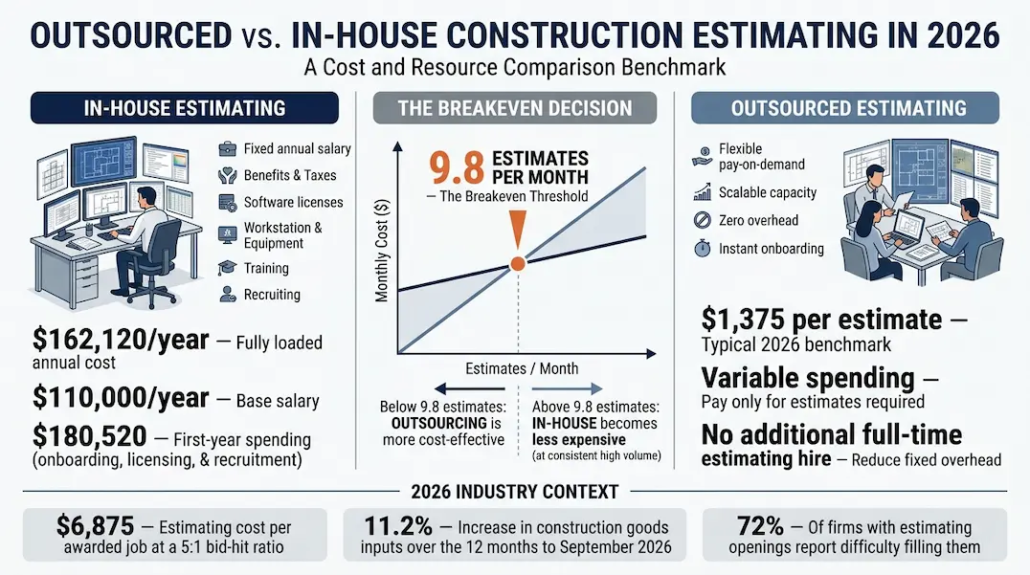
A full-time construction estimator costs a US contractor $162,120 a year once you count benefits, software, and recruiting. Outsourced construction estimating services charge a typical $1,375 per estimate.
That gap puts the break-even at 9.8 estimates a month. Below that volume, outsourcing costs less. Above it, an in-house hire can win, but only if one person can carry the load.
The 2026 market moves that math in three ways. Goods inputs to construction rose 11.2% in 12 months, so stale unit costs now erase margin fast. 72% of firms with estimating openings report difficulty filling them. Construction compensation also rose 3.5% in a year, which lifts the in-house break-even every raise cycle.
Key figures
- $162,120: annual loaded cost of one in-house estimator on a $110,000 salary.
- $1,375: typical outsourced fee per estimate in 2026.
- 8 estimates/month: break-even volume between the two models.
- $6,875: outsourced estimating cost per awarded job at a 5:1 bid-hit ratio.
- 2%: 12-month rise in the BLS producer price index for goods inputs to construction.
- 72%: share of firms with estimating openings that report difficulty filling them.
- 9 years: median construction-worker tenure with one employer (BLS, January 2026).
Key terms
- Quantity takeoff: the measured count, length, area, and volume of every item on the drawings.
- Loaded cost: salary plus every employer cost tied to the hire, such as payroll taxes, insurance, software, and recruiting.
- Bid-hit ratio: bids submitted per job won. A 5:1 ratio means one award for every five bids.
- Break-even volume: the annual estimate count where in-house cost equals outsourced spend.
- CSI MasterFormat: the Construction Specifications Institute system that numbers specification divisions, such as Division 03 Concrete.
How Much Does an In-House Construction Estimator Cost in 2026?
One in-house construction estimator costs $162,120 a year fully loaded. The $110,000 base salary covers only 67.9% of that total.
Experienced commercial estimators command $110,000 in base pay in 2026 hiring markets. Benefits then stack on top. BLS Employer Costs for Employee Compensation data for June 2026 set the burden. For full-time management, business, and financial workers, non-salary costs equal 29.8% of pay. Software, equipment, training, and recruiting add the rest.
| Cost component | Annual cost | Share of total | Per estimate at 10 estimates/month |
| Base salary | $110,000 | 67.9% | $917 |
| Payroll taxes, unemployment insurance, workers’ comp | $8,940 | 5.5% | $74 |
| Health and other insurance | $10,700 | 6.6% | $89 |
| Retirement contributions | $5,230 | 3.2% | $44 |
| Bonuses and supplemental pay | $7,900 | 4.9% | $66 |
| Takeoff and estimating software, one seat | $5,500 | 3.4% | $46 |
| Equipment and workspace | $3,250 | 2.0% | $27 |
| Training and continuing education | $4,250 | 2.6% | $35 |
| Recruiting fee, spread over tenure | $6,350 | 3.9% | $53 |
| Total loaded cost | $162,120 | 100% | $1,351 |
The recruiting line assumes a placement fee of 22.5% of salary, or $24,750. BLS puts median construction-worker tenure at 3.9 years in January 2026. Spread over that tenure, the fee costs $6,350 a year. A shorter stay raises that annual charge.
Cash flow hits harder in year one. The full fee lands up front, so first-year spend reaches $180,520. The seat also sits empty before it pays. A search takes 4 months, and a new estimator needs 4.5 months to reach full speed. Firms still planning on hiring a construction estimator should budget for both delays.
The loaded figure still excludes three real costs. It leaves out bids lost during vacancy, owner time spent on takeoffs, and management review hours.
How Much Do Outsourced Construction Estimating Services Cost?
Outsourced construction estimating costs a typical $1,375 per estimate on a flat fee. Fees track drawing count, CSI divisions, and document quality, not contract value.
Published 2026 fee schedules from US estimating providers set that benchmark. Flat per-project pricing dominates because bidders can compare it easily. Four other models compete with it.
| Pricing model | 2026 price | Best fit |
| Flat fee per estimate | $1,375 typical | Uneven or seasonal bid volume |
| Hourly freelance estimator | $35 per hour | Small scope changes and addenda |
| Monthly retainer | From $1,500 per month | A set bid count every month |
| Dedicated outsourced estimator | 54,040 a year) | Steady volume that needs one assigned estimator |
| Takeoff and estimating software only | $5,500 per seat per year, plus your labor | Firms with spare in-house hours |
A dedicated outsourced estimator costs one-third of the in-house loaded cost. The provider carries payroll taxes, benefits, recruiting, and replacement risk.
What the fee usually includes:
- Quantity takeoff organized by CSI MasterFormat division, with sheet references.
- Material and labor pricing at current regional rates.
- Written assumptions, allowances, inclusions, and exclusions.
- Excel and PDF deliverables that drop into your bid template.
What the contractor keeps: markup, risk position, subcontractor selection, bid-day strategy, and the signed bid.
Contractors comparing outsourced construction estimating services should confirm scope before price. Two quotes at the same fee can cover different divisions.
What Does Outsourced Estimating Cost by Project Size?
A single-trade takeoff on 2,400 sq ft costs $425. A full 50,000 sq ft commercial estimate costs $1,850, or less per square foot.
| Project and scope | Example size | Area | Flat fee | Fee per sq ft | Turnaround |
| Single-trade takeoff, tenant fit-out | 40 ft × 60 ft | 2,400 sq ft | $425 | $0.18 | 24 hours |
| Single-family home, all trades | 30 ft × 40 ft, two stories | 2,400 sq ft | $1,050 | $0.44 | 48 hours |
| Multi-trade package, three divisions, retail shell | 100 ft × 100 ft | 10,000 sq ft | $1,300 | $0.13 | 48 hours |
| Conceptual budget, medical office | 100 ft × 150 ft | 15,000 sq ft | $1,000 | $0.07 | 36 hours |
| Single-trade estimate, large office | 125 ft × 200 ft | 25,000 sq ft | $850 | $0.03 | 36 hours |
| Full multi-division commercial | 200 ft × 250 ft | 50,000 sq ft | $1,850 | $0.04 | 60 hours |
Effort grows with sheets and divisions, not floor area. A dense medical fit-out can carry more sheets than a large warehouse. That explains why the home costs more per square foot than the office. Each added CSI division adds measurement, pricing, and review time.
At What Bid Volume Does Hiring an Estimator Beat Outsourcing?
Hiring beats outsourcing above 9.8 estimates a month at a $1,375 average fee. A GC pricing full commercial estimates crosses that line at 7.3 a month.
Break-even volume converts an annual salary cost into an estimate count. The formula divides loaded cost by the outsourced fee.
N₍BE₎ = C₍loaded₎ ÷ F₍out₎ = $162,120 ÷ $1,375 = 117.9 ≈ 118 estimates per year
Worked conversion:
- Loaded in-house cost: $162,120 per year.
- Divide by the $1,375 fee: 117.9 estimates per year.
- Divide by 12 months: 9.8 estimates per month.
- Unit check: $162,120 ÷ 2,080 paid hours = $77.94 per loaded hour. An hourly freelance estimator bills $35 per hour.
| Monthly volume | Outsourced annual spend | In-house cost per estimate | Lower-cost option |
| 4 estimates | $66,000 | $3,378 | Outsource, saves $96,120 |
| 6 estimates | $99,000 | $2,252 | Outsource, saves $63,120 |
| 8 estimates | $132,000 | $1,689 | Outsource, saves $30,120 |
| 10 estimates | $165,000 | $1,351 | In-house, saves $2,880 |
| 12 estimates | $198,000 | $1,126 | In-house, saves $35,880 |
| 15 estimates | $247,500 | $901 | In-house, if one estimator can carry 15 |
Scope changes the line. Lower fees push the break-even higher, so specialty subs need far more volume before a hire pays.
| Bidder and typical scope | Fee per estimate | Break-even per month |
| Specialty sub, small single-trade takeoff | $425 | 31.8 estimates |
| Specialty sub, large single-trade estimate | $850 | 15.9 estimates |
| Residential builder, full home | $1,050 | 12.9 estimates |
| Trade contractor, multi-trade package | $1,300 | 10.4 estimates |
| GC, full multi-division commercial | $1,850 | 7.3 estimates |
Each break-even assumes one estimator can produce that volume across every division. Few generalists price concrete, Division 23 HVAC, and Division 26 Electrical at equal depth.
What ROI Does Outsourced Estimating Deliver per Awarded Job?
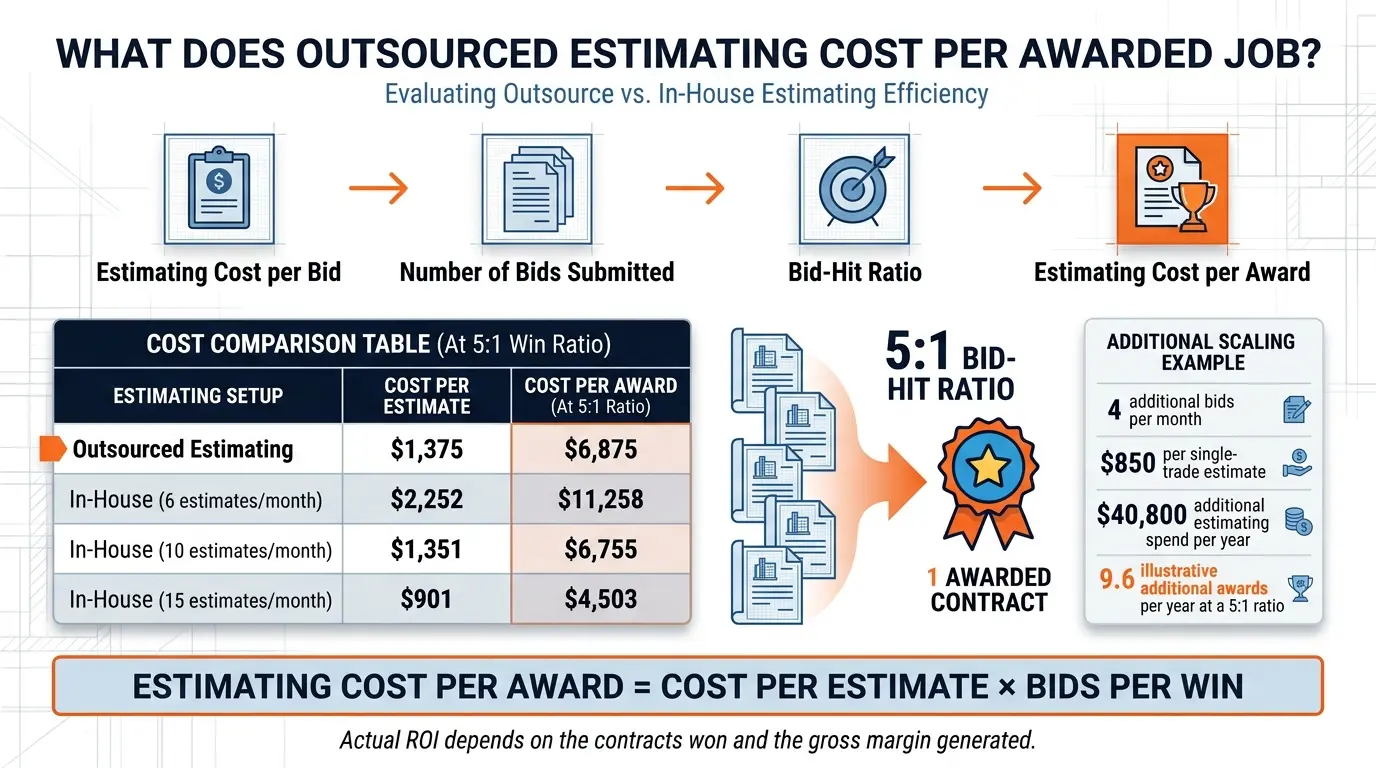
At a 5:1 bid-hit ratio, outsourced estimating costs $6,875 per awarded job. An in-house estimator producing 6 estimates a month costs $11,258 per award.
Cost per award equals cost per estimate times bids per win. Commercial GCs average a 5:1 bid-hit ratio.
| Estimating setup | Cost per estimate | Cost per award at 5:1 |
| Outsourced, any volume | $1,375 | $6,875 |
| In-house, 6 estimates/month | $2,252 | $11,258 |
| In-house, 10 estimates/month | $1,351 | $6,755 |
| In-house, 15 estimates/month | $901 | $4,503 |
Idle months raise in-house cost per award, because salary runs while bids pause. Outsourced cost per award stays flat, since spend stops when bidding stops. Capacity also adds awards. Four extra bids a month at 5:1 yield 9.6 more awards a year.
Need bid-ready numbers without adding payroll?
USA Estimators has priced construction projects since 1999 and serves contractors in all 50 states.
Upload your plans to get a construction cost estimate from USA Estimators within 10 to 48 hours!
How Do 2026 Market Conditions Change the Outsourcing Math?
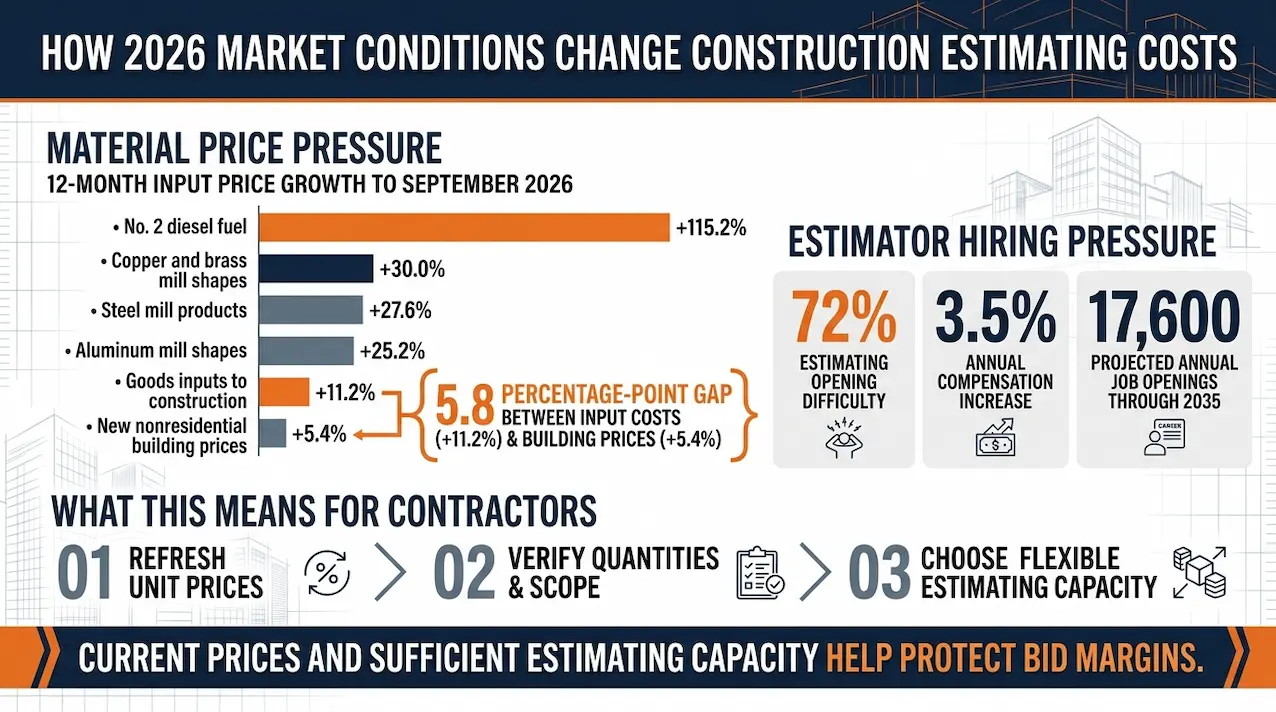
Goods inputs to construction rose 11.2% in 12 months, while bid prices rose 5.4%. That 5.8-point gap punishes any estimate built on stale unit costs.
The Producer Price Index (PPI) tracks prices that domestic producers receive for their output. The Employment Cost Index (ECI) tracks employer compensation costs over time. Both now push against contractors from opposite sides.
| Indicator | Latest value | Period | Source |
| PPI, net inputs to construction industries, goods | 365.374 (June 1986 = 100) | September 2026 | FRED, series WPUIP2300001 |
| Change in goods inputs | +11.2% | 12 months to September 2026 | BLS PPI tables compiled by AGC |
| PPI, new nonresidential building construction (bid prices) | +5.4% | 12 months to September 2026 | BLS |
| Steel mill products | +27.6% | 12 months to September 2026 | BLS |
| Copper and brass mill shapes | +30.0% | 12 months to September 2026 | BLS |
| Aluminum mill shapes | +25.2% | 12 months to September 2026 | BLS |
| No. 2 diesel fuel | +115.2% | 12 months to September 2026 | BLS |
| ECI, construction total compensation | +3.5% | 12 months to June 2026 | BLS |
| Construction spending | $2,203.1 billion annual rate | August 2026 | Census Bureau |
● Price Risk
Every $100,000 of goods priced at September 2025 levels now costs $111,200. Bid prices rose only 5.4%, so stale pricing comes straight out of margin. Copper and steel moved fastest, which hit Division 05 Metals and Division 26 Electrical first. Estimators who refresh supplier quotes each bid close that gap. An estimator buried in three overlapping bids rarely does.
● Talent Risk
The AGC and NCCER 2026 Workforce Survey polled 1,830 respondents. 72% of firms with estimating openings reported difficulty filling them. 53% raised salaried base pay by more than the prior year. 67% expect AI to change estimating and bidding most.
● Supply Risk
BLS counts 226,400 cost estimator jobs in 2025. It projects a 3% decline by 2035, yet 17,600 openings a year from retirements and exits. ABC estimates the industry needs 349,000 net new workers in 2026. Spending held at $2,203.1 billion in August, 0.9% above July. Steady work plus shrinking talent pools lengthens every estimator search.
How Does Location Change the In-House vs. Outsourced Decision?
Location moves in-house loaded cost from $133,340 in Tennessee and Alabama to $189,470 on the Pacific coast. Flat outsourced fees track sheets and divisions, not the bidder’s region.
A location factor equals regional employer compensation per hour divided by the US average of $46.89. The BLS ECEC regional table supplies June 2026 values. The factor scales salary, benefits, and recruiting. Software, equipment, and training stay fixed at $13,000.
| Census division | Example states | Location factor | In-house loaded cost | Break-even per month at $1,375 |
| Pacific | CA, WA, OR | 1.18 | $189,470 | 11.5 estimates |
| Middle Atlantic | NY, NJ, PA | 1.17 | $187,940 | 11.4 estimates |
| New England | MA, CT, NH | 1.15 | $184,990 | 11.2 estimates |
| US benchmark | All states | 1.00 | $162,120 | 9.8 estimates |
| Mountain | AZ, CO, UT | 0.96 | $156,010 | 9.5 estimates |
| West North Central | MO, MN, IA | 0.95 | $155,090 | 9.4 estimates |
| East North Central | OH, IL, MI | 0.93 | $152,040 | 9.2 estimates |
| South Atlantic | FL, GA, NC, VA | 0.93 | $151,340 | 9.2 estimates |
| West South Central | TX, OK, LA | 0.87 | $142,880 | 8.7 estimates |
| East South Central | TN, AL, KY | 0.81 | $133,340 | 8.1 estimates |
High-cost regions favor outsourcing longest. A California GC needs 11.5 estimates a month before a hire pays. A Tennessee GC needs 8.1.
What Does It Cost to Replace an Estimator Who Leaves?
Replacing an estimator costs $79,750 for a firm bidding 10 estimates a month. That equals a $24,750 new-hire fee plus $55,000 to cover 4 vacant months.
| Lifecycle item | Cost |
| Recruiting fee for the replacement hire | $24,750 |
| Outsourced cover for 4 vacant months at 10 estimates/month | $55,000 |
| Replacement total | $79,750 |
| Seat cost over a 3.9-year median tenure | $632,270 |
| Seat cost per year of tenure | $162,120 |
| Added cost each year at 3.5% compensation growth | $5,000 |
A bad hire adds $50,000 in wasted onboarding, lost bids, and a restarted search. Ramp-up adds 4.5 more months of partial output.
Signs your estimating setup needs outside capacity:
- You decline bid invitations because nobody has time to price them.
- The owner or a project manager does takeoffs at night.
- Missed addenda show up in post-bid reviews.
- One estimator holds all pricing history and supplier contacts.
Which Estimating Model Fits: In-House, Outsourced, or Hybrid?
At 8 estimates a month, per-project outsourcing costs $132,000 a year against $162,120 in-house. A hybrid that outsources 4 overflow estimates a month saves $96,120 against a second hire.
| Model | Annual cost at 8 estimates/month | Cost type | Main risk |
| In-house estimator | $162,120 | Fixed | Vacancy and key-person loss |
| Per-project outsourcing | $132,000 | Variable | Quality varies by provider |
| Dedicated outsourced estimator | $54,040 | Fixed monthly | Vendor dependency |
| Hourly freelance | $35 per hour | Variable | Hours hard to forecast |
| Software only | $5,500 plus your labor | Fixed | Adds no capacity |
| Hybrid: in-house core plus overflow | $162,120 plus $1,375 per overflow estimate | Mixed | Needs clear handoff rules |
The hybrid keeps an in-house estimator on repeat work and client relationships. Outsourced estimators absorb bid surges and specialty divisions such as Division 23 HVAC. Four overflow estimates a month cost $66,000 a year. A second in-house estimator costs $162,120.
How Can Contractors Cut Estimating Costs Without Losing Accuracy?
Ordering a single-trade takeoff instead of a multi-trade package saves $875 per bid. Complete, dimensioned drawing sets save $650 on a full commercial estimate.
| Tactic | Saving | Cause |
| Order quantities only, then price in-house | $875 per bid | Your unit costs replace the provider’s pricing pass |
| Send complete drawing sets | $650 per full estimate | Incomplete sets price at $2,500 instead of $1,850 |
| Outsource overflow instead of hiring | $96,120 a year | You pay only for bids you send |
| Use standard turnaround | Avoids the rush premium | Compressed deadlines carry a surcharge |
| Screen bids with a go/no-go rule | Fewer wasted estimates | Low-odds bids never reach takeoff |
Firms with strong unit-cost history can order quantity takeoff services and keep pricing decisions in-house. That split protects margin knowledge while removing the slowest task.
How Should You Vet and Level Outsourced Estimating Proposals?
Level every estimating proposal on the same 10 checks before you compare fees. Incomplete drawings alone can add $650 to a full commercial estimate.
Bid leveling lines up competing proposals on identical scope before anyone compares price. It matters because two contractors can quote the same job differently from one plan set. Estimating providers vary the same way.
Bid-leveling checklist:
- CSI divisions the fee covers.
- Quantities traced to sheet numbers on marked-up plans.
- Labor priced separately from material.
- Pricing date and data source stated.
- Written assumptions, allowances, inclusions, and exclusions.
- Addenda and revision terms in writing.
- Turnaround commitment in hours.
- Second-estimator review before delivery.
- Signed NDA and stated file storage.
- Flat fee quoted before work starts.
Vetting questions:
- Who reviews my estimate and do they hold an ASPE Certified Professional Estimator credential?
- Which AACE International estimate class does this deliverable target?
- Can you share a sample in my trade?
- Do you deliver in my cost codes?
Red flags:
- A fee quoted as a percentage of construction value. Effort tracks sheets and divisions, not contract size.
- No sample estimate or marked-up plans.
- No named reviewer or second check.
- No NDA, or no stated pricing date.
| Cost adder | Effect on fee |
| Incomplete or poorly organized drawings | +$650 on a full commercial estimate |
| Moving from a multi-trade package to full commercial scope | +$550 |
| Conceptual budget before the bid estimate | +$1,000 |
| Rush turnaround | Premium quoted per job |
| Late addenda re-pricing | Set by the provider’s revision terms |
Confirm whether the fee covers a site walk or relies on drawings and photos. Unknown site conditions belong in written allowances.
How Do You Onboard an Outsourced Estimating Partner?
Onboarding takes five steps and one pilot bid. Standard turnaround after scope approval runs 48 hours.
- Sign a mutual NDA and set file-sharing rules.
- Share cost codes, your bid template, markups, and recent unit costs.
- Send one pilot project you already priced in-house.
- Compare quantities line by line against your own takeoff.
- Set addenda, revision, and rush rules in writing, then scale volume.
The first few bids need closer review. Alignment tightens as the provider learns your templates and production rates.
What Is the Step-by-Step Decision Workflow for GCs and Subs?
Run five numbers through one formula. An Ohio GC bidding 8 multi-trade packages a month saves $27,240 a year by outsourcing.
- Count average monthly estimates and note your slowest quarter.
- Price your loaded in-house cost with your regional location factor.
- Pick the outsourced fee for your typical scope.
- Divide loaded cost by that fee to find break-even volume.
- Compare your volume to break-even, then test capacity and vacancy risk.
Worked example 1: GC in Ohio
- Volume: 8 multi-trade packages a month, or 96 a year.
- In-house loaded cost at a 0.93 factor: $152,040, or $1,584 per estimate.
- Outsourced spend: 96 × $1,300 = $124,800.
- Break-even: $152,040 ÷ $1,300 = 117 estimates a year, or 9.7 a month.
- Result: outsourcing saves $27,240 a year.
Worked example 2: Division 26 electrical sub in Texas
- Volume: 6 large single-trade estimates a month, or 72 a year.
- In-house loaded cost at a 0.87 factor: $142,880, or $1,984 per estimate.
- Outsourced spend: 72 × $850 = $61,200.
- Break-even: 168 estimates a year, or 14.0 a month.
- Result: outsourcing saves $81,680 a year.
The sub saves more because its fee runs lower. Its volume would need to more than double before a hire paid off.
What Do Contractors Still Ask About Outsourced vs. In-House Estimating Costs?
How Should an Outsourced Estimate Handle Price Escalation Before Award?
Request a stated pricing date and a BLS-indexed escalation clause. Goods inputs to construction rose 11.2% in the 12 months to September 2026. Clauses adjust price when a named index passes a trigger; BLS offers PPI/ECI escalation guidance. Tie each volatile line (e.g., steel mill products) to its own series, and date every unit cost for a baseline.
Is Per-Square-Foot or Flat Per-Estimate Pricing Cheaper?
Flat pricing wins on large buildings: $1,850 on 50,000 sq ft: $0.037/sq ft; higher per-sq-ft quotes cost more. Area pricing grows with floor area, effort with sheets/divisions. 2,400 sq ft fit-out: $425 flat, $0.18/sq ft.
What Does Outsourced Estimating Cost per Year at a Steady Volume?
At 8 estimates a month and a $1,375 fee, outsourced estimating costs $132,000 a year. At 4 a month, spend falls to $66,000. Annual cost equals monthly estimates × 12 × fee. Spend track volume, so slow quarter cuts cost that same quarter. An in-house seat costs $162,120 whether bids arrive or not.
Can an Outsourced Estimator Price Davis-Bacon Prevailing-Wage Bids?
Yes, if the estimator applies the correct wage determination. Davis-Bacon and Related Acts cover federally funded construction contracts above $2,000, requiring local prevailing wages and fringe benefits. DOL determinations appear on SAM.gov.
How Many Awards Must Outsourced Estimating Win to Pay for Itself?
At a 5:1 bid-hit ratio, each award carries $6,875 of outsourced estimating cost. One award covers that cost once its profit tops $6,875. Break-even contract value equals $6,875 divided by your net profit margin. Plug in your own margin from recent closeouts. Higher hit ratios lower the cost per award proportionally.
Does the Break-Even Change as Estimator Pay Rises?
Yes. Construction compensation rose 3.5% in 12 months, which adds $5,000 a year to an in-house seat. That raises break-even from 9.8 to 10.1 estimates a month at a $1,375 fee. 53% of contractors raised salaried pay faster than the prior year. Re-run the break-even after every raise cycle and benefit renewal.
Final Words
Outsource below 9.8 estimates a month, and hire only above it with steady volume and spare capacity. Many GCs and subs run a hybrid.
An in-house estimator costs $162,120 a year fully loaded, and replacement costs $79,750. Outsourced estimating costs $1,375 per bid and $6,875 per award at 5:1. Input prices rose 11.2% in a year, so current pricing protects margin. 72% of firms with estimating openings struggle to fill them, so vacancy risk stays high. Run the five-step workflow with your own volume and region before you commit.
Stop Estimating In-House. Start Bidding Smarter!
Outsourcing your takeoffs and estimates to USA Estimators frees your team to chase more bids without adding payroll. You get detailed, dated, trade-by-trade estimates with the right wage rates, delivered fast.
Send us your plans, project type, location, and funding source. We’ll handle the numbers.


Leave a Reply
Want to join the discussion?Feel free to contribute!