

Exterior House Painting Cost: 2026 Guide
Painting your home’s exterior boosts curb appeal and resale value, but costs range from $1,800 to over $20,000 depending on location, siding material, and contractor. Expect $1.50 to $4.00 per square foot in 2026, roughly $1,800 to $7,700 for a 1,000 to 2,500 sq ft home, with a national average near $3,177. Labor accounts for 60 to 90% of the total.
This guide breaks down real 2026 numbers by location, material, and paint quality before you call a contractor.
How Much Does It Cost to Paint a House Exterior in 2026?
The national average to paint a house exterior in 2026 is $1.50 to $4.00 per square foot, or roughly $1,800 to $4,500 for a typical single-family home, with most homeowners landing near $3,177.
That average comes from a cross-check of Angi’s 2026 cost data and NerdWallet’s 2026 pricing update, both of which put the per-project range at $1,800–$4,500 for an average-sized home. But “average” hides a lot. A 1,000 sq ft ranch in a small Midwest town might cost $1,500. A three-story Victorian in San Francisco with peeling lead paint can cross $20,000. The accurate number depends on five things:
- Square footage
- Your city’s labor market
- Siding material
- Prep work needed
- Paint quality
We’ll break down each of these with real 2026 numbers.
How Much Does Location Affect Exterior Painting Cost?
Location changes your final bill by 40% to 90%. The same house costs roughly twice as much to paint in San Francisco or Boston as it does in Dallas or Indianapolis, because labor rates, licensing rules, and building-stock complexity vary so widely by region.
As labor makes up 60% to 90% of the total bill, so wherever painter wages are highest, your quote climbs fastest. Here’s how that plays out city by city in 2026:
| City/Region | Cost per sq ft | Typical cost, 2,000 sq ft home | Why |
| Dallas, TX | $1.05–$2.95 | $1,450–$3,200 | No state income tax, deep contractor pool, year-round work season |
| Houston, TX | $1.24–$3.40 | $1,600–$3,700 | Similar labor advantage to Dallas; humidity pushes paint quality up slightly |
| Indianapolis / Midwest towns | $1.30–$3.75 | $2,400–$5,600 | Lower cost of living, but short painting season (May–October) adds urgency pricing |
| Charlotte, NC | $1.30–$4.00 | $2,600–$8,000 | Growing market, moderate labor costs, humidity-grade paint required |
| Atlanta, GA | $2.20–$4.37 | $4,400–$8,700 | Larger homes, higher demand, mildew-resistant paint standard |
| Chicago, IL | $1.30–$3.50 | $2,600–$7,000 | Freeze-thaw cycles mean heavier prep; short 4-month season |
| Phoenix, AZ | $1.75–$3.75 | $3,500–$7,500 | UV-resistant paint required; crews avoid painting above 100°F |
| San Diego, CA | $2.50–$5.50 | $5,000–$11,000 | Coastal labor rates, marine-layer humidity affecting dry times |
| Los Angeles, CA | $2.50–$7.00 | $5,000–$14,000 | CARB/Title 24 VOC compliance, licensed-and-bonded labor requirement |
| San Francisco, CA | Up to $10.00 | $15,000+ | Victorian-era prep complexity, highest crew rates in the country |
| Boston, MA (and Northeast metros) | $2.50–$8.00 | $4,500–$11,000+ | Old housing stock, historic-district approval requirements, high wages |
| Seattle/Portland | $2.00–$5.25 | $3,400–$7,800 | Longer rainy season narrows the painting window to June–September |
A practical way to use this table: find your metro (or the closest comparable one), take the per-square-foot range, and multiply by your home’s paintable surface area, not your total footprint, but the actual wall area (typically 70–80% of footprint for single-story homes, 130–150% for two-story homes because of the extra vertical wall space).

How Much Does Home Size Affect the Exterior Painting Cost?
A 1,000 sq ft home typically costs $1,200–$4,000 to repaint, a 2,000 sq ft home costs $3,000–$8,000, and a 3,000+ sq ft home runs $4,500–$15,000 or more. Cost scales almost linearly with paintable surface area, then jumps again for every extra story.
| Home size | Low (cheap metro, vinyl/light prep) | Mid (national average) | High (expensive metro, heavy prep) |
| 1,000 sq ft | $1,200 | $2,500 | $5,500 |
| 1,500 sq ft | $2,250 | $4,000 | $8,000 |
| 2,000 sq ft | $3,000 | $5,500 | $11,000 |
| 2,500 sq ft | $3,750 | $7,000 | $13,500 |
| 3,000+ sq ft | $4,500 | $9,500 | $22,000+ |
How Does Story Count Affect Exterior Painting Cost?
Story count matters as much as square footage.
- A two-story home costs roughly 20% to 50% more per square foot than a comparable single-story home, because painters need ladders and extra safety setup for the upper level, and the work simply moves slower.
- A three-story home or a house on a steep lot can add 100% or more once you factor in scaffolding rental ($500–$2,000), fall-protection equipment, and the slower pace of working at height.
If you’re comparing costs across a whole neighborhood or planning several properties at once, say for a property management portfolio, this is exactly the kind of variable where professional residential estimating services earn their fee, because they account for story count, roofline complexity, and access constraints that a flat per-square-foot number simply can’t capture.
Which Siding Material Costs the Most to Paint, and Why?
Brick is the most expensive siding to paint at $2.50–$7.00 per sq ft because it’s a one-way, permanent decision requiring mortar repair and masonry primer, while vinyl is the cheapest at $1.25–$3.50 per sq ft because it needs the least surface prep.
Two identical-sized homes can carry repaint bills that differ by $2,500 or more, purely because of what the walls are made of. Here’s why each material behaves the way it does:
| Siding material | Cost per sq ft (applied) | Why it costs what it costs | Repaint interval |
| Vinyl | $1.25–$3.50 | Wash and scuff only; use VinylSafe colors to prevent warping. | 8–12 years |
| Fiber cement (HardiePlank) | $1.50–$4.00 | Minimal prep: caulk joints, spot-prime cut edges, easy for contractors. | 12–15 years |
| Wood/cedar | $2.00–$6.00 | Heaviest prep: scrape, sand, prime; pre-1978 wood likely contains lead. | 5–8 years |
| Stucco | $1.50–$5.00 | Textured surface absorbs 30%+ more paint; patch cracks, efflorescence too. | 7–12 years |
| Brick | $2.50–$7.00 | High absorption needs multiple coats, mineral primer; repoint mortar first. | 15–20 years |
| Engineered wood (LP SmartSide) | $1.75–$4.25 | Like fiber cement, but unsealed cut ends may swell easily. | 10–15 years |
The brick warning is worth repeating on its own: once you paint brick, you can’t strip it back to bare masonry without damaging it, so every future repaint is now mandatory maintenance, forever, on a 15–20 year cycle. Weigh that curb-appeal decision carefully before committing.
Which Exterior Paint Is Actually Worth the Money?
Sherwin-Williams Duration and Benjamin Moore Aura Exterior are the best all-around value in 2026 at $70–$95 per gallon, lasting 10–15 years, while Consumer Reports’ 2026 lab tests found that even mid-priced options from Behr and Clark+Kensington can outperform pricier competitors on cracking and mildew resistance.
Paint quality is where a lot of homeowners lose money without realizing it. A cheap $30-per-gallon paint that needs repainting every 6 years costs more over a decade than a $75-per-gallon paint that lasts 12 years, because you’re paying for labor twice, and labor, not paint, is 60–90% of your bill. Here’s the breakdown by tier:
- Builder grade ($30–$50/gallon): Behr Premium Plus, Glidden Premium, Valspar Reserve. Lasts 5–7 years. Fine for a home you plan to sell within a few years, or a rental property where you’re optimizing for lowest upfront spend.
- Mid-range ($65–$95/gallon, list price; often discounted to $60–$70 during sales): Sherwin-Williams Duration, Benjamin Moore Aura Exterior, PPG Timeless. Lasts 10–12 years. This is the sweet spot for most homeowners: strong UV and mildew resistance without paying premium-tier prices.
- Premium ($80–$120/gallon): Sherwin-Williams Emerald, Benjamin Moore Regal Select Exterior, Behr Marquee Ultra. Lasts 12–15+ years. Worth it for homes in harsh climates (intense UV in Arizona, salt air on the coast, freeze-thaw cycles in the Midwest) where a lower-tier paint would fail early.
According to Consumer Reports’ 2026 exterior paint tests, which use accelerated weathering equal to nine years of exposure, price doesn’t guarantee performance, some mid-priced paints match or beat premium brands on cracking and dirt resistance. Takeaway: pick paint for your climate first, then compare specific ratings instead of assuming the costliest can is best.
One gallon covers roughly 350 sq ft, so a 2,000 sq ft home needs 8–12 gallons of paint plus 3–5 gallons of primer, useful for sanity-checking a quote’s materials line.
What’s Driving Exterior Painting Costs in 2026? Are Prices Going Up?
Yes. Exterior painting costs in 2026 are running 5% to 10% higher than 2024–2025 levels in most metros, driven by rising resin and coating-material costs, continued skilled-labor shortages in the trades, and higher insurance and licensing overhead for contractors.
Three forces are pushing prices up this year:
- Material costs. Acrylic resin, a core paint ingredient, has faced petrochemical input-cost pressure, which manufacturers have passed through as steady per-gallon price increases across most major brands.
- Labor shortages. The painting trade continues to report a shrinking pool of licensed, insured painters relative to demand, especially in fast-growing Sunbelt metros like Charlotte, Austin, and Tampa, and when demand outpaces supply, hourly rates rise.
- Insurance and compliance overhead. Contractors working on pre-1978 homes must carry EPA RRP certification, and liability/workers’ comp premiums have climbed in most states. Both get baked into your quote.
The upshot: if you got a painting quote in 2023 or 2024, don’t assume it still applies. Get a fresh 2026 quote, and if you’re weighing a bigger renovation alongside the paint job, new siding, trim repair, a deck refresh, it’s worth pulling a combined number through construction estimating services so you’re budgeting against current material and labor pricing across the whole project, not just the paint line item.
What Else Affects Your House Exterior Painting Cost?
Beyond size, location, and material, your final price depends on how much prep work your walls need, how many stories your home has, how complex your color scheme is, and whether your home was built before 1978. Each of these can add anywhere from a few hundred to several thousand dollars.
-
Prep Work
It is the line item most often hidden in a lowball quote. Power washing runs $150–$650, scraping and sanding on weathered surfaces adds $0.50–$2.50 per sq ft, caulking and masking adds another $0.50–$1.00 per sq ft, and patching or filling adds $0.50–$1.50 per sq ft. On a heavily weathered home, prep alone can equal or exceed the cost of the actual paint application.
-
Height and Accessibility
As covered above, two-story homes run 20–50% higher per square foot than single-story homes, and three-story or hillside homes can double the cost because of scaffolding and safety requirements.
-
Color Complexity
A single-color scheme is your baseline price. Adding a second trim color adds about 15%. A three-color scheme (body, trim, and door) can add another $300–$800 to the total.
-
Lead Paint (pre-1978 homes)
If your house was built before 1978, federal law presumes it contains lead-based paint, and any contractor disturbing more than 6 square feet of interior surface or 20 square feet of exterior surface must be EPA RRP-certified and follow lead-safe work practices.
This is spelled out in EPA’s Renovation, Repair and Painting Rule. Complying with this adds containment, HEPA vacuuming, and safe disposal costs of roughly $8–$15 per square foot in the affected areas. For a typical older row house in Boston or Philadelphia, that’s an extra $1,000–$3,500 before a single finish coat goes on. Always test for lead before scraping a home built before 1978.
Is DIY Exterior Painting Worth It, or Should You Hire a Pro?
DIY saves 60% to 75% on labor cost, but the real savings only make sense for single-story homes with sound siding. Once you factor in 60 to 150+ hours of labor, ladder risk, and the chance of an early paint failure, hiring a pro is usually the better financial decision for anything beyond a one-story ranch.
Here’s the real math on a 2,000 sq ft home (about 1,500 sq ft of paintable surface):
DIY total: $1,000–$2,000 in materials, plus 60–150+ hours of your own time
- Paint (8–12 gallons, mid-range): $560–$840
- Primer (3–5 gallons): $120–$220
- Supplies (drop cloths, brushes, rollers, tape, caulk): $200–$400
- Equipment rental (power washer, ladder, sprayer): $150–$500
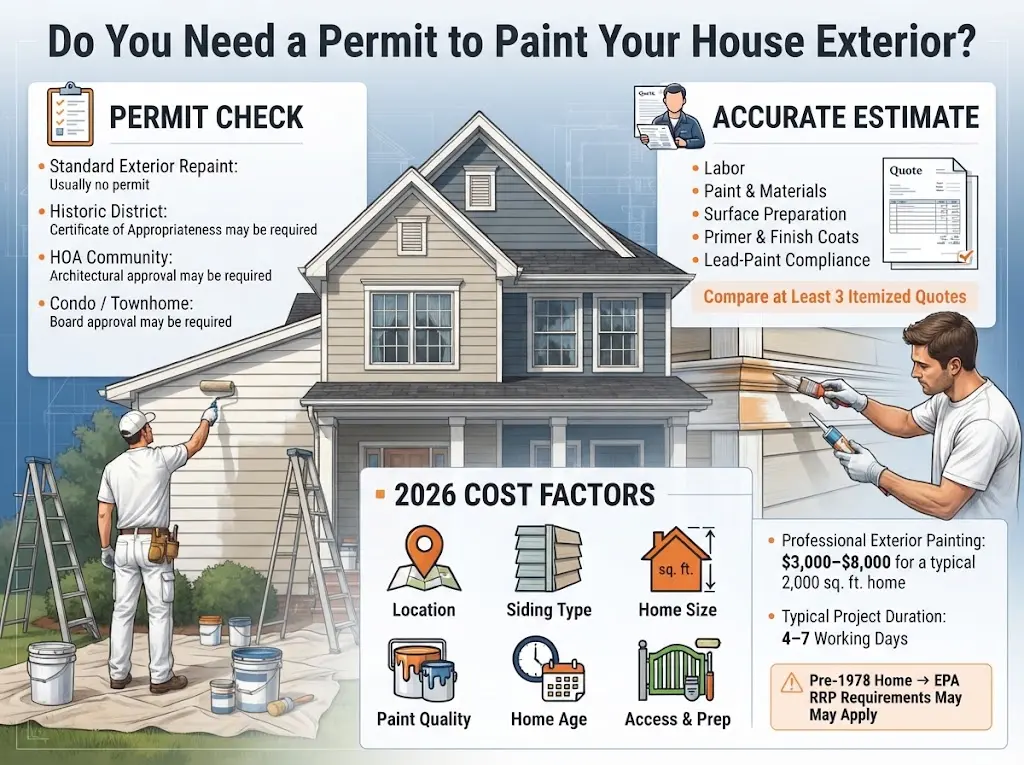
Professional total: $3,000–$8,000, plus 4–7 working days
This includes labor, materials, insurance, EPA RRP compliance where needed, and typically a 1–5 year labor warranty.
Dividing DIY “savings” by hours spent means you’re paying yourself $23-58/hour for ladder work, worth it for some, not others. Single-story homes with sound siding are the clearest DIY win; peeling paint, pre-1978 builds, or multiple stories favor hiring pros, for safety and because failed DIY often means paying someone to redo it.
If hiring, get a written, itemized quote. A detailed breakdown from painting estimating services separates labor, prep, materials, and lead-compliance costs, making bids easier to compare and padded quotes easier to spot.
Does Exterior Painting Increase Your Home’s Resale Value?
Yes. A fresh, well-chosen exterior repaint typically returns 80% to over 150% of its cost at resale, but the return depends almost entirely on color choice: neutral, on-trend colors add value, while bold or polarizing colors can actually subtract from it.
| Scenario | Typical spend | Value added at resale | Effective ROI |
| Faded/dated home, hot market, pre-listing | $5,000 | $7,500–$12,500 | 150%–250% |
| Average home, neutral on-trend repaint | $5,000 | $4,000–$7,000 | 80%–140% |
| Already well-kept home (preventive) | $5,000 | $2,000–$3,500 | 40%–70% |
| Bold/polarizing color, buyer must repaint | $5,000 | -$1,000–$1,500 | negative–30% |
Neutral whites, warm greiges, and soft grays with crisp trim are the safest resale choices. Buyers “price in” repainting costs for colors they dislike. Staying long-term? Choose colors you love. Selling soon? Keep the main color neutral. Save bold choices for the front door.
Planning an exterior painting project? Get a detailed estimate for labor, materials, prep, and compliance costs from USA Estimators.
Do You Need a Permit to Paint Your House Exterior?
In most US jurisdictions, no permit is required for a standard exterior repaint, but historic districts, HOA communities, and condo associations often require written approval of your color scheme before you start.
Exceptions to keep in mind:
- Historic districts (parts of Charleston, Boston’s Beacon Hill, Savannah, and similar areas) typically require a Certificate of Appropriateness before any exterior color change.
- HOA communities almost always require Architectural Review Board approval of your chosen colors, and some restrict you to a pre-approved palette entirely.
- Condos and townhomes typically need board sign-off, since the exterior is often considered shared property.
Check with your local building department and HOA/condo board before committing to a color, especially for a significant change. Painting outside approved guidelines can mean repainting again at your own cost.
How Do You Get an Accurate Painting Estimate and Avoid Overpaying?
The most reliable way to avoid a padded or incomplete quote is to request an itemized breakdown covering labor, prep, materials, and any lead-paint compliance costs, then compare at least three bids against the per-square-foot ranges for your city and siding type outlined above.
Seven things worth confirming before you sign anything:
- Licensed, bonded, and insured in this state
- EPA RRP-certified, if the home was built before 1978
- Specific paint brand and product line to be used
- Number of coats included, and the plan if a third coat is needed
- Warranty coverage for both labor and product, and its duration
- Prep process: washing, scraping, caulking, priming
- Three references from jobs completed in the last 12 months
A quote that comes in dramatically below the ranges in this guide is usually cutting corners somewhere, either on prep, on coats, or on paint quality, and that shortfall tends to show up as peeling or fading within two to three years, well short of what a properly done job should deliver.
Get an Accurate Estimate Before You Commit!
The accurate cost of painting your house depends on your city, siding, paint quality, and how old your home is, so a national average can be off by thousands of dollars. USA Estimators gives you a detailed, line-by-line estimate covering labor, materials, prep, and compliance costs specific to your home. Get your free quote today and budget your 2026 repaint with confidence!
Frequently Asked Questions
How much does it cost to paint a 2,000 sq ft house in 2026?
Expect $3,000 to $8,000 for a professional job, depending on your city, siding material, and paint quality tier. See the location and size tables above for your specific range.
What’s the cheapest city to paint a house exterior in 2026?
Dallas, TX currently sits at the low end nationally, at roughly $1.05–$2.95 per square foot, thanks to a deep contractor pool and year-round working season.
What’s the most expensive city to paint a house exterior in 2026?
San Francisco, CA tops the list, with Victorian-era prep pushing rates up to $10 per square foot and total projects regularly crossing $15,000. Los Angeles and Boston follow close behind due to high labor costs and older housing stock.
How long does exterior paint actually last?
7 to 15 years depending on paint quality, climate, and prep. Premium acrylics in mild climates can reach 15 years; builder-grade paint in high-UV states like Arizona or Texas may need repainting in 5–7.
Is exterior paint the same as interior paint?
No. Exterior paint is formulated to flex with temperature swings and resist UV, mildew, and moisture in ways interior paint isn’t. If you’re planning both projects, it’s worth budgeting them separately; our interior house painting cost breakdown covers the indoor side in the same level of detail as this guide.
What time of year is cheapest to paint a house?
Off-season for your region: late winter/early spring in the South before the March rush, late fall in the Midwest if weather allows, and early spring or late fall on the West Coast. Off-season discounts of 10–20% are common.
How much does a gallon of exterior paint cost in 2026?
Builder-grade paint runs $30–$50 per gallon, mid-range paint like Sherwin-Williams Duration runs $70–$85, and premium paint like Sherwin-Williams Emerald runs $95–$120. One gallon covers roughly 350 square feet.
How many coats of paint does a house exterior need?
Most jobs need one primer coat plus two finish coats. Self-priming paint can sometimes go on in one coat over a similar existing color in good condition, but most contractor warranties require two finish coats regardless. A drastic color change, like white to navy, usually needs a third coat.
Do painting contractors mark up the cost of paint?
Yes, typically by 15% to 30%. This isn’t dishonest. Most contractors buy at 25–40% off retail through supplier accounts, so the marked-up price they charge you is often still close to, or below, what you’d pay buying the same paint yourself at retail.
Is DIY exterior painting actually worth it?
Only for single-story homes with sound siding, where you can save 60–75% on labor. For two-story, three-story, pre-1978, or peeling-paint homes, the time investment (60–150+ hours), fall risk, and chance of an early failed coat usually make hiring a pro the smarter financial call.
Does homeowners insurance ever cover exterior painting?
Rarely for routine repainting. Insurance typically only covers paint or siding damage caused by a covered peril, like a storm, fire, or fallen tree, not normal wear from age or sun exposure. Check your specific policy’s dwelling coverage terms before assuming any coverage applies.
How much does it cost to paint just the trim, shutters, or front door?
Painting exterior trim runs about $1–$4 per linear foot, shutters cost $200–$500 for the full set, and a single exterior door costs $135–$300. These are common add-ons to bundle with a full repaint for a small additional cost.
How many days does it take to paint a house exterior?
Most 2,000 sq ft homes take 4 to 7 working days for a professional crew, including prep, priming, and two finish coats. Larger homes, heavy prep, or multi-color trim schemes can extend this to 10 days or more.
What voids an exterior paint warranty?
Painting over unresolved moisture issues, skipping the primer coat, applying paint outside the manufacturer’s recommended temperature range (typically 50–85°F), and DIY application on a job that required professional prep are the most common reasons a paint or labor warranty gets denied.


