


How Much Does a Whole Home Remodel Cost in San Diego in 2026? A Complete Price Breakdown
You can feel like you’re chasing a moving target when budgeting for a major renovation in America’s Finest City. You open one envelope, which offers a contractor who will charge $120,000, and then you open the next one, which calls out for a massive $450,000. Both claims are for the same footprint.
Greed is not the only reason for this discrepancy. In other cases, it is a complete contrast in terms of scope of work, underlying structure and quality of finish. A complete home remodeling in San Diego can cost anywhere from $150 to $450 per square foot in 2026. For a standard 2,000-square-foot project, the range for your base estimate is $300,000 to $900,000.
This guide explains the hidden costs associated with the whole home remodeling expenditures. Keep reading to save yourself from budget overruns.
2026 San Diego Remodeling Tiers
Your starting point depends on how deeply you plan to cut into the existing structure. Surface-level updates look nothing like structural re-engineering. Below is how the investment breaks down across different execution strategies in the current San Diego market:
| Remodel Tier | Cost Per Sq. Ft. | 1,500 Sq. Ft. Home | 2,500 Sq. Ft. Home | Typical Scope of Work |
| Cosmetic | $60 – $110 | $90K – $165K | $150K – $275K | Paint, luxury vinyl plank (LVP) flooring, refaced cabinets, minor lighting updates. |
| Mid-Range | $130 – $220 | $195K – $330K | $325K – $550K | Full kitchen/bath gut, mid-grade quartz, layout optimization, partial MEP upgrades. |
| High-End | $250 – $400 | $375K – $600K | $625K – $1M | Structural wall removal, premium oak hardwoods, custom millwork, fully integrated HVAC. |
| Luxury | $400 – $600+ | $600K+ | $1M+ | Architectural footprints altered, imported quartzite, smart-home automation, high-end glazing. |
San Diego’s position near the top of national construction cost indexes isn’t an accident. Local labor shortages, strict Title 24 energy efficiency compliance mandates, and geographical shipping premiums push baseline numbers upward.
Zip Code Premiums | All About Coastal vs. Inland Realities
Your permitting process and your labor cost depends on your location. If your project is within the jurisdiction of the California Coastal Commission, then your project dynamics will likely change drastically.
Coastal Tier (La Jolla, Del Mar, Coronado, Encinitas, Solana Beach):
Here, projects will come with a premium of 15% to 25%. Why? Staging logistics, limited street parking for subcontractors, strict HOA design guidelines and the inevitable Coastal Development Permit (CDP) process.
Historic/Character Tier (North Park, Kensington, Mission Hills, La Mesa):
Homes constructed in the 1920-1950 period contain structural problems that are not apparent. These properties often have knob-and-tube wiring, unstable foundations, a lack of modern shear walls, and hazardous materials such as asbestos or lead. When it comes time for upgrading them to conform to the structural codes of 2026, you will have to add a lot to your initial estimates.
Suburbs & Inland Tier (Mira Mesa, Santee, Poway, Chula Vista):
It tends to be closer to standard tracking costs. Also there’s easier access to lots, newer homes (less structural surprises), and expedited municipal permits for construction keep budgets predictable.
Where Your Money Actually Goes
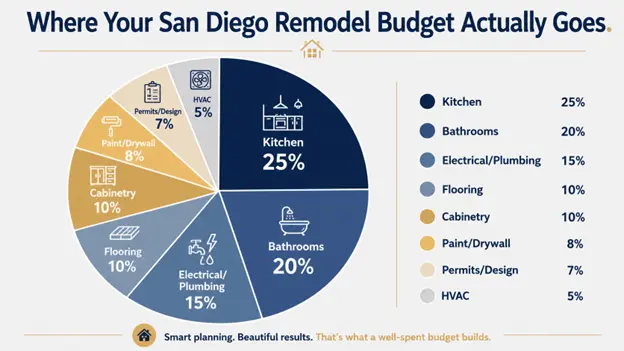
A professional construction estimate doesn’t use generalizations. It is a determined sum of separate trade units. The typical $400,000 mid-range whole home remodeling in San Diego is funded through these buckets of operational capital:
Kitchen Remodel (20–25%): $80,000 – $100,000
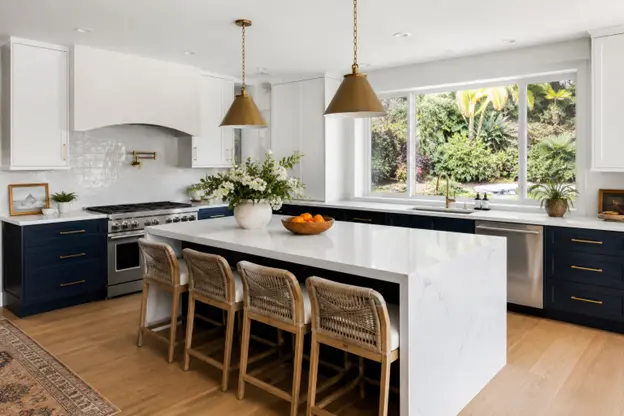
The major force behind the value of residences. This includes semi-custom cabinetry, stone surfaces, plumbing fixtures, rough-in relocations and high-efficiency appliances.
Bathrooms (2–3 Spaces) (15–20%): $60,000 – $80,000
Dense plumbing, waterproofing, tile work, and electrical circuits.
Flooring & Surface Finishes (7–10%): $28,000 – $40,000
Use engineered hardwood, large-format tile or high performance vinyl in the main living spaces.
Ready to Win More Projects?
MEP Upgrades (Mechanical, Electrical, Plumbing) (10–15%): $40,000 – $60,000
Installing 200 amp electrical panel, PEXing copper or galvanized pipes and replacing failing waste lines.
Interior Architecture & Drywall (5–8%): $20,000 – $32,000
Smooth wall texturing (Level 4 or 5 finish), modern baseboards, casing and low VOC paint.
Cabinetry & Custom Built-ins (8–12%): $32,000 – $48,000
Custom bedroom/living room millwork, storage solutions and pantries.
HVAC Systems (4–6%): $16,000 – $24,000
Switching to more efficient heat pumps or multi-zone mini-splits to meet the changing demands of clean energy.
Design, Engineering & Permitting (8–12%): $32,000 – $48,000
Architectural drafts, structural engineering load-bearing calculations, and municipal plan-check fees.
Mandatory Construction Contingency (10–15%): $40,000 – $60,000
The barrier that keeps unknown site conditions from stopping construction.
Remodeling Cost Can Go Through The Roof Due To The Following Factors
If you know what makes a budget “manageable” versus “overwhelming,” you can choose to make strategic compromises at the beginning of the design process.
1. Structural Engineering And An Open Concept Layout
Rather, one of the most sought-after design wishes for any home remodeling in San Diego is the uninterrupted view from the kitchen to the outdoor living area. But, taking out a central load bearing wall isn’t a job for a sledgehammer.
It requires a structural engineer, temporary shoring and the installation of an engineered wood (LVL) or steel I-beam into the ceiling plenum. This one design feature can cost $20,000 to $50,000 when the footings are cast to accommodate the new point loads.
2. Compliance and Title 24
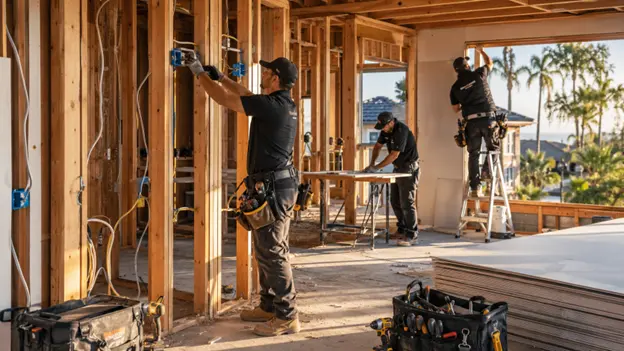
Because of California’s energy code, remodeling costs are higher than those in other states. If you are doing a full home remodel, you may be motivated to replace fenestration (windows and doors) with the new strict U-Factor requirements, or to add continuous exterior insulation, or the need to replace your water heating system with a high-efficiency heat pump system.
How Long Does Remodeling Take? Real-World Timelines
If a contractor promises a whole home gut in eight weeks, they are likely cutting corners on safety or bypassing the California Contractors State License Board regulations. Quality takes time, specifically in a city where the Development Services Department (DSD) is backlogged.
- Design & Engineering (6–10 Weeks): This involves site measurements, 3D modeling, and structural engineering.
- The Permitting “Black Box” (8–16 Weeks): San Diego’s permitting process varies wildly. While some inland projects move quickly, coastal zones or historic districts can languish in review for months.
- Active Construction (16–32 Weeks): This covers everything from demolition and rough-ins to the final finishes.
- Total Realistic Window: Expect a 7 to 11-month lifecycle for a comprehensive, permitted transformation.
ROI Analysis: The 2026 Value Proposition
With the median home price in San Diego County hovering around $980,000, remodeling is often a purely mathematical decision. The closing costs, commissions, and “mansion taxes” associated with selling and buying a new property can easily exceed $100,000.
Investing that same capital into your current footprint yields a high Return on Investment (ROI), particularly in specific zones:
- Minor Kitchen Upgrades: 82% ROI.
- Bathroom Expansion: 68% ROI.
- Primary Suite Additions: 62% ROI.
- Energy Efficiency (Solar/HVAC): 90%+ (when factoring in tax credits and utility savings).
The San Diego Factors To Keep In Mind
The geographical challenges are unique in the construction. Expansive clay soils are common in the East County (El Cajon, Lakeside), and special foundation piers, which cost an additional $15,000, are often required for these soils. The salt air requires materials and coatings designed for marine use to avoid early corrosion.
In addition, San Diego Gas & Electric (SDG&E) has very specific service upgrade requirements. The trenching and utility coordination can cost you $5,000 to $8,000 for upgrading your electrical panel from a 100 amp to a 200 amp to support an EV charger or heat pump, which is part of your”Electrical line item. Companies such as Royalty Design and Build are leaders in this field by giving clients upfront, honest estimates, and making sure the design is feasible within the fiscal constraints of the local San Diego construction market.
Conclusion
Whole home renovation in San Diego is an investment that requires more than just a “good eye” because it has high stakes. It demands a partner that is familiar with the regulatory environment, the unpredictable nature of the 2026 material supply chain, and the idiosyncrasies of Southern California architecture.
Frequently Asked Questions
Which is the more economical choice: Remodeling or moving to San Diego?
Unless you are moving to another neighborhood or downsizing, remodeling is typically a more cost-effective solution than closing.
Is a whole house renovation considered a ‘special situation’ for permits?
Yes. The City and County of San Diego must be contacted for any structural, electrical or plumbing modifications or changes so they can ensure safety and resale value.
Will I have to move out while my home is being remodeled?
If an entire gut is being done, no, because of dust, noise and no utilities. Remodeling can be done in phases, but it will be more expensive.
What is the maximum amount of a down payment allowed?
In California, there is a 10% limit on the down payment that a contractor can receive on a project, or $1,000, whichever is less.
How can I check the validity of a contractor’s license?
Go to the California Contractors State License Board website to verify that the license is active, insurance is up-to-date and that the contractor has never had a disciplinary action recorded.


